AI-driven pricing platforms outperform rule-based systems in handling large-scale, real-time pricing tasks. While rule-based systems rely on fixed "if-then" logic and batch updates, AI platforms use machine learning and cloud-native technologies for faster, real-time decisions. This makes AI ideal for industries with fluctuating demand, massive product catalogs, or time-sensitive inventory like travel or e-commerce.
Key takeaways:
- Rule-based systems: Suitable for stable, small catalogs or compliance-heavy environments but struggle with real-time updates and scalability.
- AI systems: Process dozens of variables simultaneously, adjust prices in real-time, and scale elastically, reducing latency and boosting revenue.
- Hybrid approach: Combines rule-based guardrails with AI's flexibility for optimal results.
Quick Comparison:
| Feature | Rule-Based Systems | AI-Driven Systems |
|---|---|---|
| Decision Logic | Fixed rules | Machine learning models |
| Data Processing | Batch updates | Real-time streaming |
| Scalability | Limited, manual scaling | Elastic, cloud-native |
| Best Use Cases | Small catalogs, compliance | Large catalogs, dynamic markets |
AI systems offer a clear edge in dynamic environments, but success depends on clean data, cross-team collaboration, and proper governance. For many businesses, a hybrid model provides the best balance of control and performance.
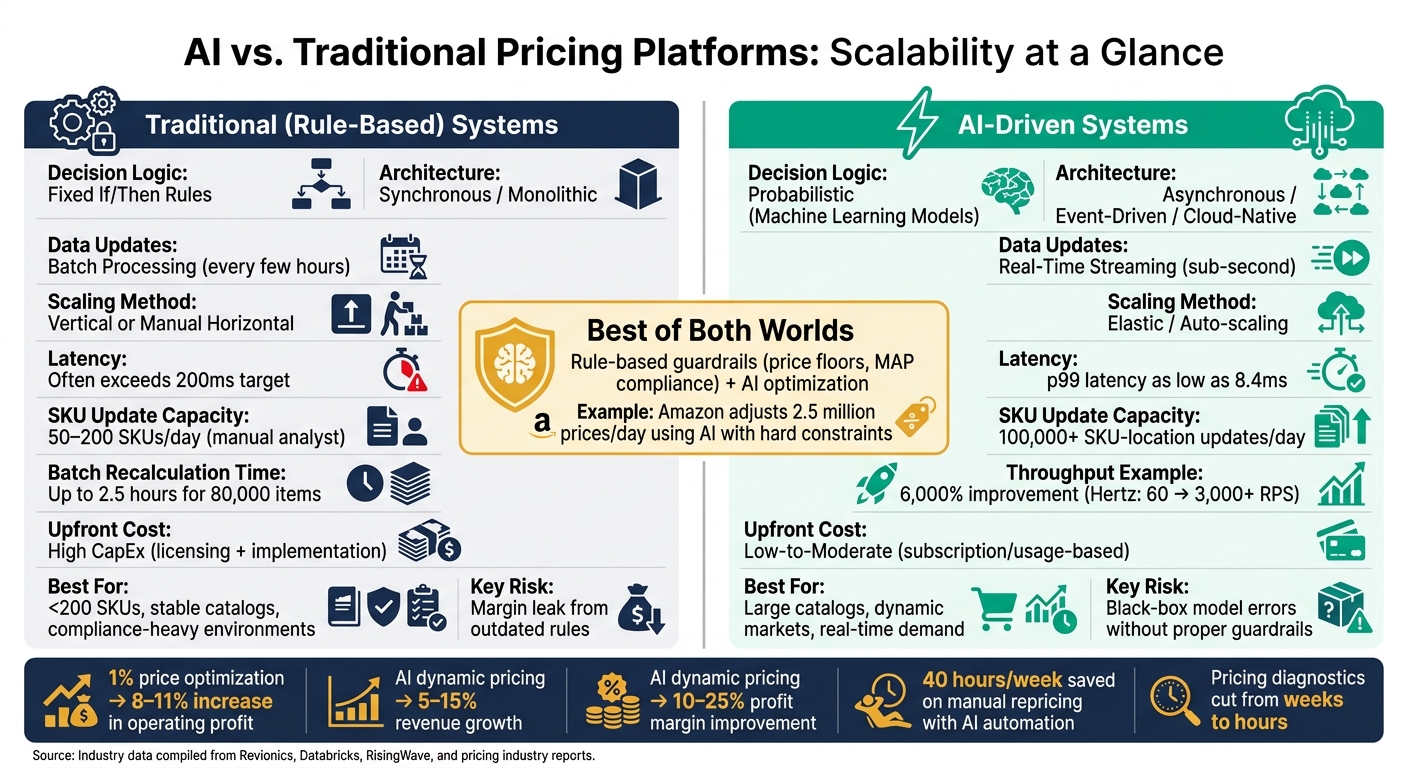
AI vs. Traditional Pricing Platforms: Scalability Comparison
How Traditional Pricing Platforms Handle Scalability
Scaling Mechanisms in Traditional Systems
Traditional pricing platforms rely heavily on rules-based engines - essentially "if-then" logic that evaluates specific conditions like customer segments, geographic regions, or competitor price thresholds. These rules are hardcoded into the system, meaning any changes require developer intervention and a fresh deployment.
To manage increasing demand, these platforms typically scale vertically and use database replication. They often precompute prices overnight and cache the results to handle load more effectively.
"Static pricing works until it does not... Before long, your pricing is a maze of if statements, and every change requires a developer, a deploy, and a prayer." - Veld Systems
However, this approach struggles to keep up with the fast-paced nature of modern markets.
Limitations and Bottlenecks of Traditional Scalability
One of the biggest challenges with traditional platforms is their dependence on batch processing. Prices are recalculated on a fixed schedule - often every few hours - rather than in real time. This means the system processes all data, even if only a small portion has changed. For example, recalculating prices for 80,000 items can take up to 2.5 hours. By the time the new prices are live, market conditions may already have shifted.
The monolithic architecture of these platforms compounds the problem. Since all pricing logic runs through a single backend service, traffic spikes can overwhelm the system. Modern platforms aim to deliver price-serving latencies under 200ms, but traditional systems often fall short of this target.
Another issue is channel inconsistency. When prices are updated in batches across various touchpoints - like websites, mobile apps, and in-store systems - synchronization gaps can occur. This can lead to customers seeing different prices for the same product at the same time.
Despite these limitations, there are scenarios where traditional systems remain effective.
When Traditional Methods Still Get the Job Done
Traditional pricing systems still work well in certain situations. For instance, businesses with fewer than 200 SKUs in stable product categories - like replacement parts or slow-moving consumables - may find manual rule adjustments more practical and cost-efficient than deploying AI models, especially when data is limited.
These systems are also indispensable in regulated or compliance-heavy environments. For tasks like enforcing Minimum Advertised Price (MAP) policies, managing legal price floors, or controlling brand-specific SKUs, deterministic rules provide the transparency and auditability required. As Chad Rubin, Founder & CEO of Profasee, puts it:
"Rule-based wins in stable categories with simple competitive landscapes and predictable patterns. It is auditable, predictable, and cheap to operate."
Additionally, for new products without sales history, traditional rules offer a reliable starting point. AI models often need 60–90 days of clean sales data to outperform simple rules like "match the lowest competitor price".
These strengths highlight the areas where traditional systems can still shine, setting the stage for how AI-driven platforms tackle scalability challenges more effectively.
sbb-itb-97f6a47
How AI Powers Scalability in Modern Pricing Platforms
AI Scaling Methods: Machine Learning and Cloud-Native Architecture
Traditional pricing systems often rely on rigid rules and scheduled batch jobs, which can limit their ability to adapt quickly. In contrast, AI-powered platforms are built for real-time, continuous adaptation. At the core of these systems is cloud-native architecture, which incorporates serverless infrastructure, microservices, and distributed systems. These elements allow platforms to scale automatically as demand fluctuates, eliminating the need for manual adjustments.
Instead of relying on scheduled processes like cron jobs, some platforms, such as RisingWave, use streaming SQL and materialized views to handle live data. This setup keeps price recommendations up to date in real time, without requiring complex orchestration. As RisingWave Labs explains:
"A streaming database replaces this pipeline with SQL materialized views that join live data sources and maintain current price recommendations without any orchestration code."
Some platforms take scalability even further by implementing multi-agent architectures. These systems use parallel AI agents, each focusing on tasks like identifying competitive gaps, modeling financial outcomes, or enforcing business rules. Revionics SVP Joshua Oettle highlighted their approach, saying, "Our engineering team utilized the Google Agent Development Kit and serverless infrastructure to ensure scalability, governance and speed to market."
These architectural advancements not only enhance performance but also reduce costs, as demonstrated in the following sections.
Performance Gains with AI-Driven Scalability
The combination of cloud-native frameworks and multi-agent systems leads to impressive performance improvements. AI-powered pricing engines can achieve a p99 latency of just 8.4 ms, even when managing a massive catalog of 10 billion SKUs. These systems also handle over 100,000 SKU-location updates daily, a stark contrast to the 50–200 updates an analyst can manually process. For high-demand events like flash sales, AI platforms can instantly apply scarcity premiums as inventory levels hit predefined thresholds.
The results speak for themselves. In early 2026, Dr. Max, Europe’s second-largest pharmacy chain, implemented an AI-driven dynamic pricing solution using the Databricks Data Intelligence Platform. During the pilot phase, the company saw a 36% revenue increase in the test market. After a full rollout across multiple countries, they achieved 12% sustained revenue growth. Iva Gergelova, Group Pricing Specialist, noted, "The rollout of the dynamic pricing solution across multiple markets has driven significant revenue growth and improved our market responsiveness."
Cost and Efficiency Advantages of AI Systems
AI-powered pricing platforms also bring notable cost and efficiency benefits, especially when compared to traditional systems. Legacy enterprise software often comes with high upfront costs and lengthy implementation timelines. On the other hand, AI-driven platforms increasingly use usage-based or subscription pricing models, making them more accessible to mid-market companies.
Efficiency improvements are equally impactful. AI systems can cut pricing diagnostics from weeks to mere hours. Retailers who switch to automated systems report saving an average of 40 hours per week on manual repricing tasks. Fabien Cros, Pricing Advisor at Ducker Carlisle, noted, "What once required years of system implementation and heavy configuration can increasingly be achieved in weeks or months."
For mid-market businesses, this shift is transformative. Companies that once struggled with the cost and complexity of enterprise-grade tools are now leveraging low-code AI platforms to build custom pricing solutions in just weeks. This approach bypasses the need for expensive, inflexible software, leveling the playing field for businesses of all sizes.
AI vs. Traditional Scalability: A Side-by-Side Comparison
Architecture and Scaling Models
The fundamental difference between traditional and AI-driven systems lies in how decisions are made and data is processed. Traditional systems rely on fixed rule trees, while AI-driven models use machine learning, adapting based on real-time data inputs. This difference significantly influences how these systems scale and handle failures.
Traditional systems typically operate with synchronous, monolithic architectures. Every pricing query directly accesses the database, which works under normal conditions but can lead to severe slowdowns during traffic surges. In contrast, AI-driven systems use asynchronous, event-driven architectures. Tools like Apache Kafka or Amazon Kinesis enable them to process market signals in real time without overwhelming the database.
Take the example of Hertz in March 2026. Mathew Dostal led a transformation of their rate engine, replacing a 30-year-old IBM AS/400 system with an event-driven architecture powered by Kinesis, Redis, and Cloudant. The result? A 6,000% improvement in throughput, increasing from 60 requests per second to over 3,000 RPS, with p95 latency under 30ms.
"The 6,000% throughput improvement wasn't from one optimization - it was from attacking the architectural constraints that had artificially capped everything." - Mathew Dostal, Strategic CTO & Principal Architect
| Feature | Traditional | AI-Driven |
|---|---|---|
| Decision Logic | Deterministic (If/Then rules) | Probabilistic (ML models) |
| Architecture | Synchronous / Monolithic | Asynchronous / Event-Driven |
| Data Updates | Batch processing | Real-time streaming (sub-second) |
| Scaling Method | Vertical or manual horizontal | Elastic / cloud-native |
| Consistency Model | Strong (ACID) | Eventual consistency |
These architectural differences enable AI-driven systems to perform far better under high-demand conditions.
Performance During High-Demand Scenarios
High-demand events like Black Friday, flash sales, or ride-hailing surges expose the limitations of traditional systems. These systems often experience database overloads as every request competes for the same resources. On the other hand, AI-driven platforms use strategies like multi-tier caching, load shedding, and predictive scaling to manage demand spikes proactively.
For instance, during Black Friday/Cyber Monday 2024, Shopify’s edge layer processed 12 TB of data per minute using a "pod" architecture. This design isolated failure domains, ensuring that a single shard failure didn’t disrupt the entire platform. In contrast, traditional systems can face delays of over 15 minutes during similar events, while AI-driven platforms respond in seconds.
| Scenario | Traditional Performance | AI-Driven Performance |
|---|---|---|
| Flash Sales | High risk of database overload | Resilient via caching and load shedding |
| Ride-Hailing Surges | Lagging response (15+ min) | Real-time response (seconds) |
| New Product Launch | Reliable via manual rules | Requires rule-based bootstrapping for "cold start" issues |
One major challenge for AI systems is the "cold start" problem. When new SKUs lack historical data, the AI struggles to make confident pricing decisions. This issue is best mitigated by using deterministic rules temporarily until the AI gathers enough data to operate effectively.
Cost Structures and Flexibility
Cost and flexibility further highlight the differences between these models. Traditional systems require high upfront CapEx for licensing and implementation, along with ongoing costs for manual rule updates. In contrast, AI platforms operate on a variable OpEx model, charging based on usage, tokens processed, or outcomes delivered.
Traditional systems often suffer from margin losses when pricing rules become outdated. Analysts can only manually update 50–200 SKUs per day, meaning prices may drift away from market conditions. AI systems automate this process, but they come with their own risks, such as "black box" pricing errors that can lead to commercially damaging outcomes.
"A sophisticated model with bad constraints produces prices that are technically correct and practically disastrous." - Thomas Prommer, AI Strategy Consultant
| Cost Factor | Traditional | AI-Driven |
|---|---|---|
| Upfront Investment | High CapEx (licensing, implementation) | Low-to-moderate (subscription/usage-based) |
| Ongoing Maintenance | High (manual rule tuning, headcount) | Low (automated model retraining) |
| Off-Peak Flexibility | Rigid; paying for idle capacity | Elastic; scales down automatically |
| Primary Economic Risk | Margin leak from outdated rules | Model errors or pricing failures |
The most effective approach isn’t a strict choice between traditional and AI-driven systems. Instead, many pricing teams are adopting a hybrid model. Deterministic rules act as guardrails (e.g., price floors, ceilings, MAP compliance), while AI optimizes pricing within those boundaries. For example, Amazon adjusts over 2.5 million prices per day using AI-driven systems, but hard constraints ensure the model doesn’t violate brand policies or erode customer trust. This hybrid strategy combines the strengths of both approaches while minimizing their weaknesses.
Picking the Right Scalability Model for Your Business
Key Factors to Weigh Before Choosing a Scalability Model
Choosing the right scalability model for your business boils down to several practical considerations.
Transaction volume and pricing complexity are major indicators. If your team manages only a few hundred SKUs daily, traditional methods might still work. But when you're dealing with thousands - or even millions - of SKUs and need real-time updates, an AI-driven approach becomes essential.
Demand volatility plays a big role too. Industries like hospitality, energy, and logistics, where inventory is perishable and prices fluctuate hourly, are prime candidates for AI-based systems. On the other hand, a retailer with a stable, predictable catalog may find that rule-based pricing continues to meet their needs without the added cost of machine learning infrastructure.
Another critical factor is data readiness. Poor data quality is one of the leading reasons pricing projects fail. Start with a thorough 2- to 4-week audit of your transaction-level data to ensure it's complete, shows consistent price variations, and is reliable. Without clean historical data, even the most advanced AI models will struggle to deliver accurate results.
"Pricing models decay faster than most ML systems because the world they price changes faster." - Phil Winder, CEO, Winder.AI
Organizational alignment is equally important. AI-driven pricing requires collaboration across departments like Product, Engineering, Sales, and Finance. Without shared goals and governance, even the most advanced system may produce results that lack the trust needed to act on them effectively.
Given these challenges, working with experienced consulting firms can help you navigate the complexities and implement the best solution for your business.
How Consulting Firms Can Help You Get It Right
Specialized consulting firms can make the transition to the right scalability model much smoother. They bring expertise to address the key factors outlined above and help bridge the gap between outdated systems and modern, AI-enabled pricing platforms.
A strong consulting partner does more than recommend a platform. They can audit your data pipelines, guide you in choosing between off-the-shelf solutions and custom-built systems, and act as a bridge between your technical and business teams. For instance, in 2026, BCG collaborated with a leading enterprise SaaS provider to overhaul an outdated user-based pricing model. By integrating advanced analytics into the client's CPQ system, the project led to a 10% boost in annual contract value and a 20% increase in deal velocity.
Consultants also help establish critical safeguards, such as price floors, ceiling constraints, and audit trails, ensuring that automated pricing decisions remain compliant and defensible. Beyond the technical setup, they assist with change management by training teams, aligning incentives, and fostering trust in the new system.
"The goal is not to replace pricing teams but to amplify their judgment with predictive insight and automated execution." - Fairsky Consulting
Finding the right consulting firm for your needs - whether you're focused on digital transformation, revenue optimization, or hands-on implementation - can be a challenge. Tools like the Top Consulting Firms Directory are a great starting point for connecting with firms that have a proven track record in pricing platform projects.
Conclusion: Choosing the Scalability Model That Fits Your Needs
Here’s the bottom line: there’s no universal solution for every pricing scenario. Traditional, rule-based pricing works well for stable product catalogs and predictable demand patterns. On the other hand, AI-driven systems shine when you’re juggling thousands of SKUs, dealing with fluctuating pricing windows, or responding to real-time competitive pressures.
As mentioned earlier, selecting the right scalability model hinges on both the state of your market and your internal preparedness. Research shows that even a modest 1% improvement in price optimization can increase operating profit by 8–11% - but achieving these results requires clean data, well-coordinated teams, and clearly defined boundaries. AI-driven dynamic pricing often delivers revenue growth of 5–15% and profit margin improvements of 10–25%.
This data makes one thing clear: striking the right balance in your pricing strategy is essential.
"A sophisticated model with bad constraints produces prices that are technically correct and practically disastrous." - Thomas Prommer, AI Strategy Consultant
For businesses in transition, a hybrid approach can be a game-changer. Combining rule-based guardrails with the flexibility of AI offers both control and adaptability - without requiring a complete overhaul of existing systems.
But remember, success isn’t just about the technology. Around 70% of the challenges in scaling AI value stem from people, processes, and governance - not the tech itself. Aligning your technology with team readiness helps navigate the complexities of real-time pricing. This is where experienced consulting firms can play a pivotal role, bridging the gap between making the right decision and implementing a functional system. To find the right partner, check out the Top Consulting Firms Directory.
FAQs
How do I know if I need AI pricing or rule-based pricing?
Choosing between rule-based pricing and AI-driven pricing depends on how complex your business is, the quality of your data, and your overall objectives.
- Rule-based pricing is a good fit if you have a smaller product catalog, stable pricing strategies, or need clear, straightforward control over pricing decisions. It’s especially useful when transparency is a top priority.
- AI-driven pricing, on the other hand, shines when dealing with larger catalogs, rapidly changing markets, or pricing that depends on dynamic variables like price elasticity and competitor trends.
A practical approach? Start with rule-based pricing for simplicity and control. Then, as your business grows and your data becomes more robust, consider transitioning to AI-driven pricing to handle greater complexity.
What data do I need before launching AI-driven pricing?
To kick off AI-driven pricing, start by building a strong data foundation. This includes gathering internal data like transaction history (net prices, units sold, timestamps), operational metrics (cost of goods sold, inventory levels, product details), and external inputs such as competitive pricing, market trends, and economic indicators. Don't overlook qualitative insights like customer reviews or sales transcripts - they can add valuable context.
Finally, establish clear pricing constraints. These could include regulatory requirements or brand guidelines to ensure the AI makes decisions that align with your business goals and legal boundaries.
How do I keep AI pricing compliant with price floors, MAP, and brand rules?
To stay compliant with price floors, Minimum Advertised Price (MAP) policies, and brand guidelines, leverage automated algorithmic guardrails. These tools integrate directly into modern platforms, ensuring that violations are blocked before they occur.
Here’s how it works:
- Set clear constraints: Define non-negotiable limits, like margin floors or MAP ceilings, to guide pricing decisions.
- Automate enforcement: Use systems that enforce these rules automatically and keep detailed audit trails for accountability.
- Handle exceptions carefully: Introduce human oversight for high-risk scenarios through human-in-the-loop workflows.
- Monitor continuously: Implement tools for ongoing monitoring and anomaly detection to quickly adapt to changing conditions.
This approach ensures your pricing strategy stays compliant while minimizing manual intervention.