Real-time pricing uses AI to adjust prices instantly based on demand, inventory, and competitors. This strategy can increase revenue by 10–25% without extra sales volume. Businesses that focus on customer segments - premium and price-sensitive - see varied results:
- Premium Customers: Less sensitive to price changes, they prioritize quality and brand reputation. Adjusting prices for this group can boost revenue and maintain higher profit margins (up to 36%). For instance, a SaaS company increased Annual Recurring Revenue by 25% in 90 days by aligning pricing with power users' needs.
- Price-Sensitive Customers: Highly responsive to price changes, this group is driven by competition and savings. Dynamic pricing can increase revenue by 12.3% but may also raise cart abandonment rates. Transparent pricing builds trust and loyalty over time.
The key takeaway? Tailoring pricing strategies to each segment maximizes revenue while balancing profitability and customer satisfaction.
The Rise and Fall of Segmentation in Pricing Adapting to Modern Realities
sbb-itb-97f6a47
1. Premium Customer Segment Performance
Focusing on premium customer segments shows how real-time pricing can be adjusted to boost revenue while maintaining healthy profit margins.
Revenue Growth
Premium customers tend to be less sensitive to price changes compared to other segments, which opens exciting opportunities for revenue growth. For example, in December 2025, a mid-market B2B SaaS platform catering to manufacturing operations revamped its pricing model to better align with its power users. The outcome? A 25% increase in Annual Recurring Revenue (ARR), equivalent to $2 million, in just 90 days. Additionally, the Average Contract Value for new customers soared 35%, jumping from $18,000 to $24,300.
"Customers loved the product but couldn't justify the cost to their CFO. Meanwhile, our power users were getting incredible ROI and would have paid significantly more." - VP of Revenue, Mid-market SaaS Company
The data underscores the revenue potential of premium segments. Enterprise clients, for instance, often pay 2 to 5 times more than small business customers for advanced, enterprise-focused features.
These results demonstrate the strategic edge of targeting premium segments, ensuring revenue growth while protecting profit margins.
Profit Margins
Real-time pricing helps safeguard margins in premium segments by avoiding unnecessary price reductions. Premium products typically have lower price elasticity, meaning demand remains steady even when prices increase.
"If a product has a low elasticity (a price increase results in very little change in demand), you do not need to bother tracking competitors' prices and matching them." - Marshall Fisher, Santiago Gallino, and Jun Li
Companies that excel in segmentation and adopt value-based pricing strategies report 10-15% higher profits than their competitors. This success often comes from using constrained optimization techniques, where pricing algorithms are designed to maximize revenue while maintaining a set profit margin. For example, businesses can focus on revenue growth while ensuring gross margins never dip below 10%.
Customer Lifetime Value
Sustained improvements in revenue and profit margins lead to significantly higher lifetime value for premium customers.
Premium users who frequently utilize advanced features deliver 2-3x higher lifetime value compared to casual users. Daily active users, in particular, are willing to pay more than those who engage weekly. Real-time pricing enhances this dynamic by aligning prices with the value customers perceive.
In the case of the mid-market SaaS company, enterprise churn dropped 50%, from 8% to 4%, after implementing pricing tied to customer outcomes. Expansion revenue also grew 40%, increasing from $400,000 to $560,000 per quarter. This success was driven by a pricing structure that reflected the value power users derived, creating a more sustainable relationship for both the company and its customers.
2. Price-Sensitive Customer Segment Performance
Unlike premium shoppers, price-sensitive customers react more strongly to changes in pricing. This group, often focused on electronics and high-volume products, shows a price elasticity of up to -1.72, meaning even small price adjustments can significantly impact their buying behavior.
Revenue Growth
Dynamic pricing can boost revenue among price-sensitive shoppers when executed carefully. Studies across industries show that dynamic pricing increases e-commerce revenue by an average of 12.3%.
But there's a downside. This approach also leads to a 8.7% rise in cart abandonment rates. These shoppers frequently compare prices across multiple platforms, and sudden price hikes can prompt them to abandon their carts. To minimize this, price adjustments should be tailored by category. For example, electronics (elasticity -1.72) require sharper pricing strategies compared to fashion items (elasticity -0.89).
Conversion Rates
Conversion rates for price-sensitive customers depend heavily on precise pricing strategies. Techniques like charm pricing - using prices that end in .99 instead of round numbers - can increase conversions by 3.2% for these shoppers. Small, targeted price changes can have a big influence on their purchasing decisions.
The challenge grows with fast-moving, popular items. These products can have extreme price elasticities, reaching -8, where a 1% price increase could lead to an 8% drop in demand. Competitive pricing is critical for such items. However, blanket price-matching isn’t necessary for slower-moving or niche products, which often have near-zero elasticity.
By fine-tuning pricing strategies, retailers can boost conversions and support revenue growth while maintaining profitability.
Profit Margins
Maintaining profit margins while catering to price-sensitive customers requires careful balancing. Retailers often rely on constrained optimization - adjusting individual product margins (ranging from -1% to 36%) while ensuring the overall category meets a target margin, such as 10%.
This strategy avoids a "race to the bottom" in pricing, which can harm profitability. Retailers can focus advanced pricing models on high-performing "Group A" items (the top 20% of SKUs generating 80% of revenue) while using simpler pricing strategies for less significant products. This approach allows for double-digit growth without compromising margins.
Customer Lifetime Value
For price-sensitive customers, building long-term loyalty hinges on transparency and trust. If dynamic pricing feels like exploitative "surge pricing", customers may feel alienated and stop shopping altogether.
"Dynamic pricing ultimately succeeds when it serves the long-term interest of companies and customers alike... it must represent a better alternative to static prices." - Marco Bertini and Oded Koenigsberg
Some retailers are taking a proactive approach by helping customers find the best deals. For instance, they notify shoppers about lower prices or encourage purchases during off-peak times. This openness fosters loyalty instead of resentment. Offering lower prices during periods of low demand - something static pricing can’t achieve - broadens access for budget-conscious shoppers and smooths out demand patterns. Over time, this strategy turns one-time bargain hunters into loyal, repeat customers with greater lifetime value.
Pros and Cons
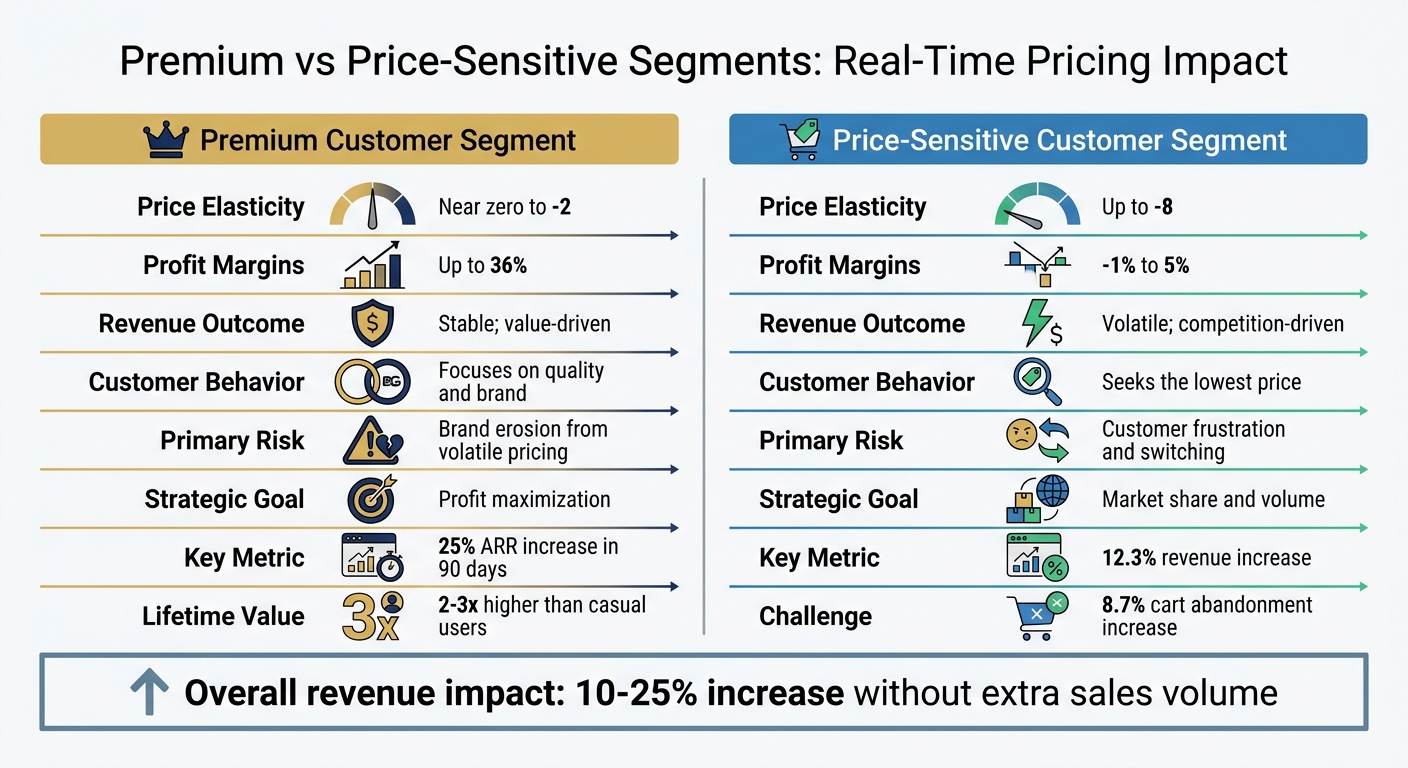
Premium vs Price-Sensitive Customer Segments: Real-Time Pricing Impact Comparison
When it comes to real-time pricing, the benefits and challenges can vary significantly depending on the customer segment. Understanding these nuances is key to using pricing strategies effectively to boost revenue. Let’s break down the pros and cons for two major customer segments: premium and price-sensitive customers.
Premium customers tend to have low price elasticity, ranging from near zero to -2. These shoppers value brand reputation and product quality, which allows for profit margins as high as 36%. This low elasticity creates opportunities for retailers to use advanced AI-driven pricing models for high-revenue products. However, there’s a catch: if price changes are too frequent or unpredictable, even these loyal customers may start to see the pricing as unfair, potentially damaging the brand’s image.
On the other hand, price-sensitive customers are much more reactive, with elasticities reaching up to -8. This means that even a small 1% price increase could lead to an 8% drop in demand. These customers typically operate within tight profit margins, ranging from -1% to 5%. Real-time pricing can help capture market share and drive sales volume in this group, but sudden price hikes can lead to frustration. These shoppers are quick to compare prices, abandon carts, or switch brands if they feel pricing isn’t transparent or justified.
| Feature | Premium Segment | Price-Sensitive Segment |
|---|---|---|
| Price Elasticity | Near zero to -2 | Up to -8 |
| Profit Margins | Up to 36% | -1% to 5% |
| Revenue Outcome | Stable; value-driven | Volatile; competition-driven |
| Customer Behavior | Focuses on quality and brand | Seeks the lowest price |
| Primary Risk | Brand erosion from volatile pricing | Customer frustration and switching |
| Strategic Goal | Profit maximization | Market share and volume |
These insights highlight the importance of balancing volume and profitability through constrained optimization. For example, businesses can aim to maximize revenue across their product catalog while maintaining a minimum gross margin, such as 10%. By concentrating advanced pricing strategies on elastic products, businesses can attract more traffic without compromising the healthy margins of premium offerings.
Conclusion
Real-time pricing can have a big impact on revenue, especially in high-volume segments where even small pricing tweaks translate into significant returns. The key is to tailor pricing strategies: premium customers prefer stability, while price-sensitive buyers respond to competitive rates.
To build on these gains, refining your pricing process is essential. This involves adopting a full "model, measure, maximize" approach: develop decision models, conduct 3–5% price experiments to test elasticity, and apply constrained optimization to boost revenue while maintaining a 10% margin. Research highlights that even a 1% improvement in price realization can lead to an average 11% boost in operating profit. Clearly, pricing is one of the most powerful tools at your disposal.
"The essence of the approach we have described is the complete cycle of 'model, measure, maximize.' A piecemeal solution... may achieve minor improvements... But the integrated use of all three, powered by AI tools, will reward retailers with substantial improvements." - Marshall Fisher, Professor, Wharton School
Start small by running A/B tests on your top products for 2–4 weeks, ensuring you gather at least 200 conversions per variant. Revisit and refine your strategy every six months. If your business lacks the in-house expertise to execute these advanced models, the Top Consulting Firms Directory can connect you with experts in pricing strategy and digital transformation. These professionals can help you build the analytical tools needed to achieve revenue gains of 10–25%.
These steps provide a strong foundation for sustainable revenue growth. At its core, real-time pricing is about understanding your customers and using that knowledge to improve your bottom line. By tailoring strategies to meet the needs of both premium and price-sensitive segments, you can maximize returns across the board.
FAQs
How do I know if my customers are premium or price-sensitive?
To figure out if your customers lean toward being premium buyers or price-sensitive shoppers, start by analyzing how they respond to different pricing strategies. Look into their willingness to pay - this can reveal a lot about their priorities. Use tools like data analytics and customer feedback to segment them based on their behaviors and preferences. By doing this, you’ll gain a clearer picture of their buying habits, allowing you to adjust your strategies to better meet their needs.
How can I prevent dynamic pricing from hurting trust or my brand?
To keep dynamic pricing from eroding trust or damaging your brand, it's crucial to be upfront about why prices change. Clearly explain that adjustments are based on factors like real-time market trends, demand shifts, or inventory levels. Stick to consistent pricing policies and avoid abrupt changes that could catch customers off guard.
You can also ease concerns by providing tools like detailed FAQs or price guarantees to address any feelings of unfairness. Incorporating value-based pricing and actively using customer feedback to fine-tune your strategy can further build trust. This approach helps ensure your pricing feels fair and aligns with what customers expect.
What’s the safest way to test real-time pricing without losing margin?
The best way to get reliable results from price testing is to run A/B tests for at least 2–4 weeks. Use Bayesian statistics during the process to ensure your data is accurate and actionable. While the test is running, keep a close eye on demand signals and customer segments. This helps you spot trends and avoid any unexpected margin losses along the way.