If I had to boil it down to one answer, it’s this: I’d use GRI for broad impact reporting, SASB for U.S. investor-facing industry metrics, and ISSB for a global investor baseline.
In 2026, this is less about brand preference and more about who needs the data, what topics you must report, which materiality lens applies, and how your business is owned and financed. For many companies, one framework is not enough. A two-layer setup often makes more sense - ISSB or SASB for financially material disclosure, plus GRI for impact reporting.
Here’s the short version:
- Choose GRI if your report is mainly for employees, communities, regulators, and other non-investor groups.
- Choose SASB if you need industry-specific metrics for investors, lenders, or a PE exit process.
- Choose ISSB if you need a global, investor-focused baseline tied to financial reporting.
- Use a mix if you need to cover both impact materiality and financial materiality.
A few facts shape this choice in 2026:
- SASB covers 77 industries across 11 sectors
- ISSB centers on IFRS S1 and IFRS S2
- ISSB S2 uses the TCFD four-part structure: governance, strategy, risk management, and metrics and targets
- California rules like SB 253 and SB 261 are pushing more companies toward auditable climate and risk data
- Suppliers can still get pulled into reporting if customers need data for rules such as CSRD
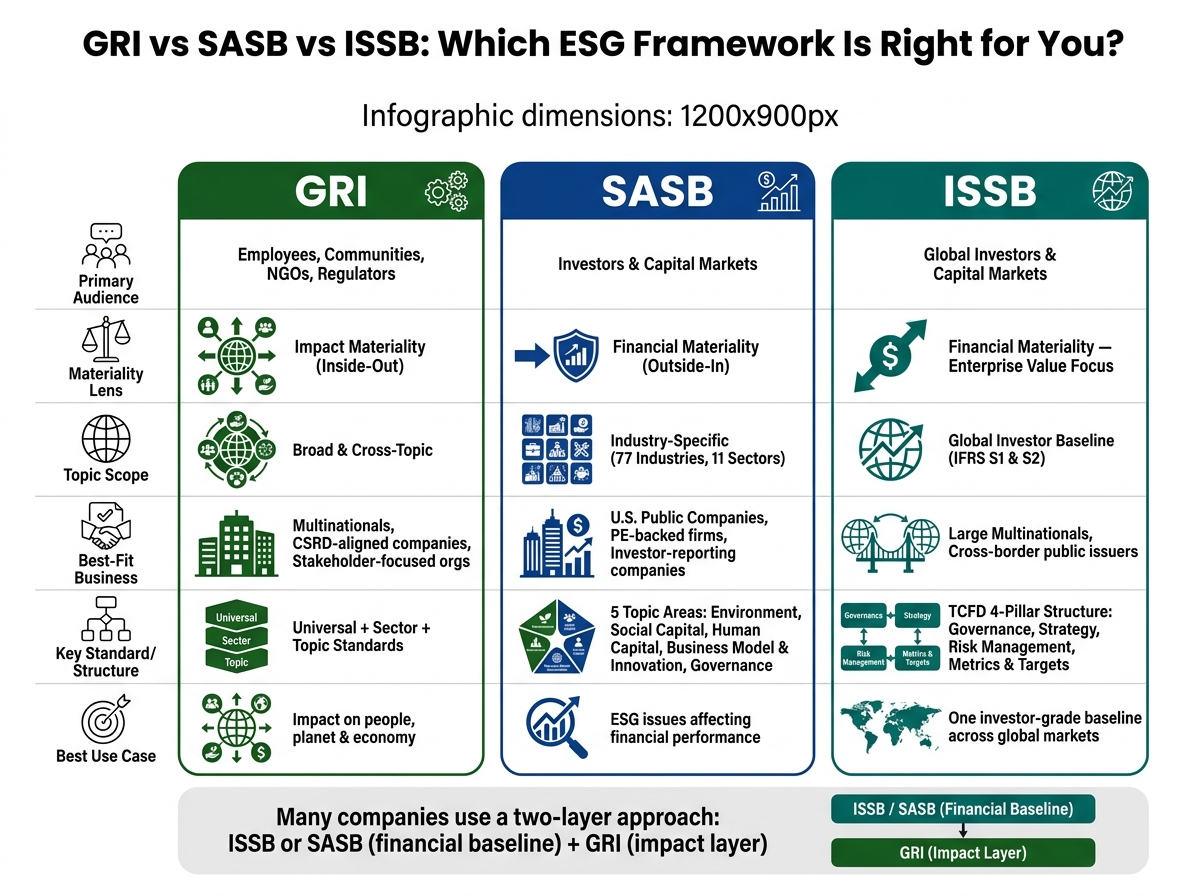
GRI vs SASB vs ISSB: ESG Framework Comparison 2026
Sustainability Reporting 2025: GRI, SASB, IFRS, ESRS, TCFD, CDP Explained for Freshers
sbb-itb-97f6a47
Quick Comparison
| Criteria | GRI | SASB | ISSB |
|---|---|---|---|
| Main audience | Broad stakeholders | Investors | Global investors |
| Materiality | Impact materiality | Financial materiality | Financial materiality |
| Topic style | Broad topic coverage | Industry-based metrics | Global baseline with investor focus |
| Best fit | Stakeholder trust, impact disclosure, CSRD support | Public companies, PE-backed firms, U.S. investor reporting | Multinationals, cross-border investor reporting |
| Best use case | What your company does to people and the world | What ESG issues may affect financial performance | One investor-grade baseline across markets |
My take: if you need one fast rule, start with the audience. If the audience is investors, start with SASB or ISSB. If the audience is broader than investors, add GRI.
Below, I break down the trade-offs in plain English so you can pick the right framework - or the right mix.
GRI: Best for Broad Stakeholder and Impact Reporting
GRI - the Global Reporting Initiative - is one of the most used standards for sustainability reporting around the world. It was built for broad stakeholder reporting, not just investor communications. That means the main audience often includes employees, local communities, NGOs, and regulators - people who care about how a company affects the world, not only how it performs financially.
Audience and Topic Coverage
GRI is built for multi-stakeholder reporting. Its framework is grouped into Universal, Sector, and Topic Standards. That setup gives companies room to report on a broader set of issues, including topics that investor-led frameworks may leave out.
Materiality Lens and Investor Use
GRI uses an impact materiality lens. Put simply, it looks at what the company does to people, the planet, and the economy. That is different from the financial materiality approach used by SASB and ISSB.
Use GRI when the main issue is impact, not investor performance. If a company also needs to meet investor expectations, GRI often handles the impact side of a double materiality approach, while SASB or ISSB covers the financial side.
Which Business Types Fit GRI Best
GRI is a strong fit for organizations that are answerable to communities, employees, and regulators. That includes:
- Multinational companies that need broad sustainability disclosure
- Companies aligning with the EU's CSRD, where double materiality is required
If investor metrics come first, SASB is usually the tighter fit.
SASB: Best for Industry-Specific Investor Metrics
SASB is built for investor-facing ESG reporting. The focus is narrow on purpose: short, financially material metrics that investors can use in valuation and risk analysis. Where GRI looks at impact on a broad set of stakeholders, SASB focuses on what matters most to capital providers.
Who SASB Is For and What It Measures
SASB is aimed at investors, lenders, and analysts who need decision-useful ESG data. It covers 77 industries across 11 sectors and organizes disclosures into five topic areas: Environment, Social Capital, Human Capital, Business Model and Innovation, and Leadership and Governance.
A mining company and a software firm don't face the same material issues, and SASB reflects that. That industry-level filter is a big reason SASB works well when investors want comparable risk data, not broad sustainability storytelling.
Financial Materiality and U.S. Market Relevance
SASB uses a financial materiality lens. It focuses on ESG issues that are reasonably likely to affect a company's financial condition, operating performance, or cash flow. For U.S. boards and management teams, that makes SASB a practical fit when the goal is peer-comparable metrics that investors can actually use.
Which Business Types Fit SASB Best
SASB fits best for:
- Public companies
- Pre-exit PE-backed companies
- Portfolio companies building reporting for investors
For PE-backed businesses, it makes sense to start 12-24 months before an exit or refinancing so buyers see clean, comparable data. A good place to start is the SASB Materiality Map, which helps identify the 5-10 issues most likely to be financially material for your industry.
GRI is better suited to broader stakeholder impact. SASB is the better fit for investor-facing financial metrics.
ISSB builds on this investor-focused logic but applies it as a global baseline.
ISSB: Best for a Global Investor-Focused Baseline
ISSB takes SASB’s investor-first approach and turns it into a global baseline for cross-border sustainability disclosure. In plain terms, it keeps the same financial lens as SASB, but sets it up for use across markets, so international investors have a consistent base for sustainability-related financial disclosures that works across borders.
IFRS S1 and S2 in Plain English
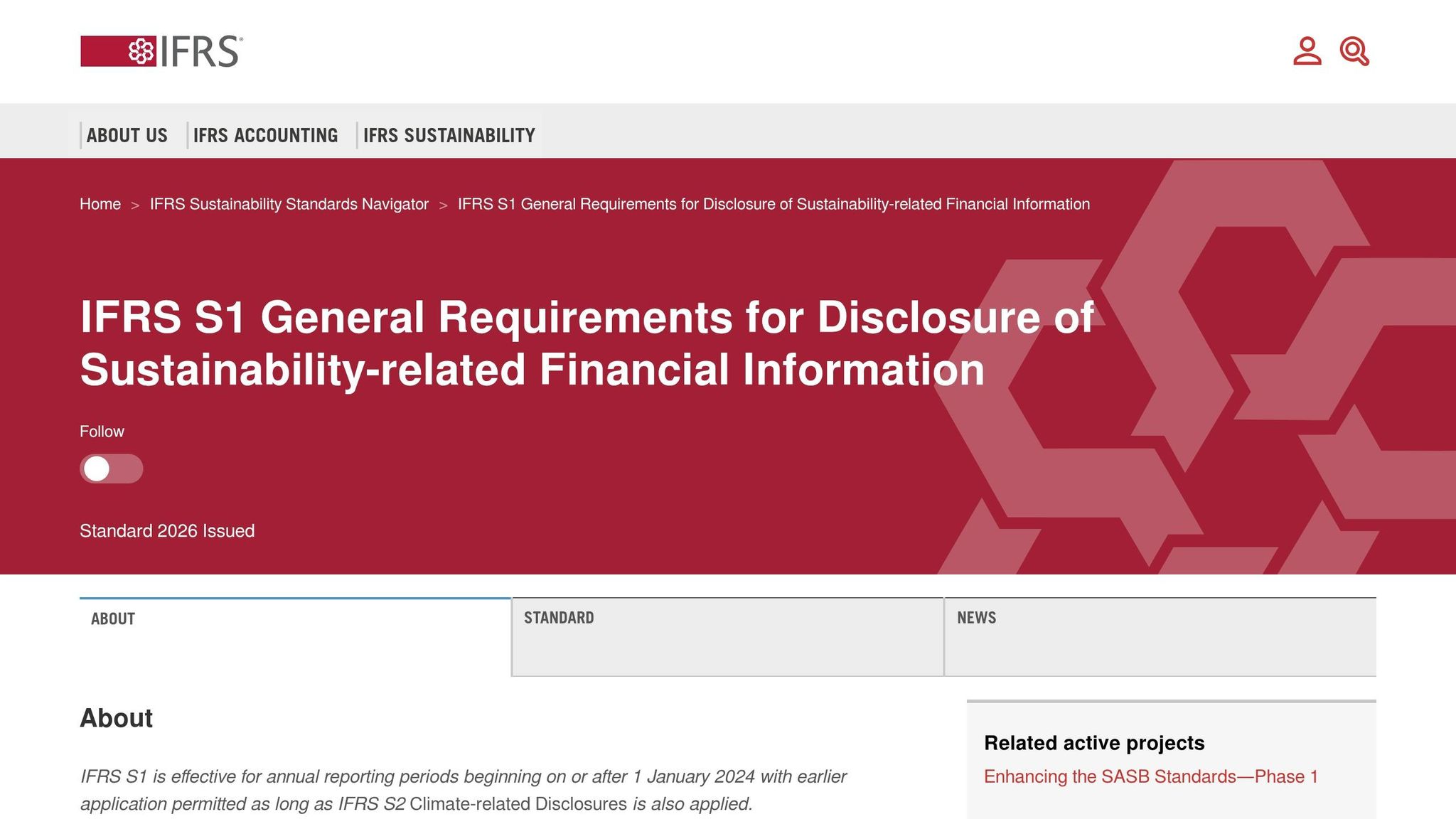
ISSB has two main standards. IFRS S1 covers sustainability-related risks and opportunities that could affect a company’s cash flow, access to capital, or cost of capital. IFRS S2 is about climate-related disclosures and brings in TCFD recommendations, including Scope 1, 2, and 3 emissions disclosure when material.
Both standards use the TCFD’s four-pillar structure:
- Governance
- Strategy
- Risk Management
- Metrics and Targets
That setup makes it easier for companies to organize disclosures alongside financial reporting.
How ISSB Handles Materiality and Uses SASB Inputs
ISSB uses the same financial-materiality lens as SASB. The focus is on how sustainability-related issues affect enterprise value. That’s a big reason SASB metrics are such a practical starting point. ISSB builds on SASB’s 77 industry-specific standards as guidance for industry-based disclosures under IFRS S1.
ISSB is also built for interoperability. A company can use it as a core baseline, then add CSRD disclosures on top.
Which Business Types Fit ISSB Best
For most companies, the main question is simple: does global investor comparability matter more than broad stakeholder reporting? If the answer is yes, ISSB is often the better fit.
It tends to work best for large public companies, U.S. multinationals, and other firms with cross-border investor bases that need one baseline aligned with financial reporting.
GRI vs SASB vs ISSB: Side-by-Side Comparison and Selection Guide
Comparison Table: Audience, Materiality, Investor Use, and Fit
Use the four filters above to pick the framework: audience, materiality, topic scope, and business fit. The table below helps narrow the choice fast.
| Feature | GRI | SASB | ISSB |
|---|---|---|---|
| Primary Audience | Broad stakeholder audience including NGOs, communities, employees, and regulators | Investors and capital markets | Global investors and capital markets |
| Materiality Lens | Impact materiality (inside-out) | Financial materiality (outside-in) | Financial materiality focused on enterprise value |
| Topic Scope | Broad and cross-topic | Industry-specific, covering 77 distinct industries | Global investor baseline |
| Investor Use | Impact context for stakeholders | Investor screening and benchmarking | Comparable investor-grade disclosures |
| Best-Fit Business | Organizations seeking broad stakeholder trust or compliance with impact-focused mandates like CSRD | U.S.-based or industry-focused companies needing industry-specific investor metrics | Multinational public issuers seeking a global investor baseline |
When to Use One Framework vs a Combined Approach
The choice usually comes down to one reporting layer or two.
Use GRI alone when broad stakeholder transparency is the main goal. It structures impact disclosure across environmental and social topics and does not depend on industry-specific investor metrics. It also supports impact-focused mandates such as ESRS.
Use SASB when investor-grade, industry-specific metrics matter most. Its industry-based standards make it easier to spot the topics that matter most for a given sector.
Use ISSB as the core when you need a global investor baseline. ISSB builds on SASB's industry-specific metrics and TCFD's climate framework. And because ISSB and GRI can work side by side, a company can use ISSB for the financial baseline and GRI for impact disclosure.
A combined approach fits when you need to cover double materiality - both what affects the company financially and what the company's operations do to the world. That setup can work well, but there is a trade-off. Using multiple frameworks can increase assurance costs because teams need extra reconciliation and testing.
Conclusion: The Short-List Decision for 2026
Choose GRI for broad stakeholder and impact reporting, SASB for U.S. investor-grade industry metrics, and ISSB for a global investor baseline for financial reporting.
Many companies use a combined approach. A common setup is ISSB as the financial baseline and GRI as the impact layer. Another is SASB as the starting point, with GRI added for stakeholder coverage.
For framework selection support, the Top Consulting Firms Directory can help identify sustainability and ESG consulting partners.
FAQs
How do I decide between impact and financial materiality?
Choose based on your main audience and reporting goal.
Impact materiality (GRI) looks at how your organization affects the economy, the environment, and people across a broad group of stakeholders.
Financial materiality (SASB and ISSB) looks at how sustainability issues affect financial performance and enterprise value for investors and creditors.
Many companies use both as part of double materiality. In practice, that often means using SASB for investor-focused reporting and GRI for broader impact reporting.
Can a private company use ISSB or SASB?
Yes. A private company can use ISSB and SASB standards, and in most cases using them is voluntary unless local or national rules say otherwise.
Private companies often use these standards to show ESG transparency and financial discipline to lenders, creditors, and potential investors. Since ISSB includes SASB’s industry-specific metrics, companies can focus on the sustainability issues that matter most financially in their sector.
When should I combine GRI with ISSB or SASB?
Combine GRI with ISSB or SASB when you need to meet the different information needs of broad stakeholders and capital markets.
GRI covers your organization’s impacts on society and the environment. SASB adds industry-specific, financially material metrics for investors, while ISSB provides a global baseline for those financial disclosures. Together, they give a clearer view of both impact and enterprise value.