ESG compliance frameworks help businesses measure and report on their environmental, social, and governance (ESG) performance. They are essential for meeting legal requirements, attracting investors, and building trust with stakeholders. With over 600 frameworks globally, companies often combine multiple ones to address diverse reporting needs. Key frameworks include:
- GRI: Focuses on how businesses impact society and the environment.
- ISSB: Targets sustainability risks and opportunities relevant to investors.
- ESRS: Requires reporting on both societal and financial impacts.
- SASB: Offers industry-specific ESG standards.
- TCFD: Focuses on climate-related financial risks (now integrated into ISSB).
To implement ESG compliance, companies should:
- Conduct a materiality assessment to identify key ESG issues.
- Establish a data governance system for accurate reporting.
- Create a compliance matrix to align data with multiple frameworks.
- Build a reporting system for real-time monitoring and regulatory alignment.
With ESG-mandated assets expected to reach $35 trillion by 2026, compliance is critical for accessing capital, improving transparency, and staying competitive.
Intro to ESG Frameworks and Standards
Key ESG Frameworks
Understanding the frameworks that guide ESG reporting is essential for navigating the complex landscape of sustainability. These frameworks serve different purposes, and organizations often combine them to meet varied stakeholder expectations.
Global Reporting Initiative (GRI)
The GRI framework emphasizes the concept of impact materiality, focusing on how organizations influence the economy, environment, and people around them. Its audience includes employees, local communities, civil society groups, and investors. With a modular structure comprising Universal, Sector, and Topic standards, GRI is designed to be adaptable for any organization. This adaptability has made it widely used - 78% of the world’s top 250 companies adhere to GRI Standards.
"The GRI Standards enable any organization – large or small, private or public – to understand and report on their impacts on the economy, environment and people in a comparable and credible way, thereby increasing transparency on their contribution to sustainable development." – Global Reporting Initiative
While GRI reporting is mostly voluntary, its metrics are increasingly influencing mandatory regulations. For instance, the European Financial Reporting Advisory Group (EFRAG) states that about two-thirds of GRI disclosures align with the European Sustainability Reporting Standards (ESRS), with only slight adjustments.
International Sustainability Standards Board (ISSB)
The ISSB focuses on financial materiality, providing a global baseline for sustainability reporting aimed at investors. In 2023, it introduced two key standards: IFRS S1 (covering general sustainability-related financial disclosures) and IFRS S2 (focused on climate-related disclosures). These standards help investors evaluate sustainability risks and opportunities.
The ISSB has integrated the Task Force on Climate-related Financial Disclosures (TCFD) and SASB standards, creating a unified global framework. Countries like the UK, Australia, and Brazil are aligning their mandatory reporting requirements with ISSB standards.
European Sustainability Reporting Standards (ESRS)
ESRS stands out for its double materiality approach, which requires companies to report both their impact on the world and how sustainability issues affect their financial performance. These standards are mandatory for companies under the EU’s Corporate Sustainability Reporting Directive (CSRD).
The CSRD applies to large EU companies with over 1,000 employees and more than €450 million in annual turnover, starting in December 2025. Initially, companies were required to report on 1,073 data points, but this was reduced to 320 material data points through a 2025 revision, simplifying the process without losing depth. Additionally, companies must meet limited assurance requirements, where auditors verify the underlying ESG data rather than just its presence.
Sustainability Accounting Standards Board (SASB)
SASB takes an industry-specific approach, offering tailored standards for 77 industries across 11 sectors. These standards identify ESG issues that are most relevant to financial performance within each industry. Around 75% of the companies in the S&P Global 1200 use SASB standards, highlighting their investor-focused practicality.
Now under the IFRS Foundation, SASB’s metrics play a crucial role in implementing ISSB’s IFRS S1 and S2 standards, providing detailed industry-level guidance.
Task Force on Climate-related Financial Disclosures (TCFD)
TCFD focuses on climate-related financial risks, offering guidance on disclosures for investors, lenders, and insurers. Its framework is organized around four pillars: Governance, Strategy, Risk Management, and Metrics and Targets. Over 5,000 organizations have endorsed TCFD recommendations, underscoring its broad influence.
"TCFD has arguably been the most influential framework on recent ESG requirements. Today, the TCFD has served as a foundation for CSRD, IFRS S1 and S2, and the SEC's Climate Related Disclosure Rule." – Valentina Francesconi, Associate Director ESG & Regulatory Solutions, Wolters Kluwer
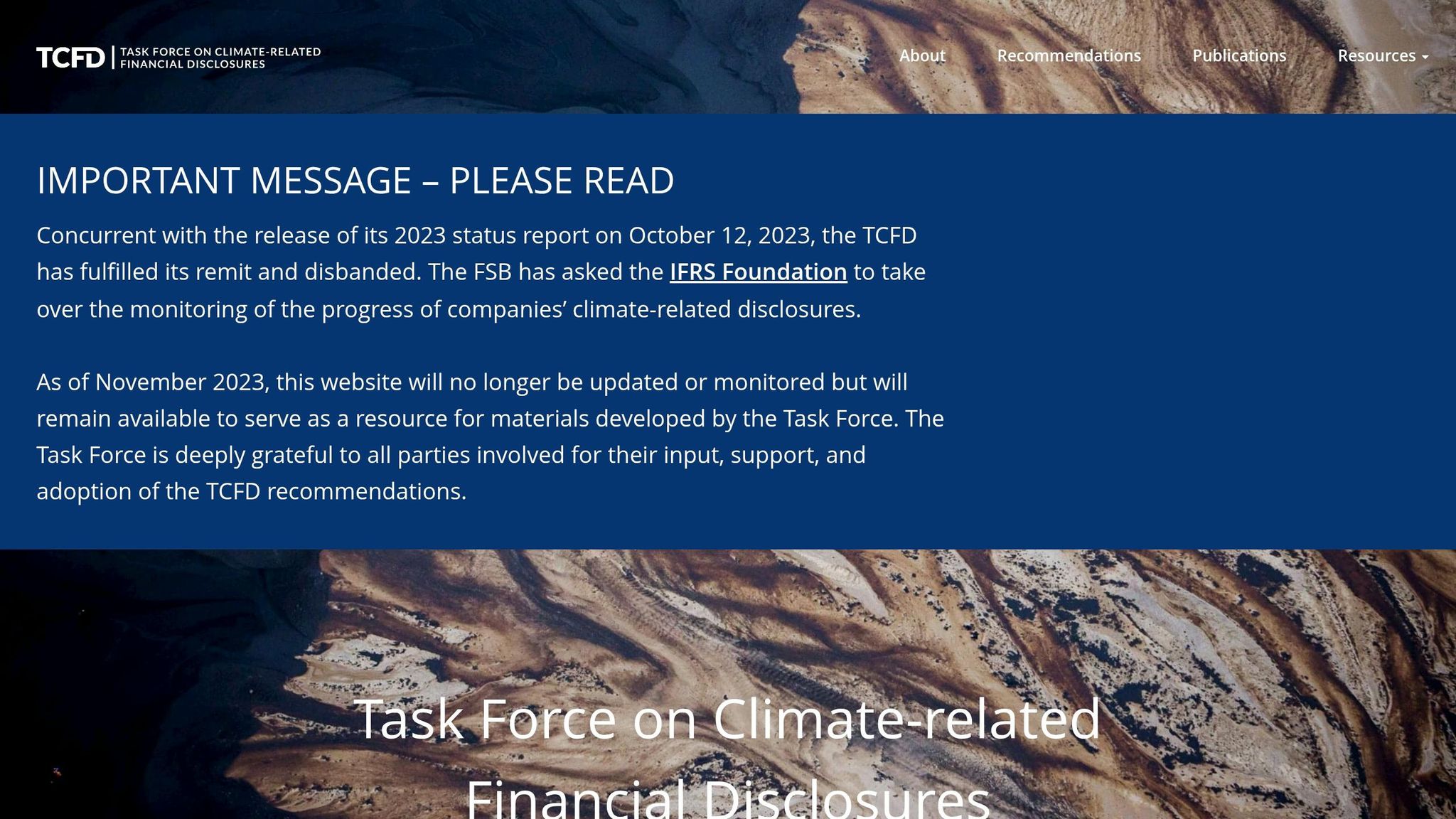
Although TCFD officially disbanded in 2023, its principles live on through ISSB standards. Both ESRS E1 and IFRS S2 now mandate the disclosure of material Scope 3 emissions, with IFRS S2 allowing for phased implementation.
Comparing ESG Frameworks
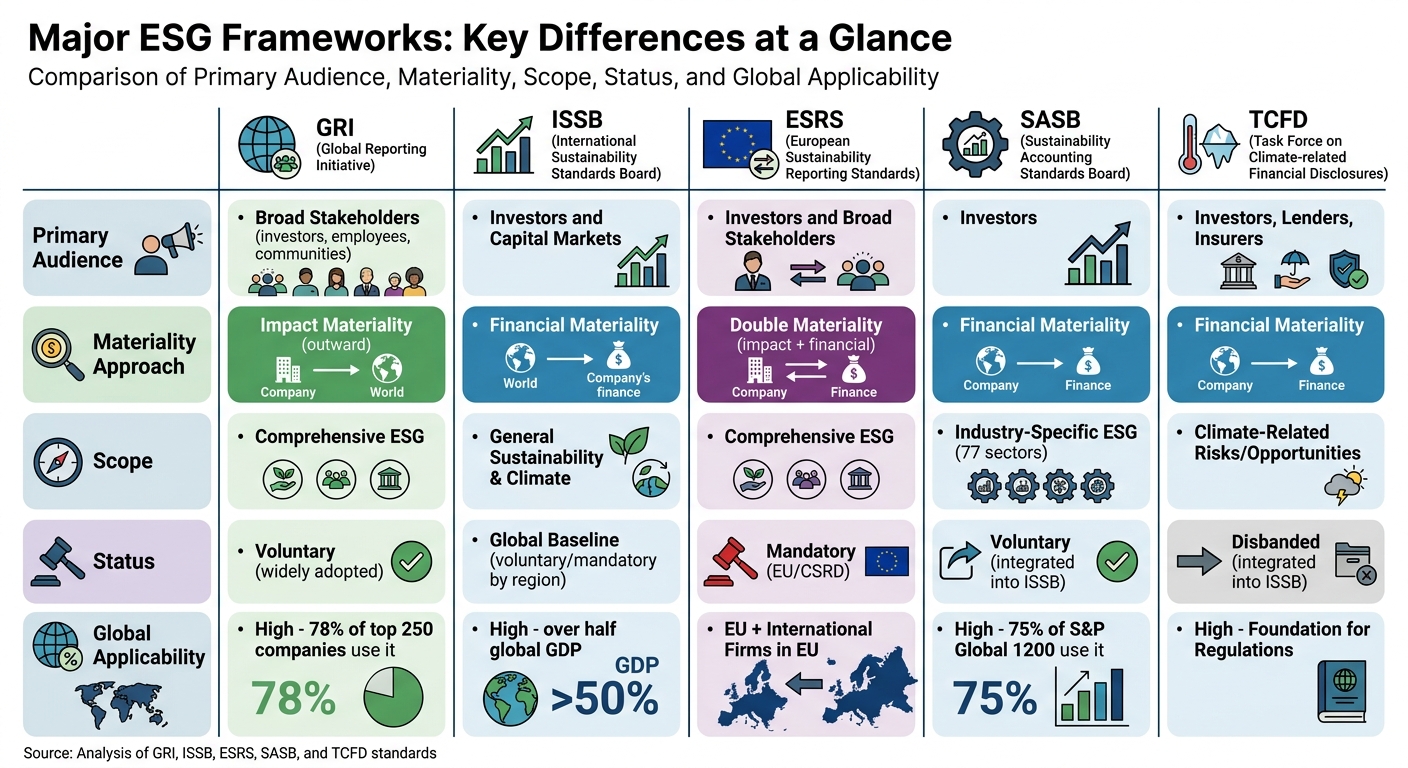
ESG Compliance Frameworks Comparison: GRI, ISSB, ESRS, SASB, and TCFD
Grasping the differences between major ESG frameworks is crucial for aligning your reporting practices with business goals, regulatory demands, and what stakeholders care about most.
One of the biggest distinctions lies in materiality - essentially, what each framework prioritizes. The GRI framework emphasizes impact materiality, focusing on how your organization affects society and the environment. On the other hand, SASB and ISSB center on financial materiality, which looks at how ESG issues might influence your company’s financial outcomes. Meanwhile, ESRS takes a double materiality approach, requiring companies to report on both financial and societal impacts. It’s also worth noting that TCFD has been disbanded, with its recommendations now folded into the ISSB framework.
Geography and regulations add another layer of complexity. For example, ESRS is mandatory for companies under the EU's CSRD (Corporate Sustainability Reporting Directive), which applies to about 50,000 companies - including non-EU firms with significant revenue in Europe. In contrast, SASB remains voluntary, although its principles are increasingly being adopted into national laws. The ISSB reflects a movement toward global consolidation, combining SASB standards and TCFD recommendations to create a unified global baseline.
Here’s a quick breakdown of the main differences:
Framework Comparison Table
| Framework | Primary Audience | Materiality Approach | Scope | Status | Global Applicability |
|---|---|---|---|---|---|
| GRI | Broad stakeholders (investors, employees, communities) | Impact Materiality (outward) | Comprehensive ESG | Voluntary (widely adopted) | High (used by 78% of top 250 companies) |
| ISSB | Investors and capital markets | Financial Materiality | General sustainability & climate | Global baseline (voluntary/mandatory by region) | High (over half global GDP) |
| ESRS | Investors and broad stakeholders | Double Materiality (impact + financial) | Comprehensive ESG | Mandatory (EU/CSRD) | EU + international firms in EU |
| SASB | Investors | Financial Materiality | Industry-specific ESG (77 sectors) | Voluntary (integrated into ISSB) | High (75% of S&P Global 1200) |
| TCFD | Investors, lenders, insurers | Financial Materiality | Climate-related risks/opportunities | Disbanded (integrated into ISSB) | High (foundation for regulations) |
This comparison highlights why tailoring your ESG strategy is essential for compliance and staying competitive.
For companies in the U.S., SASB has been a go-to framework for investor-focused reporting. By 2021, 96% of S&P 500 companies were publishing sustainability reports. Additionally, California-based businesses with revenues exceeding $1 billion must comply with SB-253, which mandates greenhouse gas emissions reporting. If your company operates in the EU or has significant European revenue, aligning with ESRS is critical to meet CSRD requirements.
sbb-itb-97f6a47
How to Implement ESG Compliance
Implementing ESG compliance involves a methodical approach. With over 90% of S&P 500 companies now releasing sustainability reports and ESG-mandated assets expected to reach $35 trillion by 2026, this is no longer optional. Companies that integrate ESG into their core strategy often excel in operational resilience, investor relations, and employee retention.
Step 1: Conduct a Materiality Assessment
The first step is identifying the ESG issues that matter most to your business and stakeholders. This involves a "double materiality" approach - evaluating how ESG factors influence your financial outcomes (outside-in) and how your operations impact society and the environment (inside-out).
"Every credible ESG strategy begins with a materiality assessment. This is not administrative box-ticking - it is the analytical process that determines which environmental, social, and governance topics are genuinely significant for your business model." - Johannes Fiegenbaum, CEO, Fiegenbaum Solutions
To get started, form a cross-functional team that includes Finance, HR, Operations, and Marketing for a well-rounded perspective. Engage stakeholders such as investors, employees, customers, suppliers, and local communities to understand their concerns. Industry-specific tools like SASB and MSCI provide useful materiality maps to guide this process. Typically, a materiality assessment takes about four to eight weeks. Use quantitative scoring to create a materiality matrix that balances impact estimates with stakeholder priorities. This matrix should be reviewed and approved by senior management and the board.
Once material priorities are established, the next focus is on building a robust data governance framework.
Step 2: Set Up a Data Governance System
ESG data demands the same level of precision as financial reporting. Establish clear ownership for each metric, automate data collection to reduce errors, and maintain thorough audit trails.
Assign specific metric owners to ensure accountability. Replace manual spreadsheets with specialized ESG software - used by 92% of companies. Tools like Workiva and Persefoni are popular choices, with costs ranging from $25,000 annually for mid-market solutions to over $100,000 for enterprise-level packages. These platforms can integrate directly with systems like ERP, HR, and utilities, creating a central repository for accurate data while minimizing human error. Currently, 83% of companies cite data collection for CSRD compliance as a major challenge.
Involve internal audit and legal teams early on to ensure the system is audit-ready. Third-party verification is increasingly required, as seen with California's SB 253 and the EU's CSRD regulations.
After securing your data governance system, the next step is to create a compliance matrix.
Step 3: Create a Compliance Matrix
To streamline efforts, map your ESG data to meet multiple frameworks at once. A centralized data system can align raw data with standards like GRI, ESRS, and ISSB.
Develop a compliance matrix that clearly shows how each data point satisfies various framework requirements. For instance, structured greenhouse gas emissions data can fulfill ESRS E1, IFRS S2, and CDP reporting needs. Document calculation methods thoroughly to support external assurance.
For companies with significant operations in the EU, it's essential to align with ISSB (IFRS S1 and S2) for investor-grade disclosures while prioritizing ESRS compliance under CSRD.
Once your metrics are mapped, focus on building a system that continuously tracks and reports ESG performance.
Step 4: Build a Reporting and Monitoring System
Establish ESG oversight at the board level, ideally through an audit or risk committee, and appoint a C-suite executive to lead the initiative. Set up a reporting calendar with clear milestones to transition from reactive to proactive compliance.
Your reporting system should enable real-time monitoring instead of relying solely on annual updates. Use AI tools for extracting unstructured data and detecting anomalies. Ensure the system supports machine-readable tagging (like XBRL) to comply with CSRD and SEC regulations.
"A single, well-governed data architecture that can serve multiple frameworks, survive external assurance, and support both regulatory reporting and internal management is the foundation that future reporting will sit on top of." - OneStop ESG
Engage top-tier suppliers early to establish data-sharing protocols for Scope 3 emissions, which often represent 70–90% of a company's carbon footprint. With CSRD and ISSB deadlines approaching in 2027, early action is crucial for meeting value chain disclosure requirements.
Initial implementation costs for mid-size companies range from $100,000 to $500,000, with annual expenses between $50,000 and $200,000. Companies in the top ESG quintile enjoy a cost of capital that is 39 basis points lower than their peers in the bottom quintile.
Benefits of ESG Compliance
Meeting ESG compliance requirements does more than satisfy regulatory demands - it offers a range of strategic advantages that can significantly impact a company's bottom line. Businesses that incorporate ESG principles into their core strategies often experience financial benefits. For example, between 2019 and 2022, companies known as "Reinventors", which combine strong ESG practices with technological maturity, saw their revenues grow by an additional 15 percentage points and achieved a 2.9 percentage point increase in profit margins compared to their competitors. Looking ahead, by 2026, the revenue growth gap between ESG leaders and those lagging behind is expected to expand to 37 percentage points.
These financial gains are just the beginning. ESG compliance also builds trust, enhances access to capital, and ensures long-term resilience in an ever-changing market landscape.
Better Transparency and Stakeholder Trust
ESG frameworks help companies move beyond vague sustainability claims by providing standardized, auditable metrics that stakeholders - whether investors, regulators, or employees - can verify. This shift from storytelling to evidence-based accountability not only builds credibility but also reduces the risks of greenwashing.
Globally, 86% of large companies now disclose sustainability information, and 78% of CFOs report feeling pressure from at least three different stakeholder groups to ramp up their sustainability efforts. A cautionary tale comes from Mondelez, which faced a class action lawsuit in 2024 over allegations of child labor and deforestation in its cocoa supply chain. This case highlighted the dangers of treating ESG disclosure as a mere formality rather than a genuine operational commitment.
"When regulations force you to look at something that you haven't paid attention to previously, you can gain new insights and inspiration." - Massimo Terrevazzi, Group CFO & Executive Director, Perfetti Van Melle Group
Proactive ESG disclosure not only fosters stronger relationships with regulators but also helps safeguard a company's reputation, showing a real commitment to building trust with stakeholders.
Improved Access to Capital
Adopting ESG standards also opens doors to better financial opportunities. ESG performance is now a key factor for investors, with 80% of them considering ESG criteria critical when deciding where to allocate capital. Additionally, 85% of asset managers prioritize ESG factors when constructing portfolios. By 2026, ESG-mandated assets are expected to hit $35 trillion, accounting for roughly one-third of all professionally managed assets worldwide.
Frameworks such as SASB and ISSB provide the kind of financially relevant data that institutional investors demand. Companies aligned with these standards often find it easier to secure financing - and at more favorable terms.
In regions like the EU, regulations such as the EU Taxonomy and the Sustainable Finance Disclosure Regulation (SFDR) have made ESG compliance a requirement for accessing green finance. These frameworks guide financial institutions in defining sustainable activities and shaping their lending strategies. Companies that fail to provide robust ESG data risk being left out of this growing pool of capital.
Market Differentiation
Strong ESG performance can set a company apart in competitive markets, especially when it comes to procurement, bidding, and attracting customers. For instance, 55% of Gen Z workers research a company's environmental impact before accepting a job offer, making ESG credentials increasingly important for talent acquisition and retention.
Sustainability efforts also lead to operational efficiencies. Tracking energy usage and waste, for example, can uncover cost-saving opportunities and streamline production cycles. Interestingly, only 20% of companies with strong ESG practices believe that prioritizing sustainability negatively impacts shareholder interests, compared to 61% of companies with weaker ESG capabilities.
"To truly incorporate sustainability into your business, it must be integrated throughout. We have an integrated strategy that includes both financial and concrete ESG KPIs..." - Léon Wijnands, Head of Sustainability, ING Netherlands
Currently, 38% of businesses invest in sustainability initiatives specifically to boost financial performance. With regulatory pressures mounting and investor expectations climbing, companies that embrace ESG early gain a competitive edge in markets increasingly shaped by environmental and social accountability.
Conclusion and Next Steps
Meeting ESG compliance standards has become a legal necessity in many parts of the world. Regulations like the EU's Corporate Sustainability Reporting Directive (CSRD), California's SB 253, and the UK's Streamlined Energy and Carbon Reporting (SECR) require companies to disclose their ESG efforts. Penalties can be steep - for example, Germany’s Supply Chain Due Diligence Act imposes fines up to 2% of global turnover for non-compliance. Meanwhile, the framework landscape is becoming more unified, with the ISSB integrating TCFD and SASB to create a global standard already adopted by 36 jurisdictions, covering over half of the world’s GDP.
To stay ahead, businesses need to move beyond basic tools like spreadsheets and adopt systems capable of producing audit-ready data. This is particularly important as 83% of companies report difficulties in collecting ESG data, especially for Scope 3 emissions. Starting with a materiality assessment helps identify the most pressing ESG issues for your business and stakeholders. From there, you can set science-based targets using the Science Based Targets initiative (SBTi) and focus on your top 20 suppliers, who typically contribute to 80% of supply chain emissions, simplifying the process.
By following the frameworks and steps shared in this guide, companies can build a strong foundation for achieving measurable results and gaining a competitive edge in ESG compliance.
Key Takeaways
The concept of double materiality has become central to frameworks like ESRS. This approach requires businesses to evaluate not only how ESG factors affect their financial performance but also how their operations impact the environment and society. As frameworks like GRI, ISSB, and EFRAG work toward interoperability, companies can increasingly use a single set of data to fulfill multiple reporting requirements. With $35 trillion in ESG-mandated assets projected by 2025 and 80% of investors prioritizing ESG factors in their capital allocation decisions, compliance offers access to funding, strengthens stakeholder trust, and enhances market positioning.
Using the Top Consulting Firms Directory
For businesses navigating ESG compliance, expert guidance can make a significant difference. The Top Consulting Firms Directory connects you with professionals who can simplify the process. These consultants assist with materiality assessments, selecting the most suitable frameworks for your industry and region, and transitioning from manual data collection methods to centralized, auditable systems. They also help interpret disclosure requirements, conduct double materiality assessments, and ensure your reports align with evolving global standards. With 98% of institutional investors now factoring ESG into their decisions, working with firms that provide third-party assurance and independent verification boosts credibility and minimizes the risk of greenwashing.
FAQs
Which ESG framework should my company start with?
For businesses beginning their journey with ESG, the Global Reporting Initiative (GRI) Standards provide a widely adopted and flexible framework. These standards work well for organizations across different sizes and industries, offering straightforward guidance for detailed sustainability reporting.
As your ESG efforts expand, you might want to include SASB Standards, which focus on investor-oriented, industry-specific disclosures. Many companies start with GRI and then integrate SASB as their objectives and stakeholder expectations evolve.
How do I run a materiality assessment without over-scoping?
When conducting a materiality assessment, it's easy to get overwhelmed by trying to cover too much ground. To keep things focused, start by identifying the issues that matter most for decision-making.
Begin by mapping impacts and dependencies across your value chain. This helps you understand where the most critical risks and opportunities lie. From there, prioritize these factors based on stakeholder interests and regulatory requirements. Clear priorities ensure you're addressing what's most relevant.
Engaging stakeholders is key. Their insights, combined with data analysis, will give you a clearer picture of what deserves attention. And don't forget - materiality assessments aren't static. Regularly updating your analysis ensures it stays aligned with current needs and remains efficient.
By concentrating on decision-useful information, you can streamline the process and avoid wasting time on less critical areas.
What’s the fastest way to make ESG data audit-ready?
The fastest way to get ESG data ready for audits is by consolidating it into one centralized system. This approach guarantees data accuracy, traceability, and completeness, while also making the verification process much smoother. Tackling issues like disconnected systems and missing data early on is crucial. Focus on building detailed and easily verifiable records. By combining centralization with better data quality and traceability, you'll be able to meet both regulatory demands and stakeholder needs more efficiently.