Custom feedback models are tailored systems that align with an organization’s specific goals, values, and structure. They focus on precise behaviors, often improving employee retention (by 30%) and productivity (by 27%) but come with higher upfront costs ($50,000–$150,000) and longer implementation timelines. Standard feedback models, on the other hand, are ready-made tools designed for general use. They’re quicker to deploy, cost less ($5,000–$15,000), and include predefined frameworks like 360-degree feedback, but they lack the flexibility to address unique organizational needs.
Key Points:
- Custom Models: High alignment with specific needs, better for long-term growth, but costly and time-intensive.
- Standard Models: Budget-friendly, fast to implement, but less precise and may lead to higher turnover in the long run.
Quick Comparison:
| Factor | Custom Feedback Models | Standard Feedback Models |
|---|---|---|
| Flexibility | High | Low to Moderate |
| Cost | $50,000–$150,000 upfront | $5,000–$15,000 upfront |
| Implementation Time | Long | Short |
| Best For | Complex needs, long-term goals | Quick solutions, tight budgets |
Choosing the right model depends on your budget, timeline, and organizational needs. Custom systems work well for organizations with unique challenges, while standard tools are ideal for simpler setups or when speed is a priority.
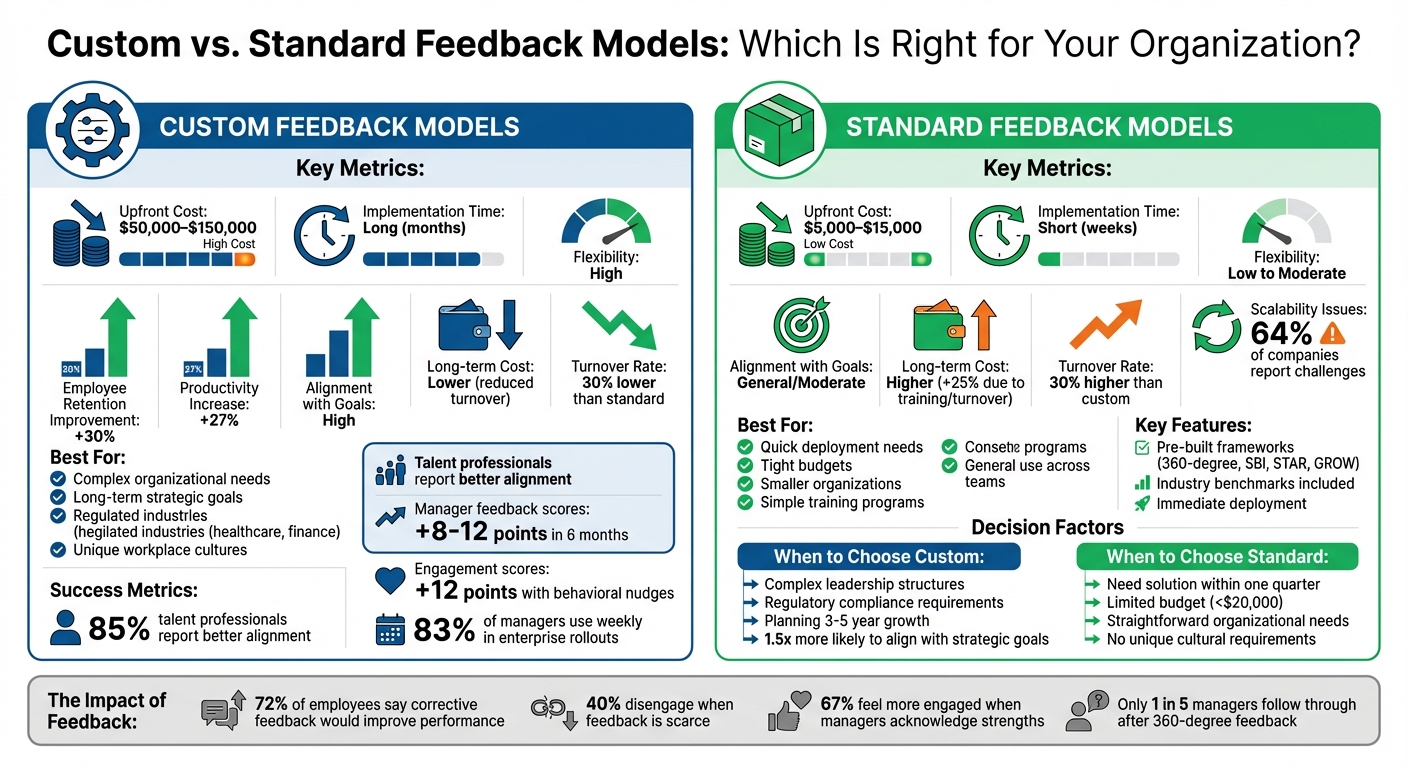
Custom vs Standard Feedback Models: Cost, Implementation & ROI Comparison
E214 - 3 Feedback Models Every Leader Should Master
sbb-itb-97f6a47
Custom Feedback Models: Tailored Solutions for Specific Organizations
Custom feedback models are performance management systems designed specifically to align with your organization's unique culture, structure, and goals. As Rachel Stewart from McLean & Company puts it:
"Every organization has its own culture, structure, and strategy, which means each needs a customized performance management framework suited to its context."
These models go beyond generic approaches by incorporating your organization's internal language and core values. Instead of relying on vague terms, they focus on clear, measurable behaviors tied to your strategic objectives. For instance, instead of a broad "integrity" competency, a custom model might define it as "keeps commitments", making it easier to observe and evaluate. Additionally, AI-powered tools like Microsoft Teams or Slack can deliver coaching tips and behavioral nudges directly within daily workflows, turning feedback into actionable habits. By mirroring your organization’s specific needs, these models provide more precise and relevant feedback.
Main Features of Custom Feedback Models
Custom feedback models are designed to reflect your organization’s unique requirements, whether they relate to leadership, industry-specific regulations, or broader goals like ESG reporting. Here’s what makes them stand out:
- Tailored Competencies: These models define skills and behaviors that align with your leadership framework or industry standards.
- Flexible Design: They offer various feedback options, such as monthly check-ins, quarterly reviews, or project-based evaluations. Organizations can also choose between top-down feedback, 360-degree assessments, or crowdsourced input to minimize bias.
- Rating Options: Whether you prefer traditional rating scales or want to eliminate ratings altogether, these models can adapt to your total rewards philosophy.
- Real-Time Data Integration: They combine evidence-based frameworks with internal insights, ensuring both scientific accuracy and relevance. Informal work style evaluations can also be included, helping leaders understand how their personality impacts their behavior.
These features provide a robust framework for delivering feedback that is both actionable and aligned with organizational goals.
Benefits of Custom Feedback Models
Custom feedback models offer more than just alignment with organizational values - they deliver measurable improvements. For example, organizations leveraging AI-powered coaching have reported manager feedback scores increasing by 8–12 points within six months. Behavioral nudges targeted at specific actions have led to a 12-point rise in engagement scores, with 83% of managers using these nudges weekly in enterprise rollouts.
Take Huge, a global design and technology company, as a case in point. In 2022, they moved from bi-annual reviews to quarterly conversations and project-based feedback cycles. Under the leadership of JD Slaughter, Group VP of Organizational Development, this shift saved the company around 2,000 hours of administrative work annually. By late 2023, 80% of employees were actively using the feedback tool, and managers who provided timely feedback saw their effectiveness scores improve by 9 points.
Custom models also address a common shortfall in traditional systems: action planning. Research shows that only 1 in 5 managers follow through after receiving 360-degree feedback. By embedding feedback into daily workflows, these models ensure that feedback leads to real, actionable change rather than being treated as a one-time event.
Drawbacks of Custom Feedback Models
While the benefits are clear, custom feedback models are not without challenges. One of the most significant drawbacks is the extended implementation timeline. Developing a model that accurately reflects your organization’s culture and strategy takes time, requiring careful attention to detail in defining competencies and aligning with internal language.
Another challenge is manager readiness. As Rachel Stewart emphasizes, the success of these models depends on managers having the skills to provide meaningful feedback and coaching. Without proper training, managers may view the framework as shifting responsibility rather than a tool to enhance leadership. This issue is even more pronounced in hybrid work environments, where managers often struggle to maintain oversight without micromanaging.
Though these challenges may require extra effort to overcome, the potential for long-term improvement in performance management makes custom feedback models a powerful option for organizations willing to invest in them.
Standard Feedback Models: Ready-Made Solutions for General Use
Standard feedback models are prebuilt tools based on established frameworks like 360-degree feedback or the SBI (Situation-Behavior-Impact) model. Unlike custom-built systems, these models are designed to fit a wide range of organizations without requiring extensive internal development. They come with predefined questions, rating scales, and proven methodologies that have been tested in various workplace settings. However, as Liz Culhane, Ph.D. from Perceptyx, points out:
"A lot of off-the-shelf 360s offer no flexibility - you get what you get."
While these models are quick to implement, they often lack the customization needed to address specific organizational needs. This section dives into the key traits, advantages, and shortcomings of standard feedback models, helping to contrast them with custom solutions.
Main Features of Standard Feedback Models
Standard feedback models are designed to be easy to roll out and operate. They rely on predefined questions and rating scales, ensuring consistent evaluations across teams. Many of these models include 360-degree feedback, which collects input from multiple sources, providing a well-rounded perspective.
One of their standout features is quick deployment. Since they are ready to use, organizations can implement them immediately, bypassing the lengthy development process required for custom frameworks. These models often come with industry benchmarks, allowing companies to compare their results against external data sets right from the start - something that would take years to build internally. Popular frameworks include the STAR model (Situation, Task, Action, Result), the GROW model (Goal, Reality, Options, Will), and the AID model (Action, Impact, Desired Outcome). These built-in structures make it possible to gain insights almost instantly.
Benefits of Standard Feedback Models
The biggest selling point of standard models is their efficiency in terms of cost and time. They minimize the financial and time investment required, enabling organizations to start collecting feedback in weeks rather than months. This makes them particularly appealing for businesses looking for a quick solution.
Another advantage is their benchmarking capability. By using established frameworks, organizations can immediately compare their leadership effectiveness to industry standards without waiting to compile internal data. This external perspective helps businesses gauge their standing relative to competitors or industry norms.
Additionally, these models are designed for broad use, making them applicable across various teams and departments. Whether assessing sales managers or technical leads, the same framework can be applied consistently, reducing the need for adjustments.
Drawbacks of Standard Feedback Models
Despite their convenience, standard models come with notable limitations. The primary issue is their lack of adaptability to an organization’s unique needs. This rigidity can be a significant drawback:
"The reality is that there is no one-size-fits-all approach to effective performance management. Every organization has its own culture, structure, strategy, etc., which means that every organization needs a customized performance management framework to suit their specific context."
Generic frameworks often fail to capture the nuances of an organization’s culture. For instance, a standard competency like "communication" might not differentiate between valuing direct, data-driven exchanges versus fostering collaborative, relationship-focused discussions.
Moreover, standardized evaluation methods like forced rankings or bell curves can hinder leadership development. These rigid approaches may stifle creativity and discourage healthy competition. Fixed processes, such as mandatory annual reviews, may also clash with an organization’s operational rhythm - particularly in hybrid or remote work setups where frequent check-ins are often more effective. The lack of flexibility can result in feedback that feels impersonal and disconnected from the specific challenges leaders face.
These trade-offs underscore the limitations of standard feedback models, setting the stage for a deeper exploration of how they compare to custom solutions in the next section.
Comparing Custom and Standard Feedback Models
Let’s break down the differences between custom and standard feedback models to better understand the trade-offs. These models vary in terms of flexibility, cost, and alignment with organizational goals.
Custom models shine when it comes to flexibility and accuracy. They allow businesses to incorporate data that aligns directly with their needs - like integrating sales performance with employee metrics. Standard models, on the other hand, often restrict users to predefined data types. The impact of this difference is clear: 85% of talent professionals say customized tools enhance how well employee capabilities align with company goals. Meanwhile, companies relying on standard tools face a 30% higher turnover rate compared to those using custom solutions.
When it comes to cost, standard models are cheaper upfront, ranging from $5,000 to $15,000, compared to the $50,000 to $150,000 required for custom models. However, the long-term financial picture tells a different story. Companies using standard solutions often incur 25% higher costs due to extra training and higher turnover rates. Custom models, while initially expensive, eliminate recurring licensing fees and lower turnover-related costs, leading to better cost efficiency over time.
Implementation speed is where standard models take the lead. They’re ready to go almost immediately, offering pre-built competencies and behavioral templates that make setup a breeze. As SkillDirector puts it:
"A standard model is really valuable when speed of implementation is essential"
Custom models, in contrast, require significant time and effort to design and implement, as they involve creating unique frameworks tailored to the organization’s needs.
Here’s a quick comparison to summarize the differences:
Comparison Table
| Factor | Custom Feedback Models | Standard Feedback Models |
|---|---|---|
| Flexibility | High; tailored to specific business data and culture | Low to Moderate; "one-size-fits-all" approach |
| Accuracy for Specific Needs | High alignment with specific organizational goals | General; may overlook critical differentiators |
| Setup Time | Long; requires development and system design | Short; immediate deployment and quick implementation |
| Upfront Cost | High ($50,000 - $150,000) | Low ($5,000 - $15,000) |
| Long-term Cost | Lower; reduces turnover and compliance expenses | Higher; hidden costs in training and turnover |
| Scalability | High; evolves with organizational growth | Limited; 64% of companies report scaling challenges |
| Ease of Integration | Moderate; may require custom technical mapping | High; designed for standard HR systems |
How to Choose Between Custom and Standard Feedback Models
When to Use Custom Feedback Models
Custom feedback models are ideal for organizations with complex leadership structures or unique workplace cultures that standard tools can't fully address. They're especially beneficial in industries with strict regulations - like healthcare or finance - where specific security features are essential.
Take TechInnovate, for example. In 2024, this tech company transitioned from a generic feedback tool to a custom-built system. The result? Employee engagement with the feedback process soared from 30% to 85%. This shift also boosted team productivity by 25% and cut turnover costs by 15%. RetailMax had a similar experience. Their off-the-shelf tool revealed a 40% mismatch between employee skills and job roles. After adopting a custom model, they saw customer service ratings improve by 50% in just one year. These examples highlight how tailored solutions can deliver real, measurable results when standard approaches fall short.
When to Use Standard Feedback Models
Standard feedback models are a better fit when you're working with a tight budget or need a quick, ready-to-use solution. They're particularly useful for smaller organizations running general training programs without intricate cultural or structural complexities. If your needs are straightforward and you lack the resources for a long development process, standard tools offer a practical and efficient option. However, keep in mind that these models may struggle to scale as your organization grows.
Factors to Consider When Deciding
Your decision should hinge on four main factors: budget, timeline, organizational complexity, and long-term goals. While standard tools may require less upfront investment, customized systems often deliver greater returns. For instance, organizations using custom tools report 30% higher retention rates and up to a 20% increase in productivity.
Timing is another critical factor. If you need a solution deployed quickly - say, within the next quarter - a standard model might be your best bet. But if you're planning for growth over the next three to five years, custom solutions are 1.5 times more likely to align with strategic goals. Data security is also a growing concern. With breaches up by 28%, and 79% of businesses citing regulatory compliance as a key factor in software decisions, your choice of feedback model could have long-term implications for performance management and overall organizational success.
Conclusion
In this article, we explored how custom feedback models provide tailored accuracy, while standard models offer quick, cost-effective solutions. Standard frameworks like SBI, STAR, and GROW deliver structured, consistent feedback across organizations. On the other hand, custom models align actions with your organization’s specific goals, creating a more targeted approach to leadership development. While custom solutions may require more time and resources, they often deliver better long-term results.
The stakes are high. Research shows that 72% of employees believe corrective feedback would improve their performance. However, 40% disengage when feedback is scarce, while 67% feel more engaged when managers acknowledge their strengths. As one expert explains:
"Every organization has its own culture, structure, strategy, etc., which means that every organization needs a customized performance management framework to suit their specific context".
Choosing between these models depends on factors like budget, timeline, complexity, and strategic priorities. For smaller organizations with straightforward needs and limited resources, standard models can be an effective starting point. But if your organization faces complex leadership dynamics, regulatory challenges, or plans for significant growth, custom solutions may be worth the investment.
With at least 12 distinct feedback models available, making the right choice is essential. Consulting firms can evaluate your organization’s culture, recommend the best framework, and train managers to deliver impactful feedback. This approach ensures your feedback model not only addresses current needs but also supports future growth. For expert guidance, check out the Top Consulting Firms Directory to connect with specialists in organizational change, strategic management, and leadership development.
FAQs
How can I tell if my organization needs a custom feedback model?
Your organization might benefit from a custom feedback model when standard tools fall short of fitting your specific culture, workflows, or objectives. These tailored models work well for tackling unique challenges, such as managing diverse teams, pursuing specialized goals, or dealing with uneven feedback practices. However, if off-the-shelf tools already meet your needs, building a custom model may not be worth the effort. Take a close look at your organizational structure, the variety within your team, and your strategic priorities to determine whether customization makes sense for you.
What hidden long-term costs should I expect with a standard feedback tool?
Hidden long-term expenses tied to standard feedback tools often catch businesses off guard. These can include unexpected upgrade fees, charges for integrating systems like CRMs or accounting software, higher licensing costs as your team expands, and support service fees. Over time, these added costs can significantly inflate the total cost of ownership (TCO).
To steer clear of these financial surprises, it's essential to conduct a thorough TCO analysis upfront. This approach ensures you have a clear picture of all potential expenses, helping you make better-informed decisions.
How can we integrate feedback into daily work without overwhelming managers?
Organizations can shift to continuous feedback practices, which often work better and feel less daunting than traditional annual reviews. By emphasizing frequent and focused check-ins tied to specific objectives, employees receive timely, actionable insights that they can immediately use to improve.
To make this work, it's important to tailor feedback systems to fit the company’s culture. This ensures feedback sessions remain concise and purposeful, making it easier for managers to incorporate them into their regular workflows without feeling overwhelmed.