Localization in API documentation bridges the gap between your product and global developers, ensuring accessibility, accuracy, and usability. Here's why it matters:
- Developer Preference: Over 75% of developers prefer documentation in their native language, leading to faster integration and fewer errors.
- Improved Adoption: Localized documentation can boost API adoption rates by up to 40% in regions like Europe and Asia.
- Reduced Support Costs: Developers with localized resources submit up to 60% fewer support requests, saving time and money.
- Revenue Growth: Companies supporting 20+ languages generate 52% of their revenue internationally, compared to 8% for English-only businesses.
- Technical Precision: Accurate translations prevent bugs, delays, and costly misunderstandings.
Localization goes beyond translation. It involves tailoring content to regional standards, such as date formats, currency symbols, and sample data. Automated tools and consulting expertise can streamline this process, ensuring efficiency and scalability while maintaining technical accuracy.
Localization isn’t just a technical task - it’s a business strategy that drives global success.
Research on Global Developer Engagement
How Language Affects Developer Productivity
Having documentation in a developer's native language can significantly reduce mental strain, allowing them to concentrate on creating and problem-solving. A 2023 Solidity survey highlighted that 15.2% of developers preferred documentation in their native language over English - a preference that continues to gain traction.
The downside of poor translations? Developers lose about three hours every week navigating unclear documentation, which translates to an annual loss of approximately $8,000 per developer. Even more striking, 39% of the time spent helping colleagues troubleshoot is used to clarify documentation or workflows.
Ron Huber, CEO of Apiboost, summed it up perfectly:
"When developers read documentation in their own language with references that make sense in their cultural context, it provides a smooth and engaging Developer Experience. As a result, they value your APIs more."
A method known as "translanguaging" has proven effective in localization. This approach keeps essential technical terms in English while translating the surrounding explanatory text. Not only does this enhance productivity, but it also builds stronger trust with users, as discussed below.
Building User Trust Through Relevant Content
Improved productivity goes hand in hand with enhanced technical clarity, which lays the foundation for user trust. Accurate and consistent technical language is critical - errors or awkward phrasing can quickly undermine confidence. According to a 2026 survey of 1,000 developers, 81% reported user confusion or increased support tickets caused by translation mistakes, and 52% of companies experienced lower conversion rates in localized markets due to these issues.
The link between language support and business growth is undeniable. Companies offering documentation solely in English generate around 8% of their revenue internationally, whereas those supporting 20 or more languages see international revenue soar to 52%. Localization efforts also adapt technical details like date formats and currency symbols to align with local standards.
Laura Vass, Co-Founder of Pronovix, highlighted the risks of poor localization:
"The misinterpretation of technical documentation or API references increases the risk of implementation errors, leading to support inquiries and delayed adoption."
For languages such as Arabic or Hebrew, localization requires additional considerations, like mirroring layouts and using the dir="rtl" attribute to accommodate right-to-left reading patterns. A notable example comes from June 2025, when Drupal's developer portal framework successfully employed these techniques to tailor content for Middle Eastern audiences.
sbb-itb-97f6a47
Impact of Localization on API Adoption and Retention
Faster Time-to-Market with Modular Content
Localized documentation can significantly speed up API integration in new markets. In fact, 72% of teams using modular or Over-the-Air (OTA) update systems report faster time-to-market when launching APIs in multiple languages. This is because modular systems separate translation workflows from traditional release cycles, allowing documentation updates to roll out independently of code changes.
A senior engineer from a B2B SaaS company highlighted the challenges of older methods: "We ship features to English users weeks before international users get them because translation is a bottleneck. We need OTA updates badly". With OTA systems, 87% of teams can fix documentation errors without waiting for a full application release. This eliminates delays and ensures all users - regardless of language - receive the same high-quality experience. By accelerating deployment and improving accessibility, modular content systems not only speed up entry into new markets but also strengthen user loyalty.
The financial impact of localization is clear: Companies supporting 11–20 languages generate 47% of their total revenue internationally, compared to just 8% for English-only products. This shows that localization isn't just about accommodating users - it’s a key driver for revenue growth, opening doors to markets that were previously inaccessible. While faster deployment helps with market entry, tailored documentation is crucial for keeping developers engaged over the long term.
Retention Metrics Through Tailored Content
Localization doesn’t just help with quick deployment - it’s also essential for maintaining long-term developer engagement. 72% of developers will abandon an API if they face issues due to unclear or inadequate documentation. Poor documentation can extend sales cycles by 50% and lead to lower user satisfaction.
By localizing content, companies reduce the cognitive load on developers. For example, documentation that uses native languages and region-specific examples - like U.S. date formats (MM/DD/YYYY), dollar signs ($), or local sample data - makes instructions easier to follow. This allows developers to focus on building rather than deciphering instructions. As a result, well-localized documentation can boost user satisfaction by up to 30% and reduce support tickets by a similar margin, as international users gain the ability to troubleshoot independently.
The benefits of localization grow over time. Including practical examples in documentation can increase API adoption rates by up to 40%. When these examples incorporate familiar references and adhere to local technical standards, developers are more likely to trust the API provider. This trust fosters stronger relationships, leading to higher retention rates and greater lifetime value per developer.
How to Create the API Document from Real API and Localization | Atsushi Nakatsugawa | API the Docs
ROI of Localization: A Data-Driven Perspective
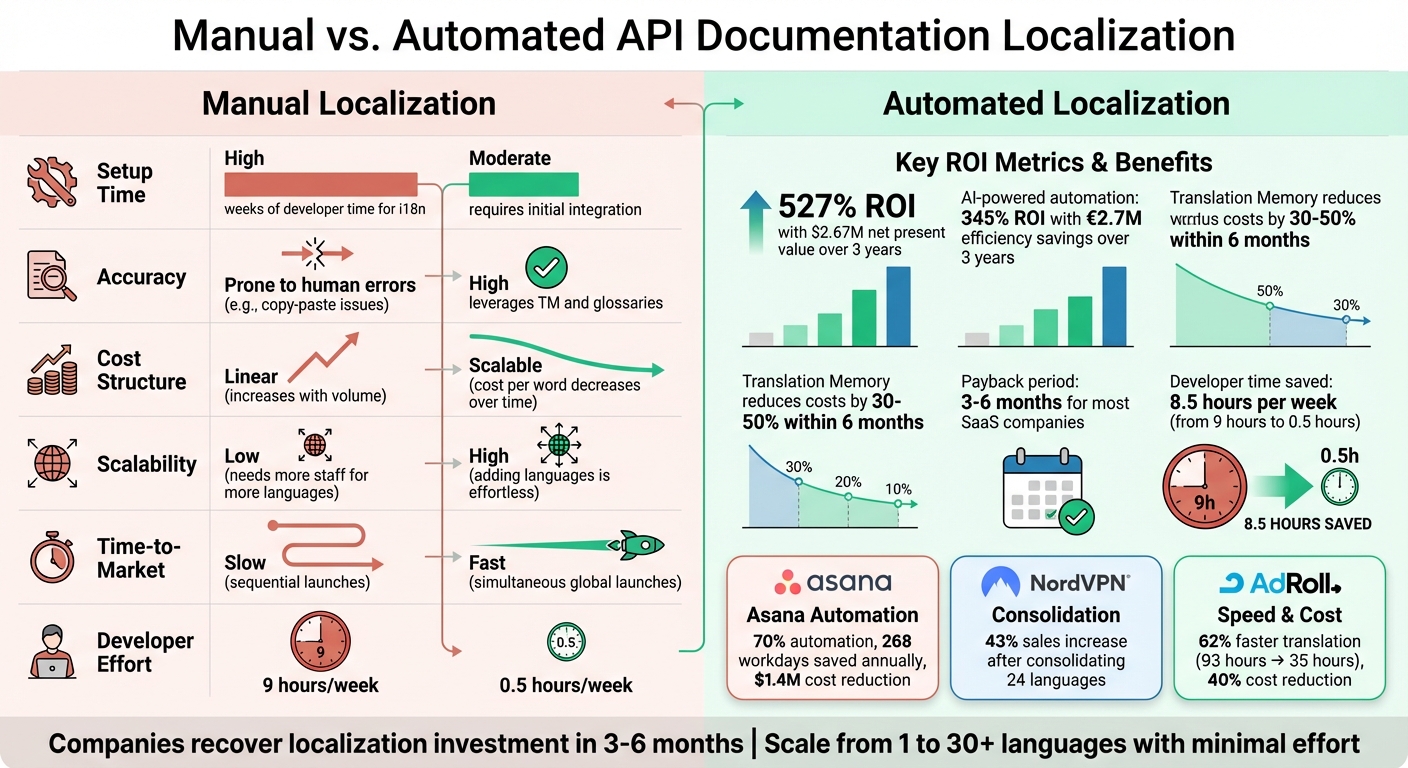
Manual vs Automated API Documentation Localization: ROI and Efficiency Comparison
Cost-Effectiveness of Automated Localization
Let’s break down the financial benefits of localization by looking at the numbers.
The case for automated localization is crystal clear. Companies using integrated translation management systems report an impressive 527% ROI, with a net present value of $2.67 million over three years. Automation eliminates tedious manual tasks that often consume developer time and inflate expenses. To put this into perspective, manual localization processes typically demand 9 hours of developer time per week, while automated workflows cut this to just 0.5 hours. A Software Applications Manager in the energy sector summed it up perfectly:
"I used to spend 10% of my time on translation tasks; with DeepL, that drops to roughly 1% - a clear efficiency boost".
Translation Memory (TM) technology also plays a huge role in reducing costs. By storing previously translated content, it can slash costs by 30–50% within six months. AI-powered translation automation further delivers a 345% ROI and efficiency savings of €2.7 million over three years.
Real-world examples illustrate these benefits even more vividly. Asana’s AI-driven localization workflow achieved 70% automation, saving 268 workdays annually and cutting costs by $1.4 million each year. Similarly, NordVPN consolidated localization efforts for 24 languages, leading to a 43% increase in sales within its target markets.
Next, let’s dive into how automated localization stacks up against manual approaches in a head-to-head comparison.
ROI Comparison: Manual vs. Automated Approaches
When comparing manual and automated localization, the advantages of automation become strikingly evident:
| Feature | Manual Localization | Automated Localization |
|---|---|---|
| Setup Time | High (weeks of developer time for i18n) | Moderate (requires initial integration) |
| Accuracy | Prone to human errors (e.g., copy-paste issues) | High (leverages TM and glossaries) |
| Cost | Linear (increases with volume) | Scalable (cost per word decreases over time) |
| Scalability | Low (needs more staff for more languages) | High (adding languages is effortless) |
| Time-to-Market | Slow (sequential launches) | Fast (simultaneous global launches) |
| Developer Effort | Around 9 hours/week | Around 0.5 hours/week |
Manual localization creates bottlenecks, especially as businesses expand. Each additional language requires more resources - both in terms of staffing and budget. Automated systems, on the other hand, allow businesses to scale from 1 to 30+ languages with minimal extra effort. Automation shifts the cost structure, turning it into a model where the more you translate, the more you save.
What’s even more compelling is the short payback period. Most SaaS companies recover their localization investment within just 3 to 6 months. For example, a mid-sized business with an annual translation spend of $500,000 can break even in just six months by cutting operational costs by 30%. Jason Hemingway, CMO of Phrase, captured this perfectly:
"The return on investment is clear: Through a better alignment of localization services with corporate strategy and gains in efficiency, companies... can expect to see significant financial benefits and substantial cost savings".
These savings not only reduce costs but also enhance API adoption and customer retention, underlining the strategic importance of localization.
Technical and Local Accuracy in Localization
Technical Precision in Translations
Getting technical translations right isn't just a nice-to-have - it’s essential. A single mistranslated parameter or endpoint in API documentation can lead to hours of unnecessary debugging for developers.
The key to avoiding these issues lies in using domain-specific AI models trained on software documentation rather than relying on generic translation tools. These specialized models can identify what needs translation and what doesn’t, ensuring that code elements like variable names and string literals remain untouched.
Take Yext’s partnership with Smartling in July 2024 as an example. They automated their translation process with tools designed to maintain technical accuracy across all their documentation.
Consistency is equally important. Centralized terminology management, using glossaries and Translation Memories, ensures uniformity across all languages.
Automation also plays a role in efficiency. For instance, AdRoll Group leveraged automated workflows with Smartling, slashing their translation time by 62% - from 93 hours to just 35 hours - while also cutting costs by 40%.
Despite automation, human validation remains critical. Native technical experts can spot subtle contextual errors that machines might miss, ensuring the translated documentation feels natural while staying technically correct.
Now, let’s explore how to balance technical precision with local market needs.
Balancing Global Standards with Local Needs
While technical accuracy is vital, adapting to local market expectations is just as important. For example, German developers often look for detailed, standards-heavy documentation with safety information upfront. In contrast, North American developers tend to prefer concise guides that focus on quick results.
The challenges of localization go beyond tone. Sixty-seven percent of developers have encountered text overflow or truncation issues due to localized content, and 41% have shipped translations that broke UI layouts. Translated text often expands, which can disrupt carefully designed interfaces.
Effective localization solves these problems through practical adjustments. This might include replacing generic placeholder data with region-specific examples - like local address formats, phone numbers, and currency symbols - or updating visuals to reflect localized UI layouts. These adjustments also ensure compliance with local regulations.
Regulatory compliance adds another layer of complexity. Documentation must meet the standards of each market, whether it’s CE certification in the European Union, UL/CSA in North America, or SASO in Saudi Arabia. The consequences of getting this wrong can be severe. In 2007, a mistranslation on a medical label - where "non-modular cemented" was incorrectly translated as "non-cemented" - led to 47 faulty knee replacements and 30 corrective surgeries. This case highlights why technical documentation requires more than just language expertise; it demands specialized knowledge to ensure both accuracy and safety.
How Consulting Expertise Drives Localization Success
Using IT Consulting for API Localization
Localization success, particularly with APIs, hinges on technical know-how, efficient workflows, and regional adaptation. This is where IT consulting firms step in to make a difference. By conducting internationalization assessments, these experts can pinpoint bottlenecks and develop strategies tailored to your team's goals.
Consultants strike a balance between speed and accuracy by combining AI tools with human expertise. This approach ensures technical terminology remains precise while adapting content to resonate with local markets. They also ensure compliance with region-specific regulations and help establish consistent terminology systems. These efforts can yield tangible results, such as a 60% drop in support tickets and a 40% boost in API adoption within target markets.
For businesses looking to navigate this complex process, consultants provide the expertise and resources needed to streamline the transition.
Top Consulting Firms Directory: A Resource for Businesses
Finding the right consulting partner for API localization can be daunting. The Top Consulting Firms Directory simplifies this process by connecting businesses with specialized firms that have a track record of success. This curated resource features experts who can guide you through every stage of API localization.
When selecting a firm, look for certifications like ISO 17100:2015 and ISO 18587 to ensure adherence to industry standards. The directory also highlights firms specializing in areas such as cloud services, data analytics, and market expansion - key priorities for businesses aiming to scale their API documentation globally while ensuring both technical accuracy and local relevance.
Conclusion
Research shows that localized API documentation leads to quicker adoption and stronger engagement. For instance, 72.4% of consumers are more likely to buy products when information is available in their native language. Additionally, companies attribute 26–50% of their revenue growth to localization efforts.
In a competitive market, 51% of businesses view the lack of localization as a risk that could put them behind their competitors. When done effectively, localization can boost API adoption by 40% and cut support tickets by 60%.
"Localization is a revenue driver, not a cost of doing business globally." - Shreelekha Singh, Lokalise
But localization isn't just about translating text. It involves technical accuracy, adapting to local norms, and keeping all language versions updated consistently. Every detail, from code examples to user instructions, must align with local expectations. This is where expert consulting plays a key role, ensuring technical precision and compliance with regional standards. These factors highlight the importance of integrating specialized consulting, as emphasized by the Top Consulting Firms Directory, to achieve global success.
The Top Consulting Firms Directory connects businesses with professionals who understand both the technical and strategic challenges of API localization. Whether you're entering new markets or strengthening your presence in existing ones, the right consulting partner can help you tackle these challenges and optimize your investment. Start planning your localization strategy early, tap into expert knowledge, and grow your global developer community.
FAQs
How do I choose which languages to localize first?
To decide which languages to prioritize for localization, take a data-driven approach. Focus on factors like market size, potential return on investment (ROI), and market readiness. Dive into metrics such as user behavior, revenue indicators, and your organization's capacity to handle new markets. By targeting languages with the greatest potential impact, you can align your localization efforts with business opportunities, boosting ROI and avoiding wasted resources.
What parts of API documentation should never be translated?
Elements such as API endpoints, parameter names, and technical identifiers should always stay in their original form. These elements are standardized and need to remain consistent to guarantee proper functionality and smooth integration across systems.
When should we use automation vs. human reviewers?
Deciding how to handle API documentation localization often comes down to the type of content you're working with. Automation works well when you need to handle large volumes, maintain consistency, or translate straightforward sections quickly. On the other hand, human reviewers are indispensable when it comes to refining nuanced language, adapting content for different audiences, and ensuring the final result is clear and easy to understand.
A smart approach combines the strengths of both. You can use automation to tackle repetitive or bulk tasks, then rely on human expertise to review and polish the content. This hybrid method strikes a balance between speed and precision, delivering documentation that's both efficient to produce and tailored to the needs of the end user.