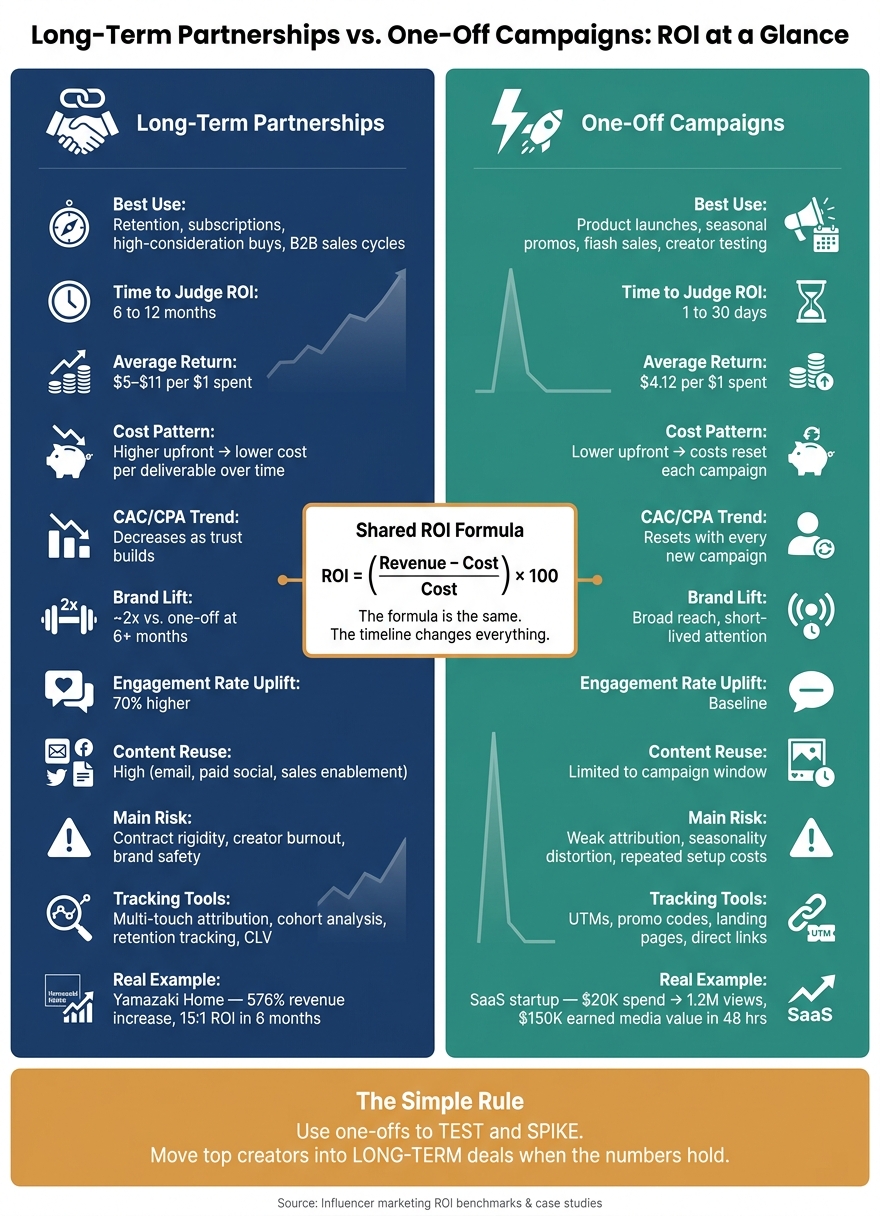
If I need fast sales, I’d lean toward a one-off campaign. If I want lower acquisition costs and more revenue over time, I’d lean toward a long-term partnership. That’s the short answer.
Here’s the core takeaway in plain English:
- One-off campaigns often look stronger in the first 30 days
- Long-term partnerships usually win over 6 to 12 months
- Long-term deals often return $5 to $11 for every $1 spent
- One-off campaigns average about $4.12 for every $1 spent
- One-offs are better for launches, promos, and testing creators
- Long-term deals are better for retention, repeat purchases, subscriptions, and longer sales cycles
- The biggest reporting mistake is using short attribution windows for work that needs months to show results
If I were deciding between the two, I’d look at four things first: timeline, CAC/CPA trend, CLV, and attribution window. A one-off can drive a sharp spike in clicks and conversions. A longer deal can cut per-post costs by 15% to 25%, lower repeat admin costs, and build more value from repeat exposure and reused content.
The simple rule: use one-offs to test and to drive short bursts, then move top creators into longer deals if the numbers hold.
Long-Term Partnerships vs. One-Off Campaigns: ROI Comparison
How Leading Brands Measure the ROI of Their Influencer Marketing Operations with Kolsquare?
sbb-itb-97f6a47
Quick Comparison
| Criteria | Long-Term Partnerships | One-Off Campaigns |
|---|---|---|
| Best use | Retention, subscriptions, high-consideration buys, B2B cycles | Launches, seasonal promos, flash sales, creator tests |
| Time to judge ROI | 6 to 12 months | 1 to 30 days |
| Average return | $5 to $11 per $1 spent | $4.12 per $1 spent |
| Cost pattern | Higher upfront, lower cost per deliverable over time | Lower upfront, but costs reset each campaign |
| Main value | Trust, repeat purchases, CLV, reused content | Reach, fast conversions, easy short-term reporting |
| Main risk | Locked-in spend, weaker fit over time, brand safety issues | Results fade fast, weak attribution, repeated setup costs |
| Best tracking | Multi-touch, cohorts, assisted conversions, retention | UTMs, promo codes, landing pages, direct links |
I’d treat this as a budget choice and a measurement choice. If I judge a 12-month play with a 30-day lens, I’ll likely undercount what it produced.
How to Measure ROI Across Both Models
The Core ROI Formula and Key Metrics
The ROI math is the same in both models. What changes is when you measure it and which supporting metrics you look at.
ROI = ((Revenue Generated − Total Campaign Cost) / Total Campaign Cost) × 100
So if a campaign costs $10,000 and brings in $50,000 in revenue, the ROI is 400%.
You’ll also want to track a set of supporting numbers: ROAS, CAC, CPA, CLV, incremental revenue, gross margin, payback period, and content reuse value. These metrics don’t all answer the same question, and that’s the point.
ROI and ROAS are a good example. ROAS looks at direct sales tied to ad spend. ROI looks at the full business return across the whole campaign life cycle.
Content reuse matters here too, and it often slips under the radar. Creator content pushed through paid social can beat brand-made ads by two to three times, and 98% of brands reuse creator content across other channels.
Short-Term ROI vs. Long-Term ROI
One-off campaigns are usually judged by short-term conversion. Long-term partnerships need a much longer view.
For one-off campaigns, look at immediate signals like:
- clicks
- conversions
- reach
- impressions
- 30-day sales
These are the numbers that make sense for campaign-level reporting.
Long-term partnerships work differently. Their value builds over time through retention, repeat purchases, brand lift, and CLV. Since these partnerships often need more than one touchpoint before someone buys, the measurement window should usually stretch across 6–12 months.
Attribution Windows and Reporting in the U.S.
This is where ROI starts to split between the two models: measurement.
For short-term reporting, use 7-day click and 28-day view windows. For long-term partnerships, a 6–12 month window is often needed to get a fair read on CLV and CAC.
Zenni Optical saw this in plain terms. After the brand moved past last-click attribution and used a multi-touch model, it found $1.5 million in hidden partnership value that old tracking had missed.
The next step is simple, but not always easy: marketing and finance need to agree on what each metric means. That includes incremental revenue, gross margin, and payback period. If those definitions aren’t shared, two teams can look at the exact same data and come away with two different stories.
That’s why the same partnership can look weak at 30 days and much stronger at 12 months.
Long-Term Partnerships vs. One-Off Campaigns: Direct ROI Comparison
Using the same ROI metrics, the winner changes based on your timeline and your goal. So this isn’t about naming one format as the winner in every case. It’s about matching the model to the time horizon that matters most.
Where Long-Term Partnerships Tend to Produce Higher ROI
Long-term partnerships tend to win because results build on themselves. If a creator talks about your brand in month one, month three, and month seven, that repeated exposure helps people connect the creator with your product. Over time, the endorsement feels more natural and more trusted.
There’s also a cost angle that matters. Creators on retainer usually charge 15%–25% lower rates per deliverable than they do for one-off deals. On top of that, brands can cut back on repeated contracting, onboarding, and legal review costs, which can eat up 30%–40% of influencer budgets in transaction-based models. That’s a big reason CAC can drop as the partnership continues instead of starting over every time.
CLV matters too. Customers who come in through steady creator advocacy are more likely to buy again because their decision wasn’t driven by one post alone. It was reinforced through repeated social proof. Yamazaki Home shows what that can look like in practice. After moving to long-term creator relationships, the brand reported a 576% revenue increase and a 15:1 ROI within six months.
Another upside is content reuse. When creators know the brand well, they usually make content that works in more than one place, including email, paid social, organic social, and sales enablement. Brands also tend to pay 2–3x less for usage rights when those rights are set up in a long-term contract from the start instead of being added later to one-off content.
Where One-Off Campaigns Tend to Produce Better Returns
One-off campaigns are often the better bet when speed matters more than depth. For product launches, limited-time offers, and seasonal sales pushes, the goal is usually immediate reach and conversion, not a long relationship. They also make sense when a brand wants to test creator fit, audience response, or a new angle before signing a longer deal.
A one-off activation can deliver a sharp, easy-to-measure spike. In June 2024, a SaaS startup paid a macro influencer with more than 1 million followers a $20,000 flat fee for one Instagram Reel and two Stories. Within 48 hours, the campaign drove 1.2 million views, 8,000 installs, a 2.5% conversion rate, and $150,000 in earned media value. That kind of result is hard to ignore.
The catch? Those gains usually fade fast. And that’s where the 12-month view starts to tell a different story.
30-Day vs. 12-Month Time Horizon
This pattern becomes a lot easier to see when you look at the same metrics over 30 days and then over 12 months.
At the 30-day mark, one-off campaigns often look stronger. The results show up fast: clicks, installs, conversions, and ROAS. Long-term partnerships can seem slower at that same checkpoint because the compounding effect hasn’t had enough time to show up yet.
By the 12-month mark, the picture usually flips. Long-term collaborations generate $5–$11 for every $1 spent, while one-off activations return about $4.12 per $1. Brands that keep creators on retainer for six months or more also see brand lift metrics at roughly 2x those of one-off campaigns, and sustained partnerships produce 70% higher engagement rates.
The table below sums up the tradeoff:
| Metric | Long-Term Partnerships | One-Off Campaigns |
|---|---|---|
| Cost trend | Higher upfront; lower CPA over time | Lower initial outlay; higher per-campaign cost |
| CAC/CPA trend | Decreases as trust and familiarity build | Resets with each new campaign |
| ROAS window | Compounding growth over 6–12 months | Immediate spike within 30 days, then drops |
| CLV contribution | High; drives repeat purchases and loyalty | Low; focused on single transactions |
| Content reuse | High; supports email, paid social, and sales enablement | Limited to the campaign window |
| Brand impact and CLV | Deep trust; roughly 2x brand lift at 6+ months | Broad reach; short-lived attention |
At 30 days, one-offs often come out ahead. At 12 months, long-term partnerships usually do.
Measurement, Risk, and Decision Criteria
Tracking Methods for Each Model
ROI splits because each model picks up value on a different timeline. One-off campaigns tend to reward fast attribution. Long-term partnerships tend to reward value that builds over time. So the tracking setup needs to fit the campaign model.
For one-off campaigns, basic tracking tools usually do the job:
- UTMs
- Promo codes
- Landing pages
- Direct links
These tools are built to catch fast conversions in a 1–30 day window. That works well for quick sales. But it can miss value that builds later.
Long-term partnerships need a deeper view. That means using multi-touch attribution, cohort analysis, assisted conversions, and retention tracking. Multi-touch attribution is a good example. It can show value that last-click models miss. Rugs Direct used a U-shaped multi-touch model that gave credit to partners at both the top and bottom of the funnel, and the company saw 600% year-over-year revenue growth.
If you judge long-term work with short-term tools, ROI will look lower than it is.
Common Risks That Distort ROI
Both models can skew ROI when teams ignore attribution, seasonality, or overhead. With one-off campaigns, last-click models often miss early touchpoints. Seasonal timing can also make results look better than what the creator actually drove.
Long-term partnerships come with a different set of problems. Rigid contracts can lock in spend even when performance drops. Frequent posting can lead to forced content and weaker engagement over time. On top of that, a creator’s public image can shift, which may create brand safety risk later.
One cost many teams leave out is coordination time. That’s a mistake. Add 40 hours of management labor at $50/hour, and the true cost of a partnership goes up by $2,000.
That changes the conversation. This isn’t just a budget call. It’s also a measurement call.
When to Choose Each Model
A simple rule set helps here.
Choose one-off campaigns for launches, flash sales, seasonal pushes, and audience tests. Dunkin’s one-off campaign with Sabrina Carpenter for the limited-edition "Strawberry Daydream Refresher" drove more than 2 million Instagram likes and immediate social buzz. That’s the kind of short-term lift a time-sensitive launch is built for.
Choose long-term partnerships for subscriptions, high-consideration purchases, B2B sales cycles, and retention goals. As Brianna Doe, Founder & CEO of Verbatim, puts it:
"B2B brands often request longer-term partnerships, usually lasting three to six months to cover their sales cycles, while B2C requests are shorter."
| Factor | One-Off Campaigns | Long-Term Partnerships |
|---|---|---|
| Tracking | Promo codes, UTMs, campaign landing pages | Cohort analysis, multi-touch attribution, assisted conversions, retention tracking, CLV |
| Main risks | Weak attribution, seasonality distortion, high contracting overhead | Contract rigidity, creator burnout, brand safety exposure |
| Flexibility | High; easy to pause, pivot, or test new creators | Lower; requires documented exit clauses and phased benchmarks |
| Budget commitment | Lower upfront; higher per-campaign overhead | Higher upfront; lower per-deliverable cost over time |
| Best fit | Product launches, seasonal sales, quick audience testing | Subscription growth, high-consideration purchases, brand loyalty, customer retention |
Run a 60- to 90-day pilot before committing to a longer contract.
Conclusion: Choosing the Right Partnership Mix for Growth
Use one-off campaigns for product launches, seasonal promos, and fast audience tests. They’re a simple way to see what clicks without making a long commitment.
Long-term partnerships tend to pay off over a 6- to 12-month stretch. They can lower acquisition costs, build audience trust, and improve customer lifetime value.
For most teams, the smart move is a hybrid approach. Start with one-off campaigns to test creators. Then move your best performers into long-term roles.
If your team wants help putting that plan into action, the Top Consulting Firms Directory can help you find firms with the right expertise.
FAQs
How long should I measure ROI before deciding?
It depends on your campaign strategy.
For one-off campaigns, ROI is usually measured across the campaign’s set run time. The goal there is short-term impact, so you’re looking at what the campaign did during that window.
For long-term partnerships, take a multi-month view. Brand lift often doubles after at least six months, and the full return builds over time through customer lifetime value, loyalty, and brand equity.
What metrics matter most beyond ROAS?
Look past return on ad spend and pay close attention to metrics that reflect long-term business value, especially customer lifetime value (CLV) and customer acquisition cost (CAC).
It also helps to watch engagement signals like likes, comments, and shares. On top of that, track brand metrics such as unaided brand recall, sentiment, and share of voice.
Taken together, these numbers give you a clearer view of relationship value, not just immediate sales.
When should I switch from one-off campaigns to long-term partnerships?
Switch when your goals move past short-term visibility, like product launches or seasonal sales, and toward lasting trust, customer loyalty, and higher customer lifetime value.
Long-term partnerships tend to make more sense for complex products, high-consideration categories like finance or health, and brands that want to lower customer acquisition costs through steadier performance and volume-based pricing. A smart way to handle it is simple: start with one-off campaigns, see which partners deliver, then grow from there with the ones that have already proved themselves.