I would fund a regional launch only when demand, margins, and delivery capacity support it. For companies with $30M-$500M in revenue, I would rank regions on a 1-5 scorecard, test pricing and coverage, and run a 3-6 month pilot before approving rollout.
My approach puts 5 decisions in front of your leadership team:
- Where to launch: Rank customer fit, revenue potential, competition, and cost-to-serve - not population alone.
- How to sell profitably: Check realized prices after discounts, freight, partner fees, and service costs. Assign sales and service owners.
- What to test: Measure demand and delivery separately, with preset margin, conversion, retention, and capacity thresholds.
- When to hire advisors: Define the unanswered decision, required work, budget, and internal owner before selecting outside help.
- When to expand: Approve each region separately, with clear conditions to proceed, revise, pause, or stop.
My rule: a strong sales forecast does not excuse weak delivery. I would bring the board a <u>region-by-region funding decision</u>, backed by pilot results, contribution margins, and named owners.
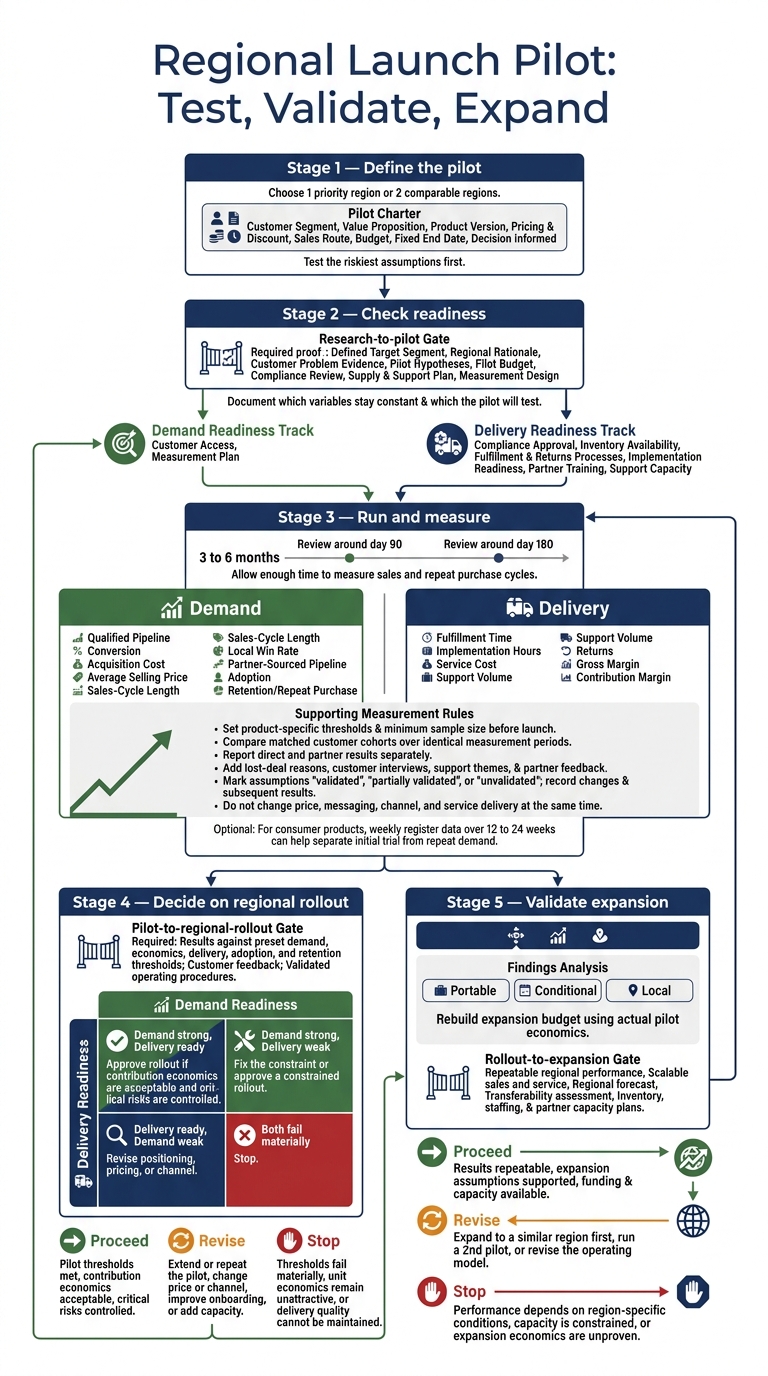
Regional Launch Pilot: Test, Validate, Expand
Geographic Segmentation Bases
sbb-itb-97f6a47
2. Plan Regional Pricing and Sales Coverage
Regional pricing and sales coverage determine launch profitability. Once regions are ranked, test whether each region’s pricing, channel costs, and service requirements support the margin target.
Choose Regional Pricing
Build a price waterfall for each priority region. Include list price, discounts, rebates, commissions, marketplace fees, freight, returns, payment costs, and variable service costs. Compare net realized price with fully loaded cost-to-serve to calculate contribution margin without double-counting costs.
Check competitor offers, willingness to pay, price sensitivity, payment preferences, and applicable taxes. Keep outcome-based pricing separate from pass-through costs, such as delivery or installation. For cross-border launches, include currency and duty impacts.
| Pricing approach | Control | Margin potential | Customer fit | Complexity | Best use case |
|---|---|---|---|---|---|
| Standardized pricing | High | Moderate when regional economics are similar | Strong for transparent, easily compared products | Low | National e-commerce, simple products, early launches, or markets with similar costs |
| Regionally adjusted pricing | Moderate to high with explicit rules | High when regional economics differ | Strong when cost-to-serve or market conditions vary by region | Moderate | Products with different delivery costs, taxes, competitive conditions, or channel structures |
| Value-based pricing | Moderate; requires disciplined segmentation and evidence | Potentially highest for measurable outcomes | Strong for differentiated or complex products | High | Products that reduce costs, increase revenue, lower risk, or require implementation |
Value-based pricing can use national or regional prices. Test 2 or 3 price points or bundles by segment before changing regional pricing. Set target prices, discount floors, and approval authority. Track conversion, win rate, average discount, realized price, returns, and contribution margin. Channel-specific bundles, service levels, or warranties can reduce direct price comparisons.[6][7][8]
Evaluate pricing and channel choice against the same regional economics.
Choose Sales and Partner Channels
Choose the channel customers will use, not the channel with the most reach. Match buying behavior, product complexity, implementation needs, local relationships, and readiness for self-service. Compare channel-level contribution after partner discounts, commissions, marketing development funds, support costs, returns, and inventory obligations.
| Channel | Control | Launch speed | Geographic reach | Margin | Implementation burden | Fit for complex products |
|---|---|---|---|---|---|---|
| Direct field sales | Highest | Slow to moderate | Limited by territory and travel capacity | High gross margin potential, but high selling cost | High | Strong |
| Inside sales | High | Moderate to fast | Broad where remote selling is accepted | Generally favorable | Moderate | Strong with standardized onboarding |
| E-commerce | High over pricing and customer experience | Fast | Broad | Can be strong at scale, but includes platform, fulfillment, and support costs | Moderate | Limited to simple implementation |
| Retail | Moderate | Moderate | Broad local presence | Lower due to retailer margin and trade spending | Moderate to high | Limited to moderate |
| Wholesalers | Low to moderate | Fast once relationships exist | Broad | Lower due to wholesale margin | Low internally; less control | Limited to standardized products |
| Distributors | Moderate | Moderate to fast | Strong in local or international markets | Lower per-unit margin, offset by reach | Moderate | Strong with technical support |
| Value-added resellers | Moderate | Moderate | Strong within specialized markets | Shared margin, with potential for higher-quality deals | High enablement burden | Strong |
| Service partners and alliances | Shared | Moderate | Depends on partner network | Shared economics, often justified by service capacity | High coordination burden | Strong |
Define territory and account boundaries, lead registration and protection periods, discounts, payment terms, training, certification, inventory requirements, and service duties. Tie rebates to sell-through and service performance, not bookings. Give direct representatives credit for supporting partner deals. Document how duplicate claims and pricing disputes will be resolved.[4][5][7]
Assign Regional Sales and Service Owners
Assign owners for regional sales and service responsibilities, with separate leads where needed. Document revenue and pipeline targets, territory boundaries, lead routing, response standards, available selling hours, partner coverage, recruitment, training, inventory, and support ownership.
Calculate workload using qualified opportunities, customer touches, sales-cycle length, and implementation hours. Account for U.S. time zones and travel distances. Resolve coverage gaps before approving hires or partner commitments.[4][7] Clear ownership connects the regional plan to daily coverage decisions.
Model conservative, base, and upside cases, then compare contribution dollars with launch spend. Set decision thresholds for margin, CAC, pipeline coverage, payback, and response time.[6][8] Use those thresholds to determine whether the region is ready for a pilot.
3. Test a Regional Pilot Before Expansion
Test the launch model in the highest-ranked region, or a close comparison set, before committing to expansion.
Set Pilot Assumptions and Readiness Checks
Choose 1 priority region or 2 comparable regions. Create a one-page pilot charter that defines the customer segment, value proposition, product version, pricing and discount assumptions, sales route, budget, fixed end date, and decision the pilot will inform.[2] Test the riskiest assumptions first. Run the pilot for 3 to 6 months, with reviews around day 90 and day 180. Allow enough time to measure sales and repeat purchase cycles.[10]
Keep demand readiness separate from delivery readiness. Confirm customer access and a measurement plan. Require evidence of compliance approval, inventory availability, fulfillment and returns processes, implementation readiness, partner training, and support capacity. Document which variables will stay constant and which the pilot will test.[2]
Measure Sales and Delivery Results
Use 2 scorecards to separate demand from delivery performance:
- Demand: qualified pipeline, conversion, acquisition cost, average selling price, sales-cycle length, local win rate, partner-sourced pipeline, adoption, and retention or repeat purchase.
- Delivery: fulfillment time, implementation hours, service cost, support volume, returns, gross margin, and contribution margin.
Set product-specific thresholds and a minimum sample size before launch. Compare matched customer cohorts over identical measurement periods, and report direct and partner results separately.[2]
Pair these metrics with lost-deal reasons, customer interviews, support themes, and partner feedback. Mark each assumption as validated, partially validated, or unvalidated, and record changes and subsequent results. Do not change price, messaging, channel, and service delivery at the same time - you will not know which change drove the result. For consumer products, weekly register data over 12 to 24 weeks can help separate initial trial from repeat demand.[9]
Use the scorecards to make the stage-gate decision below.
Set Expansion Approval Gates
Translate the pilot scorecards into a proceed, revise, or stop decision.[2]
| Gate | Required proof | Accountable owners | Proceed | Revise | Stop |
|---|---|---|---|---|---|
| Research-to-pilot | Defined target segment, regional rationale, evidence of the customer problem, and pilot hypotheses; pilot budget, compliance review, supply and support plan, and measurement design | Product or general manager; marketing; finance; legal/compliance; operations | Research supports the region, risks are understood, funding is secured, and readiness checks pass | Narrow the segment, redesign the offer, secure a partner, or resolve delivery gaps | No supported evidence of demand, unresolved compliance risk, inadequate capacity, or an untestable measurement plan |
| Pilot-to-regional-rollout | Results against preset demand, economics, delivery, adoption, and retention thresholds; customer feedback; validated operating procedures | General manager; sales; product; finance; operations; customer success | Pilot thresholds are met, contribution economics are acceptable, and critical risks are controlled | Extend or repeat the pilot, change price or channel, improve onboarding, or add capacity | Thresholds fail materially, unit economics remain unattractive, or delivery quality cannot be maintained |
| Rollout-to-expansion | Repeatable regional performance, scalable sales and service, regional forecast, transferability assessment, and inventory, staffing, and partner capacity plans | Executive sponsor; finance; operations; commercial leadership; regional owners | Results are repeatable, expansion assumptions are supported, and funding and capacity are available | Expand to a similar region first, run a 2nd pilot, or revise the operating model | Performance depends on region-specific conditions, capacity is constrained, or expansion economics are unproven |
Label findings portable, conditional, or local, then rebuild the expansion budget using actual pilot economics. If demand and delivery meet thresholds, approve rollout. If demand is strong but capacity is weak, fix the constraint or approve a constrained rollout. If delivery is ready but demand is weak, revise positioning, pricing, or channel. If both fail materially, stop.[2]
4. Define Advisory Needs Before Hiring
Define the launch decision before hiring outside help. If the pilot leaves questions about demand, pricing, or coverage, document them in a launch-scope brief.
Write the Launch-Scope Brief
State the launch decision external support must resolve. Cover product scope, target segments, candidate regions, launch order, sales and partner coverage, pricing questions, and regulatory or localization constraints. Specify the required evidence, budget, deadline, data age, geographic limits, and exclusions.
Name the decision owner, sponsor, and approval authority. Assign internal implementation duties and document available staff hours by function. For each deliverable, set the format, due date, and acceptance test.
Define measurable success criteria, such as contribution margin or partner-sourced revenue. Each measure needs a baseline, target, data source, and review date. Use the brief to distinguish work the team cannot perform from questions it cannot yet answer.
Match Advisor Support to Decision Gaps
Separate capacity gaps from decision gaps.
Missing an analyst is a staffing gap; not knowing which region has viable demand is a decision gap.
Record the decision, evidence needed, evidence available, internal owner, and support required. Commission work that closes a material gap rather than a broad strategy engagement.
| Advisor support type | Purpose | Deliverables | Internal effort | Best used at |
|---|---|---|---|---|
| Internal assessment | Establish what the company knows and can execute | Data audit, capability map, ownership matrix | Product, sales, finance, operations, and customer service assess the baseline | Before sourcing advisors |
| Specialist research | Resolve demand, customer, or regulatory uncertainty | Regional market assessment, customer research, regulatory findings | Provide access and validate assumptions | Region and segment selection |
| Launch planning | Turn evidence into operating choices | Segmentation model, pricing analysis, coverage design, partner evaluation, pilot recommendation | Approve trade-offs and resource limits | Launch approval |
| Implementation support | Fill execution capacity gaps | Launch roadmap, CRM setup, partner onboarding, reporting tools, approval gates | Company owners remain actively involved | Execution and expansion |
Require editable working tools, not just slides. Pricing analysis should show price and discount boundaries in U.S. dollars, margin assumptions, and sensitivity cases. Partner evaluations should document reach, capabilities, economics, and conflicts.
Keep final pricing, staffing, partner, and investment decisions internal. Require handover training so employees can update the tools without continued advisor dependence. Once the gap is defined, shortlist only firms that can close it.
Shortlist Advisors for the Launch Scope
Top Consulting Firms Directory can help PE sponsors, portfolio companies, and mid-market operators shortlist firms against the launch brief. Use PE consultants, operating partners, or due diligence firms only for the gaps they can close. Use integration advisors only when the launch depends on a deal or integration.
Give candidates the same brief. Compare regional and industry experience, methods, named staff, deliverables, fees in U.S. dollars, and implementation expectations for segmentation, pricing, coverage, or pilot support.
Request comparable references and redacted work samples. Specify expense limits, change-order rules, and access to source files.
5. Conclusion: Approve the Regional Launch Plan
Approve each region separately using the pilot readout and regional scorecard. Move markets from test to approval only when they meet demand, pricing, coverage, partner, and delivery criteria. Keep secondary and expansion markets in later phases until the evidence supports entry.
Score each criterion 0 to 3: 0 = unknown, 1 = material gap, 2 = conditionally ready, and 3 = threshold met. Record the evidence and owner for each score.[12] Use the score as the final approval gate, not a summary metric.
Final approval checklist: Confirm that prices cover discounts, fulfillment, partner commissions, and service costs. Verify that unit economics meet thresholds, the budget funds launch and operations, and regional owners, sales coverage, and support capacity are in place.
The pilot readout must separate measured results from forecasts and report performance by region, segment, and channel.[11] Define expansion gates with thresholds, evidence sources, owners, and review dates. Cover margin, conversion, retention, capacity, and service standards, including explicit pause and stop conditions.[14] Only regions that clear these gates move to rollout.
Grant conditional approval only when each gap has a defined recovery plan and owner. Defer launch if critical evidence or delivery readiness is missing. Tie advisory support for unresolved launch decisions to a defined gap, scope, budget, and deliverable. Record who has authority to approve launch, pause it, or order rollback, and set the post-launch review date.[13]
FAQs
How do I rank regions with limited market data?
Rank regions using quantitative analysis and local input. Map regional clusters shaped by shared customs and migration patterns. Use social listening to assess community sentiment, then analyze consumer behavior to understand purchasing habits and preferred communication channels.
Consult local experts on competition, regulations, and local customs that may affect market entry. Test commercial potential through pilot programs or small-scale launches before committing major resources.
How can I prevent regional pricing conflicts?
Set launch pricing to fit each local market. Before rollout, assess regional purchasing power and competitor prices. Localize packaging and branding, and keep prices and availability consistent across stores and online channels.
Maintain a central hub for current pricing and promotion details. Use feedback from stores and customers to flag complaints early, then adjust pricing or inventory promptly.
When should I hire a launch advisor?
Hire a launch advisor before finalizing the plan when regional segmentation involves different regulations, local customs, sales coverage needs, partner routes, or unfamiliar markets. Bringing in expertise early helps validate region selection, pricing fit, and go-to-market channels, reducing costly errors caused by assumptions that don't hold across markets.
If internal teams are stretched, use a short-term engagement, such as a 90-day roadmap or focused analysis, to assess and refine the scope before committing to a full rollout [1][2][3].