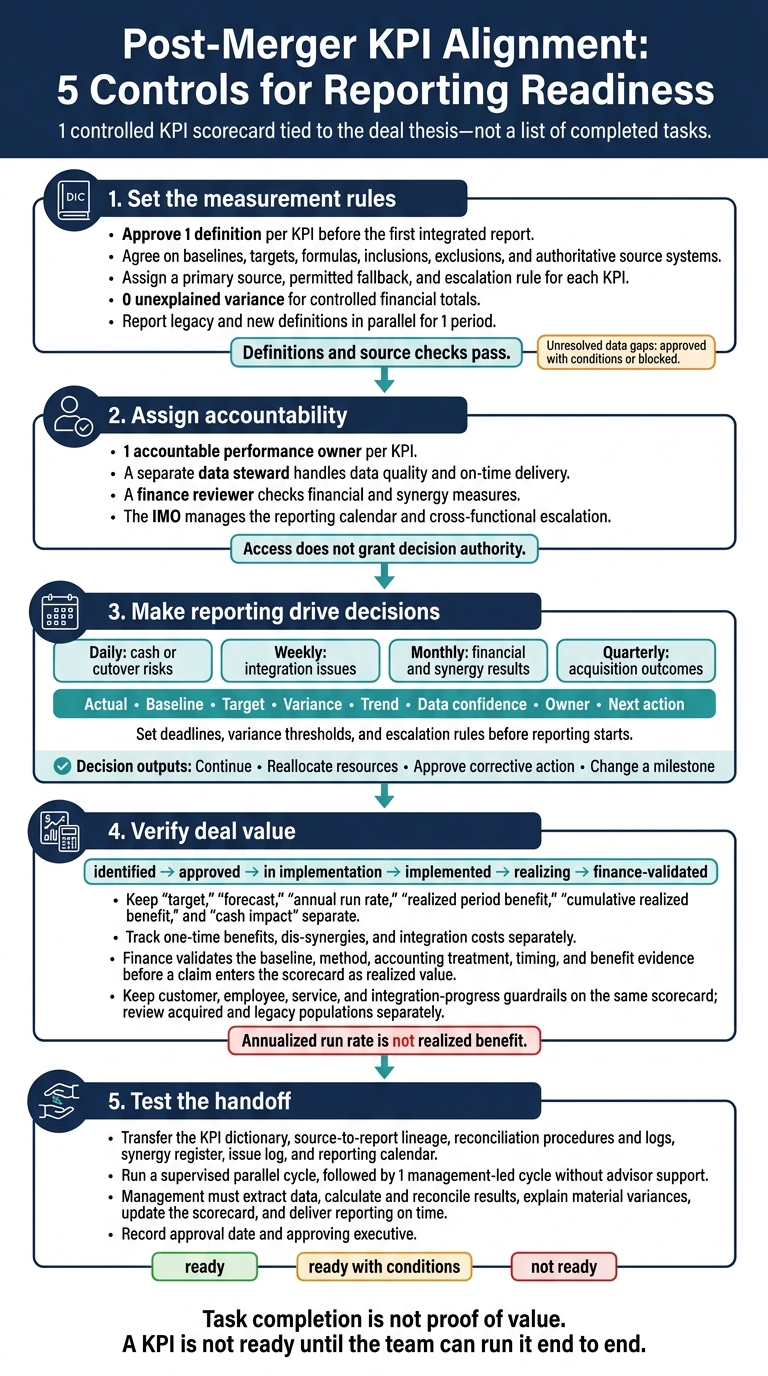
I start with 1 controlled KPI scorecard tied to the deal thesis - not a list of completed tasks. Before the first combined report, I lock definitions, verify source data, and assign owners so you can judge EBITDA, cash, and business health on the same basis.
My checklist covers 5 controls:
- Set the measurement rules: Agree on baselines, targets, formulas, and source systems. Require 0 unexplained variance in controlled financial totals.
- Assign accountability: Name 1 performance owner per KPI, a separate data steward, and a finance reviewer for financial results.
- Make reporting drive decisions: Set deadlines, variance thresholds, and escalation rules before reporting starts.
- Verify deal value: Keep forecasts, annual run rates, and realized savings separate. Track integration costs alongside customer, employee, and service measures.
- Test the handoff: Require management to complete 1 reporting cycle without advisor support.
<u>Task completion is not proof of value.</u> I count results only after finance checks them, and I treat reporting as ready only when management can trace the numbers and act on them.
Post-Merger KPI Alignment: 5 Controls for Reporting Readiness
Standardize KPI Definitions and Data Sources
Approve a Shared KPI Dictionary
Approve 1 definition per KPI in the KPI charter before the first integrated report. Resolve differences between buyer and acquired-company definitions before combining reports into a scorecard. Document inclusions, exclusions, and source hierarchy. Require Finance, the functional owner, and the integration management office to approve changes. Treat definition gaps and data gaps separately - they need different fixes.
| KPI | Buyer definition | Acquired-company definition | Agreed definition | Authoritative source | Data steward | Reconciliation method |
|---|---|---|---|---|---|---|
| Revenue | GAAP revenue recognized in the period; excludes sales tax and intercompany revenue | Invoiced revenue; includes certain pass-through charges | Consolidated GAAP revenue, with pass-through items separately identified | Consolidated general ledger and revenue subledger | Corporate Controller | Reconcile subledger to the general ledger and eliminate intercompany revenue |
| EBITDA | Adjusted EBITDA excluding restructuring and acquisition costs | Operating income plus depreciation and amortization | Reported EBITDA plus separately disclosed, approved adjustments | Consolidated general ledger and adjustment schedule | Corporate Finance | Reconcile operating income, depreciation and amortization, and each adjustment to supporting entries |
| Gross margin | (Revenue − GAAP COGS) ÷ revenue | (Revenue − product and delivery costs) ÷ revenue | (Revenue − consistently classified COGS) ÷ revenue | General ledger, product-cost ledger, and revenue subledger | FP&A | Reclassify cost centers and reconcile to the income statement |
| Churn | Lost recurring revenue ÷ beginning recurring revenue | Lost customer logos ÷ beginning customer logos | Report revenue churn and logo churn separately; define contraction and reactivation rules | Billing system and CRM | Revenue Operations | Match cancellations and contractions to billing records and customer IDs |
| Employee turnover | Voluntary and involuntary exits ÷ average headcount | All exits ÷ ending headcount | Voluntary and involuntary turnover reported separately using average active headcount | HRIS and payroll | HR Operations | Match termination records to payroll and the approved employee roster |
| Savings | Run-rate savings estimated by workstream | One-time spend reductions reported as savings | Validated recurring run-rate savings, net of implementation costs and leakage | Procurement, AP, payroll, and general ledger | Synergy Finance Lead | Compare baseline spend with normalized actual spend and retain approval evidence |
Use this table as the proposed standard set, with the same effective date for all approved KPIs. Proposed effective date: January 1, 2027.
Report legacy and new definitions in parallel for 1 period and quantify differences caused by the definition changes. Restate history only where definitions allow. Otherwise, mark the trend break and avoid comparing unlike figures.
Validate Data and Reconcile Results
Assign a primary source, permitted fallback, and escalation rule for each KPI. For recognized revenue, use the general ledger as the primary source - CRM pipeline data is not a substitute.
Build field-level crosswalks across legacy ERP, CRM, HRIS, billing, procurement, payroll, and data warehouse systems. Cover customer, employee, vendor, product, legal entity, cost center, account, contract, and transaction IDs. Record code translations, hierarchy changes, currency handling, time zones, duplicate-resolution rules, cutoff dates, late postings, and unmapped fields.
Test completeness, accuracy, validity, consistency, uniqueness, and timeliness. Compare source and report record counts and totals, then bridge every transformation and adjustment to the published result. Retain extracts, mappings, transformation logic, adjustment logs, workpapers, approvals, and published outputs.
Set acceptance thresholds, such as 0 unexplained variance for controlled financial totals. Log each unresolved gap with a remediation owner and due date. Mark affected KPIs approved with conditions or blocked. Never hide a material gap in a combined number.
Once definitions and source checks pass, assign owners and reporting deadlines.
sbb-itb-97f6a47
Corporate Finance Explained | Post-Merger Integration: Why Most M&A Deals Fail
Assign KPI Owners and Reporting Schedules
Assign KPI owners and reporting deadlines once definitions and data sources are locked.
Define Ownership and Review Duties
Give every KPI 1 accountable performance owner and a separate data steward. The owner is responsible for results and corrective action. The steward handles data quality and on-time delivery. Assign a finance reviewer to financial and synergy measures. The IMO manages the reporting calendar and escalates cross-functional issues.
Use this RACI-style matrix for each KPI: R performs the work, A answers for the activity, C provides input, and I receives the outcome. Accountability for an activity does not replace the KPI’s single performance owner.
| Activity | Responsible | Accountable | Consulted | Informed |
|---|---|---|---|---|
| Extract and prepare source data | Data steward | KPI owner | IT or data-platform lead | IMO analyst |
| Validate calculation and reconcile financial results | Finance analyst or controller | Finance reviewer | KPI owner, data steward | IMO |
| Approve KPI results and commentary | KPI owner | Executive function leader | Finance, IMO | Steering committee |
| Review cross-functional variance | IMO analyst | IMO lead | Affected workstream owners | Executive sponsor |
| Approve corrective action | Functional workstream lead | Executive sponsor or delegated decision-maker | Finance, legal, HR, IT, as relevant | KPI owner and IMO |
Test source-system access and backup coverage before the first reporting cycle. Document who can approve spending, change targets, defer milestones, or accept exceptions. Access does not grant decision authority. Record approval limits and the escalation path for decisions above those limits.
Set Reporting Deadlines and Escalation Rules
Match reporting frequency to risk: daily for cash or cutover risks, weekly for integration issues, monthly for financial and synergy results, and quarterly for acquisition outcomes.
Set weekly submission for noon Monday, validation for Tuesday, and review for Wednesday. For monthly reporting, freeze data at 5:00 p.m. Eastern Time on business day 2, prepare results by day 3, validate on days 4 and 5, submit commentary by day 6, and hold executive review on day 7. Align deadlines with the close calendar. Name the decision recipients and the approver for late changes.
Every scorecard line needs actual, baseline, target, variance, trend, data confidence, owner, and next action. For material variances, commentary must explain the cause, business impact, recovery date, resources, and requested decision. Review exceptions rather than unchanged metrics. Then decide whether to continue, reallocate resources, approve corrective action, or change a milestone.
Set thresholds before reporting begins:
- Green: Within 5% of target.
- Amber: A 5% to 10% unfavorable variance or a decline across 2 periods.
- Red: Above 10% unfavorable variance or a 7-day delay to a critical milestone. Payroll failure or a customer-impacting outage triggers escalation regardless of percentage.
Require amber recovery plans within 2 business days. Send unresolved blockers to the IMO for a decision within 1 business day. Escalate red risks immediately, with an executive response within 4 business hours when harm to operations is possible.
Log the trigger, recipient, response deadline, options, decision, action owner, and follow-up date. Preserve original results. For KPI changes, record approvals, rationale, and effective dates. Apply these owners and deadlines to synergy, integration cost, and operational progress reporting in the next scorecard.
Track Synergies and Business Performance
Once KPI ownership and review cadence are set, separate claimed synergies from finance-validated results.
Verify Synergy Results and Integration Costs
Task completion does not prove financial value. Maintain 1 synergy register with each initiative’s owner, baseline, target, timing, confidence, milestones, evidence, and integration costs. Track its status through identified → approved → in implementation → implemented → realizing → finance-validated. Before a claim enters the scorecard as realized value, the assigned finance reviewer must validate the baseline, method, accounting treatment, timing, and benefit evidence.[3][4][6][10][11]
Keep target, forecast, annual run rate, realized period benefit, cumulative realized benefit, and cash impact separate. Track one-time benefits, dis-synergies, and integration costs separately as well. Annualized run rate is not realized benefit.[7][12]
| Initiative | Planned value | Realized value for period | Benefit type | Integration costs | Realization date | Variance to plan | Validation status |
|---|---|---|---|---|---|---|---|
| Supplier consolidation | Annual run-rate target and phased plan | Invoice-supported period savings | Recurring cost savings | Contract-transition costs | First period with verified savings | Actual versus phased plan | Finance validated |
| Duplicate software removal | Annual run-rate target and phased plan | Verified reduction in license expense | Recurring cost savings | Termination and migration costs | First period with reduced expense | Actual versus phased plan | Implemented, not validated |
| Facility exit | Approved one-time benefit target | Supported one-time benefit | One-time benefit | Exit and relocation costs | Date benefit is recognized | Actual versus one-time target | Finance validated |
Finance should verify the evidence supporting each initiative’s savings, revenue gains, and associated costs. Assign each benefit to 1 initiative and remove overlapping claims. Measure results against the standalone baseline, excluding unrelated market growth, pricing changes, and standalone restructuring. Report validated gross benefits and integration costs before net value, with consistent periods and accounting treatment.[3][6][10][12]
Monitor Customers, Employees, and Integration Progress
Keep nonfinancial guardrails on the same scorecard as financial results, rather than in a separate report. These metrics test whether synergies are hurting the business, but remain distinct from financial results. Monitor service levels, on-time fulfillment, customer and revenue retention, critical-employee attrition, staffing gaps, system adoption, milestone completion, and issue resolution time. Review acquired and legacy populations separately so combined averages do not hide deterioration.[5][9]
Pair synergy targets with business-health guardrails. Set retention, fulfillment, staffing, and service thresholds against the pre-close baseline, not an industry average. For each breach, record the corrective-action owner, deadline, required action, and closure evidence. Challenge savings that coincide with customer losses, critical vacancies, or unresolved service incidents. Those savings may reflect revenue leakage or deferred operating risk rather than lasting value.[5][8][9]
Conclusion: Confirm Handoffs and Reporting Readiness
Set Advisor Scope and Management Handoffs
Once KPI reporting is stable, end advisor mandates and transfer the process to management. Management owns the KPI after handoff. Give each advisor a written mandate that defines scope, deliverables, milestones, decision rights, checkpoints, and exit criteria. Transfer the KPI dictionary, source-to-report lineage, reconciliation procedures and logs, synergy register, issue log, and reporting calendar.[13]
Document approved storage, retention, confidentiality, data transfer, and permission removal. Require owner approval of the transfer and remove advisor access promptly when the mandate ends. The company must own the files, credentials, workflows, and documentation.
After transferring access and documentation, test whether the team can run reporting without help. Require the operating team to rebuild the report from raw or system-generated data. Dashboard access alone does not complete the handoff. Management must be able to trace variances and fix a broken feed.
Complete the Reporting Readiness Checklist
Confirm that each KPI has a current source, owner, target, deadline, and escalation path. A KPI is not ready until the team can run it end to end.
Keep the existing synergy register current, with one-time integration costs separate from synergy benefits.
Run a supervised parallel cycle, followed by 1 management-led cycle without advisor support. Management must extract data, calculate and reconcile results, explain material variances, update the scorecard, and deliver reporting on time.[2][13]
Record the reporting-readiness result as ready, ready with conditions, or not ready, along with the approval date and approving executive. Log unresolved issues and blockers, affected KPIs, impact, severity, interim controls, owners, corrective actions, deadlines, closure evidence, and residual-risk acceptance.
FAQs
Which KPIs should we prioritize after an acquisition?
Use 2 KPI layers: portfolio oversight measures - revenue, gross margin, EBITDA, and cash - and operating measures tied to your value-creation plan, such as recurring-revenue conversion, utilization, churn, or backlog.
Keep the total to 3-5 metrics across both layers. Before any KPI goes on the dashboard, it must meet SMART criteria (Specific, Measurable, Achievable, Relevant, and Time-bound) and have an approved definition, a named owner, a designated source system, and a documented update cadence.
How do we set targets when historical data is unreliable?
Fix data quality before setting targets. Map the process from collection through reporting to find bottlenecks and manual errors. If historical data is missing, begin tracking to establish a baseline or use industry standards to set realistic starting points.
Define minimum acceptable performance, target performance, and stretch goals. Pilot new metrics to verify that data collection is reliable before rolling them out across the organization.
How can we isolate merger synergies from market-driven gains?
Standardize KPI definitions in a metric dictionary that documents formulas, inclusion and exclusion rules, source fields, and update frequency. Enforce governance at data entry so every team measures performance the same way [1].
Compare actuals against prior periods, budget/forecast, and the original investment case. Require brief commentary on material variances to separate operating drivers from market effects. Track leading indicators for process changes alongside lagging indicators for outcomes that have already occurred [1].