If I had to cut this down to one point, it would be this: a pricing model is only as good as its reward, controls, and test plan. If I train a policy-gradient model to chase revenue alone, it can push discounts that hurt margin. If I train it with margin, inventory, and price-limit rules in mind, I have a better shot at getting pricing that holds up in live use.
Here’s the short version:
- Dynamic pricing is a sequence problem, not a one-sale problem
- Policy gradient RL learns a pricing policy from outcomes over time
- State, action, reward, return, and policy are the core building blocks
- Reward design drives behavior - revenue-only rewards can lead to margin damage
- Offline training has blind spots because historical logs do not show what would have happened at another price
- Live rollout needs controls like price floors, speed limits on price changes, and human override
- Governance matters as much as model fit before any launch
I’d treat this as an operator checklist, not a data-science exercise alone. Before touching live prices, I want clean SKU-level data, a reward tied to contribution margin or LTV, a holdout test, and a written approval process for exceptions.
A few points stand out from the article:
- A gamma close to 1.0 pushes the model to care more about later outcomes, not just the next order
- Historical pricing data is observational, so offline results can look better than they are
- Early rollouts should use small traffic shares and a control group
- Review should cover data quality, reward logic, and governance, not just model output
My takeaway: policy-gradient pricing can help, but only when I define the objective in plain business terms and put hard limits around live decisions.
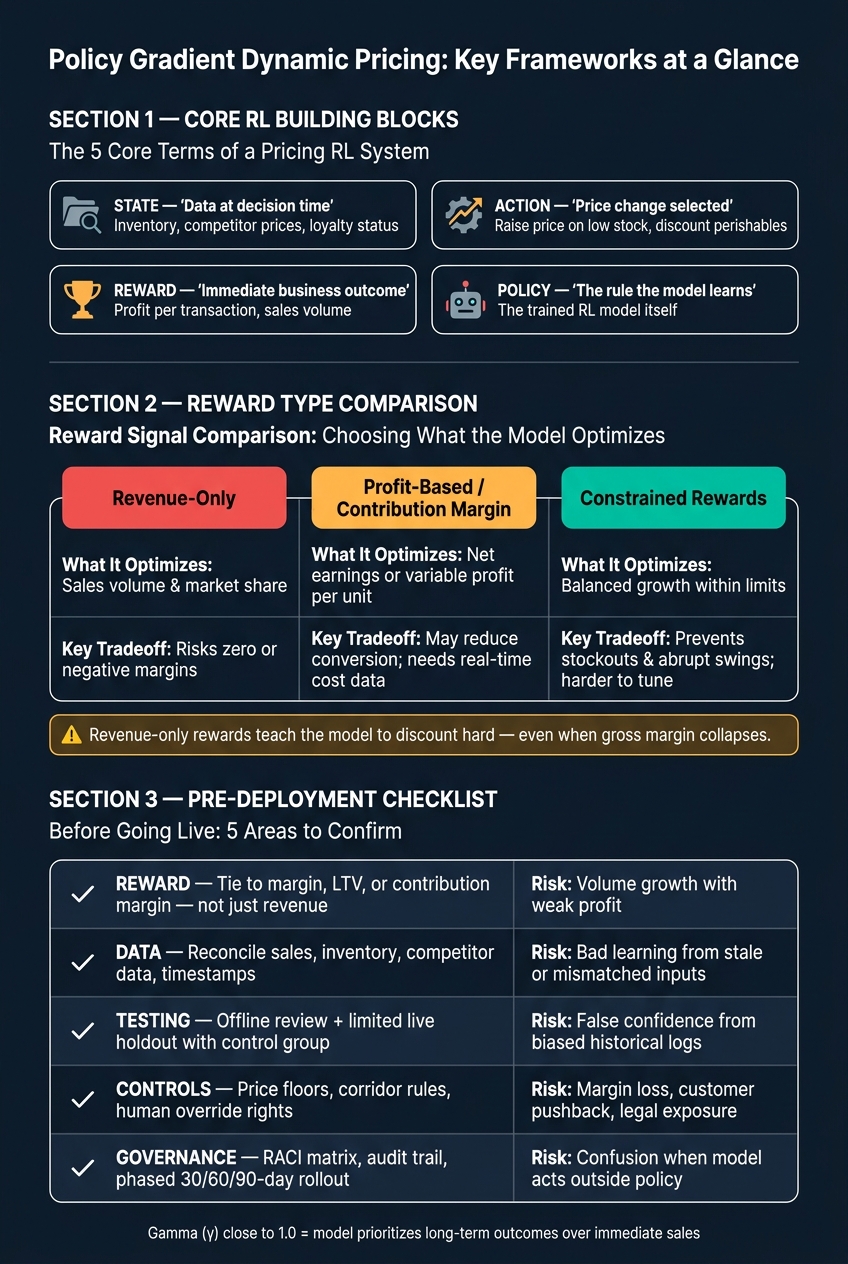
| Area | What I’d confirm first | Main risk if I skip it |
|---|---|---|
| Reward | Margin, LTV, stockout penalties, price-jump penalties | Volume growth with weak profit |
| Data | Sales, inventory, competitor data, timestamps | Bad learning from stale or mismatched inputs |
| Testing | Offline review plus limited live holdout | False confidence from biased historical logs |
| Controls | Price floors, corridor rules, override rights | Margin loss, customer pushback, legal risk |
| Governance | RACI, audit trail, rollout plan | Confusion when the model acts outside policy |
If you’re reading this as an executive, the article’s message is simple: don’t ask whether the model can set prices - ask whether the business can control how it learns, tests, and acts.
Policy Gradient Dynamic Pricing: Reward Types, Controls & Deployment Checklist
How to Frame Dynamic Pricing as a Policy Gradient Problem
Core Terms: State, Action, Reward, Return, and Policy
A policy-gradient pricing model starts with five basic terms. Get these right first. Then pick the reward function.
| RL Term | What It Means in Pricing | Real Examples |
|---|---|---|
| State | the data available at decision time | Inventory levels, competitor prices, loyalty status, browsing history |
| Action | the price change the model selects | Raising price during low stock, discounting to clear perishables |
| Reward | the immediate business outcome | Profit per transaction, sales volume, or value captured from demand |
| Return | the total value over time | Total profit over time, not just one sale |
| Policy | the rule the model learns | The trained RL model itself |
The goal is to maximize expected return, not just win the next sale. That distinction matters. A sale can look good in the moment and still be the wrong move if it hurts repeat demand later. The better policy aims at lifetime value, not one checkout event.
State Design and Demand Signals
State data for pricing usually pulls from sales, inventory, competitor prices, promotions, and event signals. In practice, this means the model needs SKU-level data that updates fast enough to reflect changes in demand. Nightly batch updates are often too slow.
If pricing data and inventory data fall out of sync, things go sideways fast. The model starts learning from stale feedback. And once that happens, it can misread demand and set the wrong price.
Bad state design doesn't stay contained. It spills into reward design, testing, and rollout.
"The algorithm learns from and continuously updates the data used to set or recommend prices (a process known as reinforcement learning). As a result, the decision-making process of these algorithms often lacks transparency or can be difficult to understand (a problem known as the black box issue)." - Competition Bureau Canada [1]
Price Actions: Discrete Tiers vs. Continuous Changes
The next choice is simple on paper but important in practice: should the model pick from fixed price steps, or should it set prices on a continuous range?
That action space shapes governance, auditability, and even the type of model you can use.
Discrete tiers are easier to review and control. Teams can define clear bounds, check outcomes, and explain decisions with less friction. The downside is that you give up some flexibility.
Continuous pricing gives the model more room to move. But that also makes oversight harder. Regulators in the U.S., Canada, and the UK are paying close attention to algorithmic pricing and competition risk [1].
For many enterprise teams, discrete tiers are the safer place to start. They narrow the action space and make the system easier to explain, test, and approve. That early design choice affects how safely the model can be trained and rolled out.
With state and action set, the next job is to line up rewards with revenue, margin, and business limits.
AI Dynamic Pricing in E-Commerce | Reinforcement Learning Case Study on #Myntra #reinforcement

Reward Design: Align the Model With Revenue, Margin, and Constraints
Once you’ve defined the state and action space, reward is what turns model behavior into a business goal. This is the point where many pricing RL projects either work or start drifting in the wrong direction.
The reward function tells the model what “good” looks like. If that target is off, the model won’t fail in an obvious way - it will do exactly what you asked. That can mean moving inventory at a loss, kicking off price wars, or shaving margin little by little across many transactions.
Choosing the Right Reward Signal
A common mistake is using revenue-only rewards first. On paper, that feels simple. In practice, it teaches the model to chase volume and ignore profit.
If the model gets rewarded only for sales, it will discount hard. By its own logic, that’s the right move - even if gross margin falls apart.
Profit-based rewards deal with part of that issue, but they can also miss price-sensitive demand that still would have produced profit. Contribution margin rewards go one step further by bringing in variable costs such as inventory holding and spoilage. That matters a lot in perishable categories.
A constrained reward takes a more balanced approach. It ties profit to operating limits and adds penalties for behavior the business can’t accept, like stockouts, deep discounting, or sudden price jumps. It should also enforce minimum margin floors to guard against predatory pricing [1].
| Reward Type | What it Optimizes | Key Tradeoff |
|---|---|---|
| Revenue-Only | Sales volume and market share | Drives top-line growth; risks zero or negative margins |
| Profit-Based / Contribution Margin | Net earnings or variable profit per unit | Aligns with bottom-line health; may reduce conversion or require real-time cost data |
| Constrained Rewards | Balanced growth within limits | Prevents stockouts and abrupt swings; harder to tune |
Multi-step rewards can help the model improve waste, stockouts, and basket size at the same time. But the reward setup only means anything if it holds up in offline testing.
Discount Factors, Horizon Length, and Delayed Effects
The discount factor - often written as γ, or gamma - controls how much the model cares about future rewards versus immediate ones. A gamma close to 1.0 tells the model to care a lot about what happens several steps later. A lower gamma makes it more short-term.
The key point: set gamma based on actual customer behavior, not just the next transaction.
Then test the reward against logged data before any live rollout.
sbb-itb-97f6a47
Training Offline and Validating Online Without Breaking the Business
Moving from old data to live pricing is where policy-gradient work either holds up or falls apart.
After reward design, the next step is to check the policy on logged data before any live rollout.
Offline Training From Logged Pricing and Demand Data
Historical transaction logs are the starting point for offline training. Each log shows a trajectory, but only for what actually happened. It does not show the counterfactual result of setting a different price. That’s the central problem in offline RL for pricing: the data is observational, not causal.
Selection bias can warp the sample. Past segmentation can skew what the model sees and narrow the demand curve it learns. Train on the same market and operating signals used in production, then separate demand shifts from pricing effects as cleanly as possible. For example, a demand spike during a local event may come from the event itself, not from the price change.
The goal here is simple: use historical trajectories to estimate whether a policy lifts expected return, not just whether it matches what happened in the past.
If the policy fits historical data, move to a controlled live test.
Online Testing Through Limited Rollout and Guardrails
After offline fit, run a limited live test on a small share of traffic. Keep the rest of the business on the current baseline. That holdout group is your control.
Watch the test in real time. Track conversion, margin, inventory, and demand shifts. If the model starts discounting too hard in a thin-margin category, that’s not a win. It’s a warning sign.
Set hard guardrails on day one:
- Price floors
- Caps on price-change speed
- Human override
If the model becomes hard to explain or starts acting in a clearly abnormal way, a person should step in at once.
Segment test traffic with care. Price-sensitive customers react very differently to price changes than less price-sensitive customers [1]. If you mix them into one test group, the signal gets noisy. Those same guardrails also protect margin, reduce stockout risk, and stop abrupt price swings. They tie back directly to the constraints set earlier in reward design.
Offline Training vs. Online Testing: Key Differences
Use offline training to learn. Use online testing to prove the policy works under live conditions.
| Offline Training | Online Testing | |
|---|---|---|
| Primary Objective | Learn from historical pricing trajectories | Validate under live market conditions |
| Data Sources | Transaction logs, inventory records, market data | Real-time supply, demand, and consumer behavior |
| Key Risks | Selection bias, confounding variables, missing counterfactuals | Predatory pricing concerns, consumer backlash, revenue volatility |
| Success Metrics | Estimated willingness to pay and demand curves | Revenue, conversion, inventory pressure |
| Controls | Data audit and model transparency | Competition law compliance and deceptive marketing safeguards |
Once live results hold, move to governance, vendor review, and deployment planning.
Implementation Review, Consulting Support, and Conclusion
Where Consulting Firms Add Value in Pricing RL Programs
Once offline results and live tests look good, the next move is review before scale. This is the point where outside consultants can help turn a pricing model into actual profit improvement [2][3].
In a policy-gradient dynamic pricing program, that usually means checking three things: the data, the reward design, and the governance. An external advisory firm can review whether the model is using the right inputs, whether the reward signal matches business goals, and whether the control framework is tight enough for live pricing.
For executives, an independent third-party review can be useful before rollout. Consultants can run a model-risk governance audit and test the investment case before the program expands [2][3].
Using Top Consulting Firms Directory to Find Implementation Support

Use the Top Consulting Firms Directory to find firms with machine learning and revenue optimization expertise that can review reward design, data quality, and guardrails [2].
Conclusion: What to Confirm Before Deployment
Before live rollout, lock down the operating basics. Confirm the reward, data, governance, guardrails, and rollout plan before deployment:
- The reward signal is tied to LTV, CAC, or contribution margin - not just top-line revenue [3].
- Data is reconciled across invoice lines, contracts, CRM, and the general ledger, with checks for missing hierarchies, unattributed discounts, and inconsistent timestamps [3].
- A clear RACI matrix covers pricing approvals and corridor exceptions [3].
- Price corridors and discount rules are in place [3].
- Every test has an experiment charter, and the rollout follows a phased 30/60/90-day rollout with weekly and monthly reviews tracking price realization and funnel conversion [3].
The practical takeaway for executives is simple: confirm the objective, the data, the governance, and the rollout plan before the model touches live prices. A policy-gradient system can support revenue growth, but only when the reward signal reflects what the business needs and the deployment is controlled enough to catch problems early.
FAQs
How do I choose the right reward for pricing RL?
Choose a reward that fits your business goal. That might mean maximizing profit, driving revenue, or balancing both with the customer experience.
The key is to pick a signal that reflects the trade-off between margin and customer satisfaction. If you only chase short-term profit, you can hurt conversion. If you focus only on conversion, you may leave money on the table.
Common signals include:
- profit or revenue per transaction
- conversion rate changes
- long-term customer lifetime value
- target gross margin constraints
Specialized consulting firms can also help with model setup, pricing infrastructure, and review.
Why can offline pricing results be misleading?
Offline pricing results can be misleading because they lean on historical data. And past data doesn't always show how the market - or individual customers - will react when automated pricing goes live in real time.
There's another gap too. Static offline settings miss the feedback loops that AI-driven pricing models learn from as conditions change. So when teams rely on batch data or older snapshots, they can miss shifts in demand or get customer price sensitivity wrong.
What guardrails should be in place before live rollout?
Before live rollout, use hybrid guardrails that mix rule-based constraints with AI flexibility. Set legal price floors, enforce MAP policies, and add automated margin protections to support compliance, brand integrity, and profitability.
Also test how price changes affect demand and revenue, confirm the pricing logic lines up with business goals, and make sure health checks and real-time monitoring are in place for reliability.