Market intelligence is about gathering and analyzing market data to make informed business decisions. This article highlights how companies like Netflix, Amazon, and Coca-Cola use data to refine strategies, improve customer retention, and identify new opportunities. Key takeaways include:
- Netflix leverages user data to personalize content, driving 90%+ customer retention and saving $1 billion annually.
- Amazon identifies market gaps, growing businesses like AWS into $80 billion revenue streams.
- Coca-Cola transforms drink-mixing data into retail products, boosting revenue and reducing waste.
These examples show how data-driven strategies improve growth, efficiency, and decision-making across industries. Whether you're in biotech, fintech, or retail, actionable insights from market intelligence can guide better outcomes.
Beyond Sales & Strategy: How to Leverage Competitive Intelligence Across Your Entire Business
sbb-itb-97f6a47
Lessons from Leading Company Case Studies
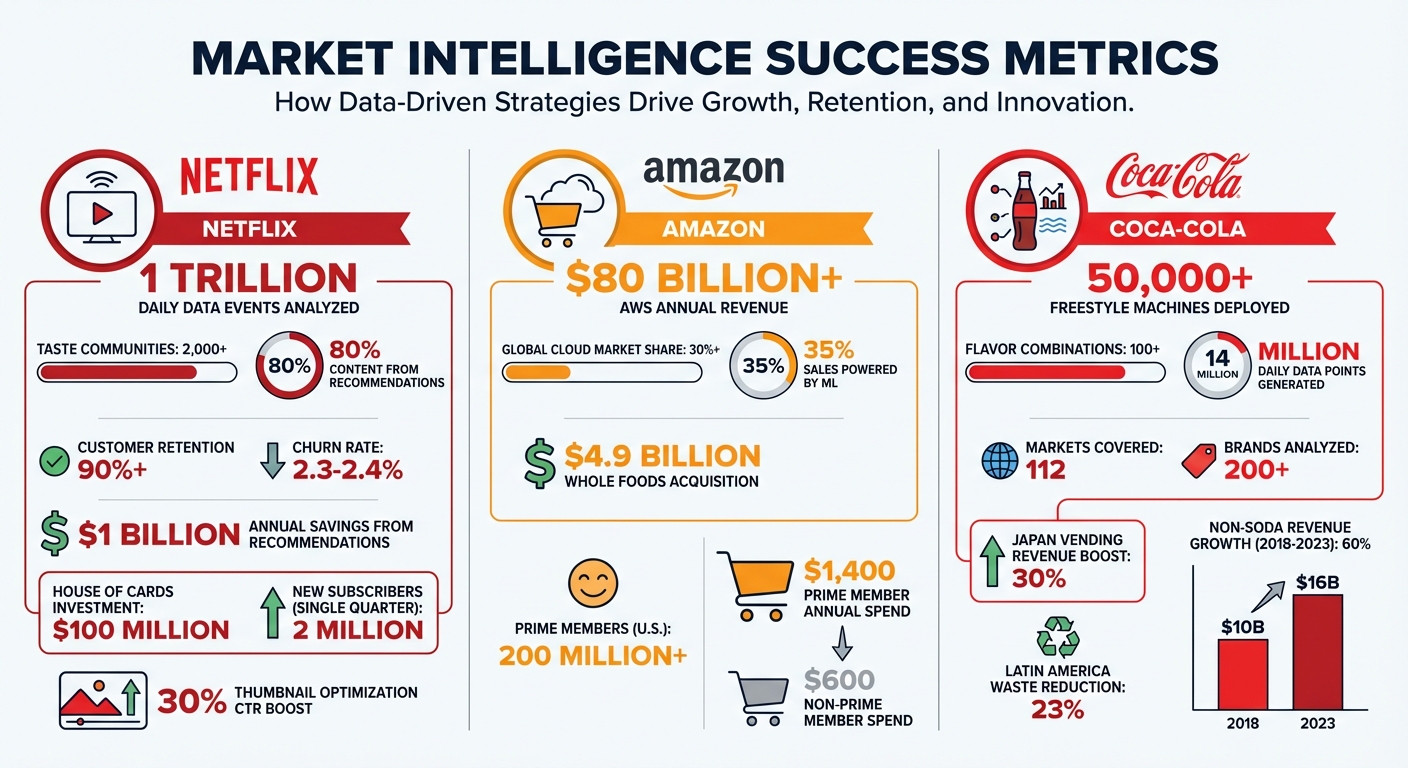
Market Intelligence Success Metrics: Netflix, Amazon, and Coca-Cola Case Study Comparison
Netflix: Using Data for Personalization
Netflix has reshaped the entertainment industry by diving deep into user data to enhance personalization and retention. The platform analyzes over 1 trillion events daily, tracking everything from pause and rewind actions to device preferences and viewing times. This data allows Netflix to group users into more than 2,000 "taste communities" based on their viewing habits.
This strategy pays off: 80% of the content watched on Netflix comes from algorithmic recommendations, helping the platform maintain a churn rate of just 2.3% to 2.4%. In comparison, Netflix's customer retention surpasses 90%, while competitors like Hulu and Amazon Prime see retention rates of 64% and 75%, respectively. The recommendation system alone saves the company an estimated $1 billion annually by keeping users engaged.
One standout example of Netflix's data-driven approach was its bold move in February 2013 to invest $100 million in House of Cards without a pilot. Data had shown strong viewer interest in director David Fincher, actor Kevin Spacey, and the original British series. This gamble paid off, bringing in 2 million new U.S. subscribers in a single quarter. Even small details, like personalized thumbnails, are optimized. For instance, Uma Thurman fans might see her image from Pulp Fiction, while action fans see John Travolta - boosting click-through rates by 30%.
"We know what people watch on Netflix and we're able to understand how big the interest is going to be for a given show based on a lot of factors."
- Ted Sarandos, Co-CEO, Netflix
Netflix's use of market intelligence highlights how understanding customer behavior can drive retention and growth. Similarly, Amazon has built its empire by identifying and acting on new market opportunities.
Amazon: Finding New Markets to Enter
Amazon excels at spotting untapped markets by focusing on customer challenges. For instance, internal infrastructure issues led the company to create Amazon Web Services (AWS), which has grown into a business generating over $80 billion annually and capturing more than 30% of the global cloud market.
This strategy of "working backward" from customer needs has helped Amazon evolve from an online bookstore into a multi-faceted marketplace. Today, machine learning powers over 35% of Amazon's sales, predicting what customers want before they even search.
Acquisitions also play a key role in Amazon's expansion. Buying Whole Foods for $4.9 billion allowed Amazon to enter the grocery market instantly. Other acquisitions, like Twitch (streaming) and PillPack (healthcare), have broadened its reach into new industries. Amazon Prime further locks in customers, with over 200 million global members in the U.S. spending an average of $1,400 annually, compared to $600 for non-members.
"We're not competitor obsessed, we're customer obsessed. We start with what the customer needs and work backwards."
- Jeff Bezos
Amazon's ability to identify and fill market gaps demonstrates how intelligence-driven strategies can fuel long-term success. Coca-Cola, on the other hand, uses consumer data to innovate and create new products.
Coca-Cola: Product Development from Consumer Data
Coca-Cola has turned its 50,000+ Freestyle machines into live data hubs. These AI-powered dispensers allow customers to mix drinks from over 100 flavor combinations, generating 14 million data points daily.
When data revealed a popular mix of Sprite with cherry, Coca-Cola launched Sprite Cherry and Sprite Cherry Zero as permanent retail products in February 2017. This reverse approach - turning custom drink trends into retail products - also led to the launch of Orange Vanilla Coke in 2019.
Coca-Cola’s data strategy extends beyond Freestyle machines. Using its Consumer Data Service (CDS 2.0) on AWS, the company consolidates insights across 200+ brands in 112 markets, enabling rapid scaling of successful campaigns. In Japan, machine learning personalization boosted vending machine revenue by 30%, while improved demand forecasting reduced supply chain waste by 23% in Latin America. Between 2018 and 2023, revenue from non-soda beverages surged 60%, climbing from $10 billion to $16 billion.
"When a new idea arises, we want to scale from one market to 200 markets within weeks or months instead of years. Using AWS technology and processes, we can do that."
- Sunil Ramakrishnappa, Senior Director of Global Architecture and Engineering, Coca-Cola
Coca-Cola’s ability to transform customer data into actionable insights highlights how real-time analytics can drive both product innovation and competitive advantage.
Market Intelligence in Specialized Industries
Biotech: Monitoring Competitor Pipelines
Biotech companies face a daunting task: keeping tabs on over 500,000 registered clinical studies and more than 20,000 active drug programs worldwide as of 2025. With datasets this massive, manual tracking is out of the question. Instead, companies rely on AI-driven tools to sift through the noise and identify emerging threats early.
Take Merck & Co., for example. With the 2028 patent expiration of Keytruda (pembrolizumab) looming, Merck made a bold move by focusing on a subcutaneous formulation of the drug. Analysts predict this new version could bring in $1 billion in 2026 and climb to $7 billion by 2032. By leveraging competitive intelligence, Merck proactively shifted the treatment landscape, protecting billions in revenue.
In another case from October 2025, a mid-sized biopharma company gearing up for an oncology launch used an AI-based competitive intelligence platform to analyze 100,000+ data points. The system flagged a competitor's therapy gaining traction six months before its launch, estimating a 12% drop in market uptake. Armed with this insight, the company adjusted its pricing strategy and focused on key healthcare providers, resulting in a 25% adoption boost in the first quarter. This example highlights how timely data can directly shape business outcomes.
"73% faster decision-making, 45% more accurate competitive assessments, and 58% improvement in identifying high-value opportunities" - Patap.io
Patent intelligence is another critical area. Between 2026 and 2030, a "patent super-cliff" could jeopardize $180 billion to $400 billion in annual revenue for top pharmaceutical assets. Companies deploying AI for patent tracking have reported impressive results, such as 40% faster target validation (Pfizer) and a 25% reduction in late-stage failures (Roche). Monitoring "patent thickets" and filing trends enables firms to spot R&D opportunities or prepare for revenue risks.
While biotech leans on real-time intelligence to tackle complex challenges, fintech employs similar tools to stay competitive in a fast-moving market.
Fintech: Competing in the Payments Market
Fintech operates in a landscape that shifts rapidly. Real-time monitoring of competitor announcements, events, and customer feedback helps companies uncover gaps, such as unmet customer needs or accessibility issues.
For instance, one fintech firm analyzed competitor event calendars and customer frustrations to refine its own event strategy. The result? A 50% increase in developer API sign-ups by addressing pain points developers faced with other solutions. Another fintech company used targeted competitive strategies to achieve a 35% boost in brand visibility in specific regional markets.
But it’s not just about events. Some fintech firms engage in internal “war gaming,” where teams act as competitors to stress-test their own strategies. This approach helps pinpoint vulnerabilities and adapt quickly to market changes.
Regulatory changes also demand close attention. For example, understanding the rollout of new payment systems like PayTo in Australia or evaluating the effects of Open Banking regulations can guide companies on when and how to enter new markets.
"Competitive intelligence functions as both an early-warning system and a strategic navigation tool." - Sedulo Group
Customer sentiment analysis is another powerful tool. By surveying competitor customers and resellers, fintech firms gather insights into pricing, service quality, and feature preferences. This data shapes everything from pricing strategies to product development, ensuring they stay ahead of evolving customer expectations.
Patterns Across Multiple Case Studies
Making Decisions Based on Data
Today’s leaders are leaning heavily on data to make smarter, faster decisions. Here’s a striking fact: 72% of businesses now use AI-powered tools for competitor analysis, and this number is projected to climb to 90% by 2025. Companies using real-time data have a serious edge - they adapt to market changes 5x faster than those sticking to traditional methods. And the payoff? They see 21% higher year-over-year revenue growth.
Take SurveyMonkey, for example. In July 2022, they brought in Claire Brunvand as their first competitive intelligence leader to close gaps in their market strategy. By centralizing competitive insights through Klue, they conducted over 50 interviews within a year. The result? A 65% boost in win rates against key competitors and a 30% cut in the average deal cycle.
"The difference between Klue and our previous vendor was noticeable right away... This level of depth gives us real insight into what we can act on and prioritize".
And it’s not just about sales wins. Organizations report a 314% return on investment within three years when using data-driven tools, with most breaking even in just 11 months. JPMorgan Chase is a prime example. Since 2020, they’ve used real-time machine learning to process over 5 billion daily transactions, instantly flagging suspicious activity. This system has reduced fraud losses by 20%, saving the bank more than $150 million annually.
These examples showcase how data-driven strategies fuel success across industries.
Responding to Market Changes
Data doesn’t just drive internal decision-making - it’s also a game-changer for staying ahead in the market. For instance, during Black Friday in November 2023, a retailer used an automated repricing engine to adjust prices on 450 key SKUs in just 2 hours. This quick move boosted revenue by 39% (about $12.8 million) and improved online conversion rates by 67%.
Timing, as much as speed, is critical. A fashion retailer, for example, launched seasonal clearance sales 10–14 days before competitors, capturing early demand with smaller discounts. This approach led to 18% revenue growth and a 6-point gain in gross margins, going from 48% to 54%. Similarly, a regional grocery chain analyzed 18 months of POS data to identify 847 key value items (KVIs). By matching competitor prices on these items within 4 hours, they improved gross margins by 15% (from 26.3% to 30.2%) and increased store traffic by 8% in just a year.
These examples highlight how agile, data-driven approaches consistently deliver results across different sectors.
How the Top Consulting Firms Directory Can Help
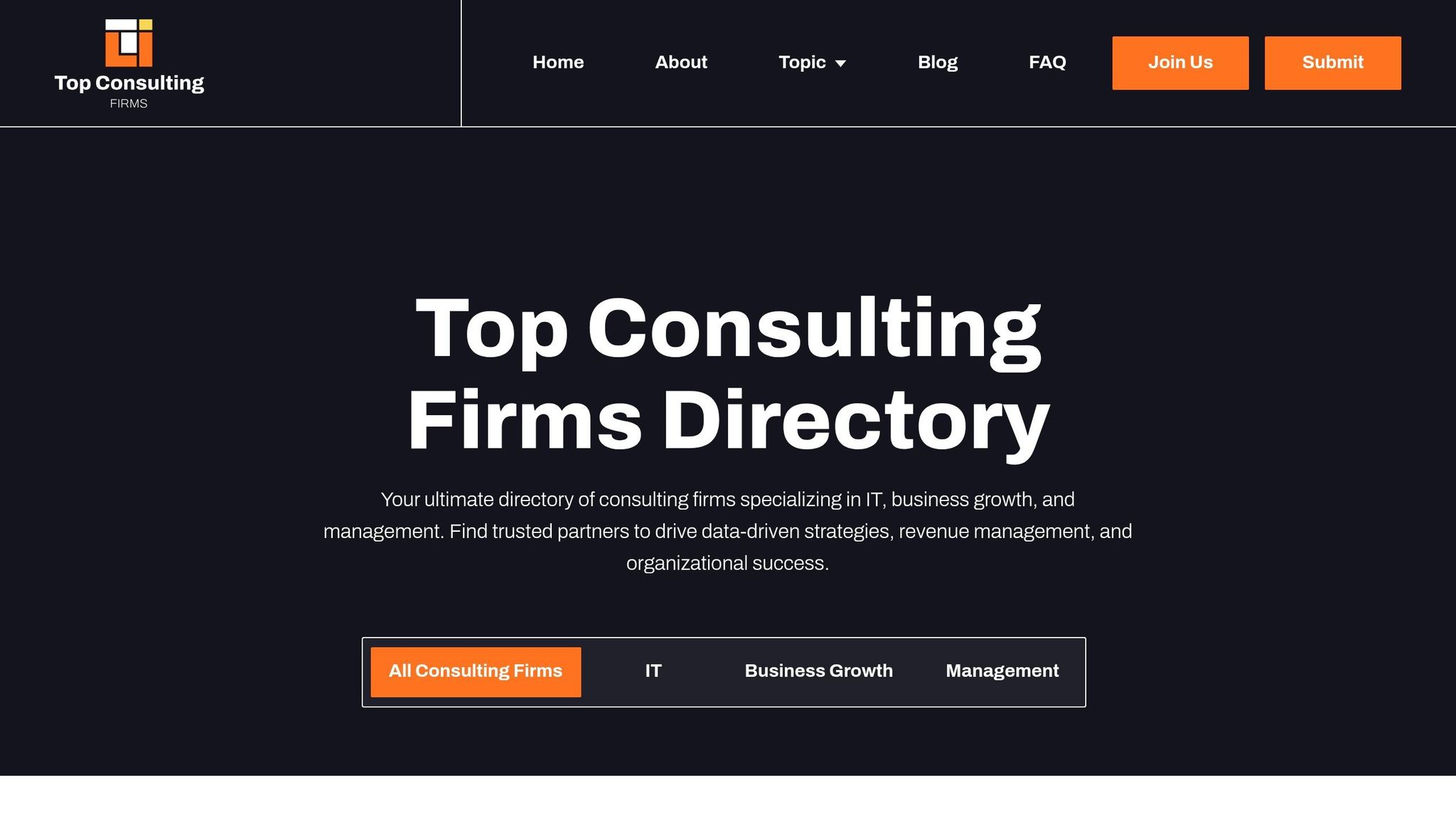
In today’s fast-paced business world, having access to expert consulting partners who can turn market intelligence into actionable strategies is a game-changer. The Top Consulting Firms Directory is designed to connect business leaders with specialists who excel at transforming insights into plans that drive results.
Finding Specialized Consulting Experts
This directory is your go-to resource for finding consulting firms that focus on specific areas like digital transformation, ESG (Environmental, Social, and Governance) initiatives, and supply chain challenges - key areas fueling the $300 billion management consulting industry. It’s more than just a list; it’s a tool that categorizes firms based on their expertise, making it easier to find a perfect match for your needs.
For instance, firms listed in the directory often leverage AI-powered platforms to track competitor activities, hiring trends, and regulatory shifts across various regions and languages. Pablo Zabaleta, an Associate Partner at a global consulting firm, shared how implementing one such AI platform cut down market research time from three days to just a few hours. He explained that while traditional methods provided logical insights, they often lacked the depth needed for strategic decisions.
The directory also features firms offering managed services, essentially acting as an extension of your internal team. One global consulting firm, with over 20,000 employees, used automation to reduce manual data collection by 70%, freeing up analysts for more strategic work and saving them up to eight hours each week.
Once you’ve identified the specialists that fit your needs, the directory streamlines the next step: selecting the right partner.
Simplifying the Search for Consulting Partners
The Top Consulting Firms Directory is designed to save you time and effort by showcasing firms with proven track records and offering tools like customizable filters. Instead of spending weeks researching potential partners, you can quickly find consultants who deliver high-quality, executive-ready intelligence.
For example, you can filter for firms that provide multi-language support (covering over 117 languages) to monitor local news in foreign markets or those that offer custom taxonomy configurations tailored to your business. These features ensure you’re not just picking any partner but the right one for your unique needs.
Additionally, firms using automated market intelligence platforms can help you make decisions twice as fast as traditional methods while saving analysts between 10 and 12 hours per week. This kind of efficiency isn’t just about saving time - it’s about gaining a competitive edge in your industry.
Conclusion: Using Market Intelligence for Competitive Advantage
The case studies discussed highlight a clear trend: companies that effectively use market intelligence consistently outperform their competitors. They see faster revenue growth and more efficient sales cycles. This success comes from pinpointing true competitors, centralizing intelligence across teams, and digging deep with win-loss analyses and expert interviews instead of relying on surface-level data.
To make these strategies work, businesses need both cutting-edge technology and skilled guidance. This is where the Top Consulting Firms Directory becomes a game-changer. It connects businesses with consulting partners who use AI-driven platforms and industry expertise to deliver actionable insights. These tools and strategies can save analysts up to 10 hours a week and enable executives to make decisions twice as quickly.
Whether you're in biotech monitoring competitor pipelines or in fintech navigating the payments market, having the right consulting partner can shift your approach from reactive to proactive. The directory’s customizable filters make it easy to find firms with the exact expertise you need, ensuring insights that are tailored to your goals and challenges.
In today’s fast-paced market, leveraging intelligence isn’t just about staying competitive - it’s about leading the way. The companies that rise to the top are those that transform insights into action. The Top Consulting Firms Directory is here to help you turn knowledge into results, giving your business the edge it needs to thrive.
FAQs
What market intelligence data should I track first?
To keep ahead in your industry, start by tracking your competitors' activities. Pay attention to things like product launches, pricing adjustments, and corporate announcements. It’s also smart to monitor shifts in management, new partnerships, or when competitors enter new markets - these moves can signal shifts in the competitive landscape.
Stay on top of updates by regularly checking for changes to their websites or reviewing public disclosures. This kind of systematic tracking ensures you’re not caught off guard. It gives you the chance to respond quickly, avoid potential blind spots, and position yourself to take advantage of emerging opportunities.
How do I turn insights into faster decisions?
To speed up decision-making, consider using advanced market intelligence platforms that handle data collection and analysis automatically. These tools cut down on manual work, simplify processes, and provide insights you can act on right away. For instance, businesses that use AI-driven platforms have been able to make decisions faster by quickly accessing insights across departments and responding to market shifts more effectively. Automating these tasks not only supports timely, well-informed decisions but also boosts efficiency across the board.
When should I bring in a consulting partner?
When you're up against complex challenges that demand specialized knowledge, strategic thinking, or a fresh, unbiased perspective, it might be time to bring in a consulting partner. These experts can help pinpoint market changes, identify competitive threats, or uncover weaknesses in your positioning. They’re particularly useful for tasks like benchmarking, analyzing new trends, or gathering competitive intelligence - especially when your internal team lacks the bandwidth or when an outside view is essential to tackle shifting market dynamics effectively.