Securing legacy systems is a critical challenge for enterprises. These systems often run outdated software, lack modern security features, and struggle to meet evolving compliance standards like HIPAA, PCI DSS, and CMMC 2.0. However, structured security frameworks can help mitigate risks while planning for modernization.
Key frameworks include:
- NIST Cybersecurity Framework (CSF 2.0): Focuses on risk management and compliance with six core functions. Cost-effective but requires sustained effort for maturity.
- ISO/IEC 27001: A global standard emphasizing risk-based controls and compliance. Demands significant investment and documentation.
- Zero Trust Architecture (ZTA): Secures systems externally with strict access controls and network segmentation. Effective but resource-intensive to implement.
- Risk-Based Security Engineering: Prioritizes security investments based on system-specific risks. Useful for addressing vulnerabilities in outdated systems.
Each framework has strengths and trade-offs. Choosing the right one depends on your organization’s regulatory requirements, technical debt, and modernization goals. A dual approach - securing legacy systems while transitioning to newer technologies - offers the best path forward.
How Security Frameworks and Regulations Address Legacy System Risks
1. NIST Cybersecurity Framework (CSF)
The NIST Cybersecurity Framework is a widely used security standard in the U.S., serving as a benchmark for both federal agencies and private organizations. Under Executive Order 13800, it became mandatory for all federal agencies. Over time, it has proven practical for private-sector companies dealing with the risks of outdated systems. The latest version, CSF 2.0, organizes security into six core functions: Govern, Identify, Protect, Detect, Respond, and Recover.
Risk Coverage
CSF 2.0 introduced two new categories under the "Protect" function that address aging infrastructure: Platform Security (PR.PS) and Technology Infrastructure Resilience (PR.IR). These additions aren’t just theoretical - they allow for documented compensating controls when legacy systems, like Windows Server 2012 R2, no longer receive vendor patches.
Here’s a real-world example: In early 2026, Pratt & Whitney used a NIST 800-171 mapping to secure a legacy environment that included Windows Server 2012 R2 and SharePoint Server 2016. By implementing 14 documented compensating controls, they maintained CMMC 2.0 Level 2 compliance during an 18-month transition to the cloud. This approach highlights how the framework emphasizes managing risks rather than demanding immediate system upgrades.
Regulatory Alignment
The framework also plays a critical role in regulatory compliance. CSF aligns closely with major U.S. regulations such as HIPAA, PCI DSS, CMMC 2.0, and NIST SP 800-171. The "Govern" function (subcategory GV.OC-03) ensures legal and regulatory requirements are identified and managed. However, this alignment isn’t automatic.
"Regulators do not accept 'we are migrating' as a current-state answer - the controls have to be in place now, on the systems that exist now, with documented evidence the assessor can verify." - i3solutions
This is particularly important as PCI DSS 4.0, effective March 31, 2025, mandates that all software in cardholder data environments must be vendor-supported. Systems reaching end-of-life will automatically trigger audit findings. This regulatory clarity underscores the importance of addressing legacy system challenges proactively.
Implementation Complexity
While the CSF’s flexibility is a strength, it also presents challenges. The framework defines what outcomes to achieve but leaves the how up to each organization. For legacy systems, this often means grappling with gaps like missing audit logs, lack of native MFA support, or the absence of a patching process.
The "Govern" function is often the hardest to implement.
"Govern is often the hardest function to implement because it requires organizational commitment, not just technical controls." - Mustafa A., Founder & Principal Security Engineer, Fortress MSSP LLC
For a mid-sized company, an initial implementation typically takes 3 to 6 months, while achieving a "Repeatable" (Tier 3) maturity level can require 12 to 24 months of sustained effort. Addressing these complexities is essential for securely integrating legacy systems into modern frameworks.
Cost Effectiveness
One major advantage of the CSF is that it doesn’t require licensing or certification fees, making it accessible. For a company with 100 employees, the first-year costs typically range from $80,000 to $250,000, covering tools and program setup. By the second year, costs often drop by 30% to 50% as initial investments in tooling and policies carry forward. Additionally, several states like Ohio, Connecticut, and Utah recognize CSF alignment as an affirmative defense in breach-related lawsuits.
| Phase | Typical Cost (2026) | Typical Duration |
|---|---|---|
| Initial Gap Assessment | $15,000 – $45,000 | 4 – 8 weeks |
| Policy Development | $8,000 – $20,000 | 4 – 6 weeks |
| Tooling (SIEM, EDR, IAM) | $30,000 – $120,000/year | Ongoing |
| Annual Self-Assessment | $5,000 – $15,000 | 2 – 3 weeks |
| Independent Assessment | $25,000 – $75,000 | 4 – 6 weeks |
(Source:)
2. ISO/IEC 27001
ISO/IEC 27001 takes a risk-based approach, focusing on setting up an Information Security Management System (ISMS) rather than prescribing specific technical solutions. This system helps organizations identify, address, and monitor risks effectively. By October 31, 2025, all active certifications must comply with ISO/IEC 27001:2022. Organizations still using the 2013 standard will be considered non-compliant by that date.
Risk Coverage
The 2022 update streamlined Annex A, cutting the number of controls from 114 to 93 and organizing them into four themes: Organizational, People, Physical, and Technological. For environments with older systems, Control 8.8 (Management of Technical Vulnerabilities) is especially critical. This control requires organizations to address vulnerabilities even when no vendor patch is available. When legacy systems cannot meet a standard control, the framework allows for compensating controls, which must be documented in the Statement of Applicability (SoA). For instance, if Active Directory integration isn't possible on an outdated server, local account management combined with session recording can serve as an alternative, provided it's properly documented. This flexibility ensures that ISO/IEC 27001 remains relevant across diverse risk scenarios.
Regulatory Alignment
ISO/IEC 27001 also establishes a baseline for global compliance, addressing vulnerabilities in legacy systems while simplifying adherence to major regulations like GDPR, HIPAA, NIS2, and DORA. This alignment helps businesses manage compliance more efficiently and can be a critical factor in securing contracts, especially with enterprise buyers in Europe and Asia.
Implementation Complexity
Achieving ISO 27001 certification involves a detailed, multi-step process. The Stage 1 audit examines the design and documentation of the ISMS, while the Stage 2 audit assesses whether the controls are functioning as intended. For mid-sized companies, the certification process typically takes 12 to 18 months from start to finish. However, about 30% of organizations fail the Stage 1 audit on their first try, often due to an incomplete Statement of Applicability or weak risk assessment practices. Legacy systems add another layer of complexity, as outdated software may require additional risk evaluations, and virtual machines running legacy workloads can expose vulnerabilities in the hypervisor if not carefully managed.
Cost Effectiveness
ISO 27001 demands a higher upfront investment compared to frameworks like NIST CSF. For mid-sized companies, first-year costs typically range from $175,000 to $640,000, covering consulting, audits, tools, and staffing. Annual costs in subsequent years generally fall between $110,000 and $445,000. Businesses with an existing SOC 2 program may see a 60% to 70% overlap in controls, which can help reduce the effort needed for implementation.
| Cost Category | Typical Range (2026) |
|---|---|
| Gap Analysis | $8,000 – $15,000 |
| ISMS Implementation | $25,000 – $60,000 |
| Certification Audits (Stage 1 & 2) | $15,000 – $60,000 |
| Compliance Automation Tooling | $15,000 – $40,000/year |
| Annual Surveillance Audits | $5,000 – $25,000/year |
(Sources:)
While the initial costs may seem steep, ISO 27001 directs resources toward well-documented, risk-prioritized controls, which can help reduce spending on ineffective security tools. With the average cost of a data breach now exceeding $4.4 million, this certification can be seen as a strategic investment to manage long-term risks effectively.
3. Zero Trust Architecture (ZTA)
Zero Trust Architecture (ZTA) operates on a simple but powerful idea: never trust, always verify. As explained in NIST SP 800-207:
"Zero trust assumes there is no implicit trust granted to assets or user accounts based solely on their physical or network location."
This approach is a game-changer for enterprises with legacy systems because it moves away from the outdated "castle-and-moat" security model. In the old model, once an attacker breached the perimeter, they could move freely within the network - an obvious risk.
Risk Coverage
One of ZTA's biggest benefits for legacy systems is its ability to secure systems externally without requiring changes to outdated code. Tools like API gateways, reverse proxies, and web application firewalls (WAFs) act as protective layers, checking every access request before it reaches the application. These tools also address vulnerabilities by using identity proxy services and applying virtual patches.
For instance, legacy systems that lack native multi-factor authentication (MFA) can still enforce modern security measures through identity proxy services at the gateway level. Meanwhile, WAFs act as a shield, blocking known exploits for vulnerabilities that may never get patched.
A large number of legacy systems, particularly those running unsupported Windows versions, are especially vulnerable. In these cases, micro-segmentation and network enclaves are crucial for isolating high-risk assets and stopping attackers from moving laterally across the network . Research from operational technology (OT) environments shows that combining ZTA measures with hardening for outdated systems can suppress threats by 99% overall.
Regulatory Alignment
ZTA also helps organizations meet compliance requirements by aligning with frameworks like NIST CSF 2.0 and NIST SP 800-53r5 . For legacy systems that lack modern features like encryption or detailed logging, ZTA bridges the gap by routing traffic through secure gateways that add these capabilities externally.
| Legacy System Gap | ZTA Compensating Control | Regulatory Benefit |
|---|---|---|
| No MFA support | Identity proxy / MFA gateway | Meets identity verification standards (e.g., NIST 800-53) |
| Unencrypted protocols | TLS/VPN tunneling via gateway | Meets data-in-transit encryption requirements (e.g., HIPAA, PCI DSS) |
| Insufficient logging | Centralized SIEM / UEBA integration | Maintains audit trails required by regulators |
With stricter regulations, such as the NIS2 directive, coming into effect by 2026, ZTA is quickly becoming a necessity for compliance. These compliance benefits also pave the way for addressing technical challenges, which we'll explore next.
Implementation Complexity
Implementing ZTA in legacy environments comes with its own set of hurdles. Many legacy systems rely on hardcoded IP addresses and undocumented dependencies, making it easy for micro-segmentation rules to disrupt operations if traffic isn't carefully mapped . To avoid outages and ensure a smooth transition, organizations should follow a phased approach:
- Contain and Stabilize: Start by enabling MFA on VPN gateways and segmenting critical legacy servers.
- Incremental Hardening: Introduce micro-segmentation and Network Access Control (NAC) gradually.
- Integration and Optimization: Connect legacy telemetry to centralized monitoring tools like SIEM and UEBA.
As Yuriy Syvytsky, Co-founder of Softline, explains:
"Adapting legacy systems to Zero Trust demands a deep architectural analysis and critical point identification."
Cost Effectiveness
Implementing ZTA is not cheap, and costs can vary depending on the scope. For a mid-size enterprise (5,000 seats), first-year expenses typically range from $1M to $5M, with the following breakdown: 50% for software and tools, 30% for consulting and integration, and 20% for staff training. A one-month discovery phase alone can cost around $50,000.
| Phase | Duration | Key Focus | Estimated Cost |
|---|---|---|---|
| Assess | 1 month | Asset inventory & gap analysis | ~$50,000 |
| Identity | 2 months | MFA, SSO & IdP consolidation | ~$200,000/year |
| Devices | 1 month | EDR & posture checks | ~$150,000 |
| Network | 3 months | Micro-segmentation & ZTNA | ~$300,000 |
| Data/Apps | 2 months | DLP & CASB implementation | ~$250,000 |
(Source: ChiefViews CIO Playbook, 2026)
Despite the upfront costs, the returns are evident. Companies with robust ZTA frameworks report a 55% drop in insider threats and a 47% reduction in phishing success rates. Micro-segmentation alone can shrink the lateral movement risk by over threefold. Considering that 89% of manufacturing companies have faced cyberattacks, with average damages reaching $3 million per incident, the investment in ZTA pays off significantly.
sbb-itb-97f6a47
4. Risk-Based Security Engineering Frameworks
Risk-Based Security Engineering Frameworks take a different approach compared to perimeter-focused or identity-centric methods. These frameworks prioritize security investments based on the specific risk profile of each legacy system. While they aim to address security gaps like other methods, they do so by tailoring efforts to the inherent risks of individual systems. Here's a closer look at how this approach works.
Risk Coverage
One of the standout features of these frameworks is their ability to zero in on vulnerabilities unique to legacy systems - issues that might otherwise be ignored. These include challenges like End-of-Life (EOL) software, expired vendor contracts, and knowledge gaps caused by the departure of experienced staff. Systems are scored based on the likelihood of failure and the potential business impact. Any system scoring 16 or higher out of 30 is classified as "red-rated" and requires immediate remediation.
"A 'red-rated' system refers to an IT system that has been assessed and scored as having both high likelihood and high impact in terms of potential risks." - GOV.UK
For systems that can't support modern protocols, these frameworks suggest measures like isolation, strict access controls, and proxy layers to manage traffic securely between legacy and modern infrastructures. This approach allows for a gradual transition. When vendor patches are no longer available, virtual patching through tools like Web Application Firewalls (WAFs) and Intrusion Prevention Systems (IPS) can help mitigate vulnerabilities.
Regulatory Alignment
These frameworks also tackle regulatory challenges head-on, particularly when dealing with legacy systems. Often, attempts to manage legacy risks with compensating controls - like policy overlays or identity proxies - fail to meet regulatory standards. As Keerthi Murali, Customer Delivery Manager at Legacy Leap, points out:
"Legacy systems are not in a gray zone; they are out of compliance. The moment a regulated system's underlying technology falls outside vendor support, specific mandatory controls become architecturally impossible to meet."
For example, under PCI DSS 4.0.1 Requirement 12.3.4, any EOL technology automatically triggers a non-compliance finding, regardless of how stable it appears operationally. A single outdated system, like SQL Server 2008, can lead to compliance issues across multiple regulations, including SOX 404, NYDFS Part 500, PCI DSS, and the GLBA Safeguards Rule. In one notable case, Healthplex faced a $2M penalty in August 2025 due to non-compliance with Part 500, underscoring the financial risks of neglecting these systems.
Implementation Complexity
Legacy environments often suffer from poor documentation and hidden dependencies, making them difficult to manage - especially when the original developers are no longer available. Risk-based frameworks address these challenges by requiring detailed assessments of a system's technical health. These assessments evaluate factors like system performance, physical conditions, and potential project impacts.
Typically, a comprehensive security risk assessment takes 4 to 8 weeks, depending on the complexity of the system and the quality of the asset inventory. Implementing least privilege principles adds another layer of complexity, as legacy users often rely on workarounds that are deeply embedded in business processes.
Cost Effectiveness
Security upgrades in legacy modernization projects usually account for 15% to 25% of the total budget. Taking a proactive approach to modernization is far less expensive than reacting to breaches, which can cost 3 to 27 times more.
"In our experience, when you calculate true TCO, legacy systems cost 2-4 times what organizations initially estimate." - JJ Rosen, Founder, Atiba
Hidden expenses, such as extended security updates and manual workarounds, can inflate the total cost of ownership (TCO) for legacy systems by 2 to 4 times the original estimates. In 2025, the average cost of a data breach in the U.S. reached $10.22M, while ransomware payments averaged $2.3M. By investing in risk-based modernization, organizations can cut breach costs and make smarter long-term security investments.
Pros and Cons
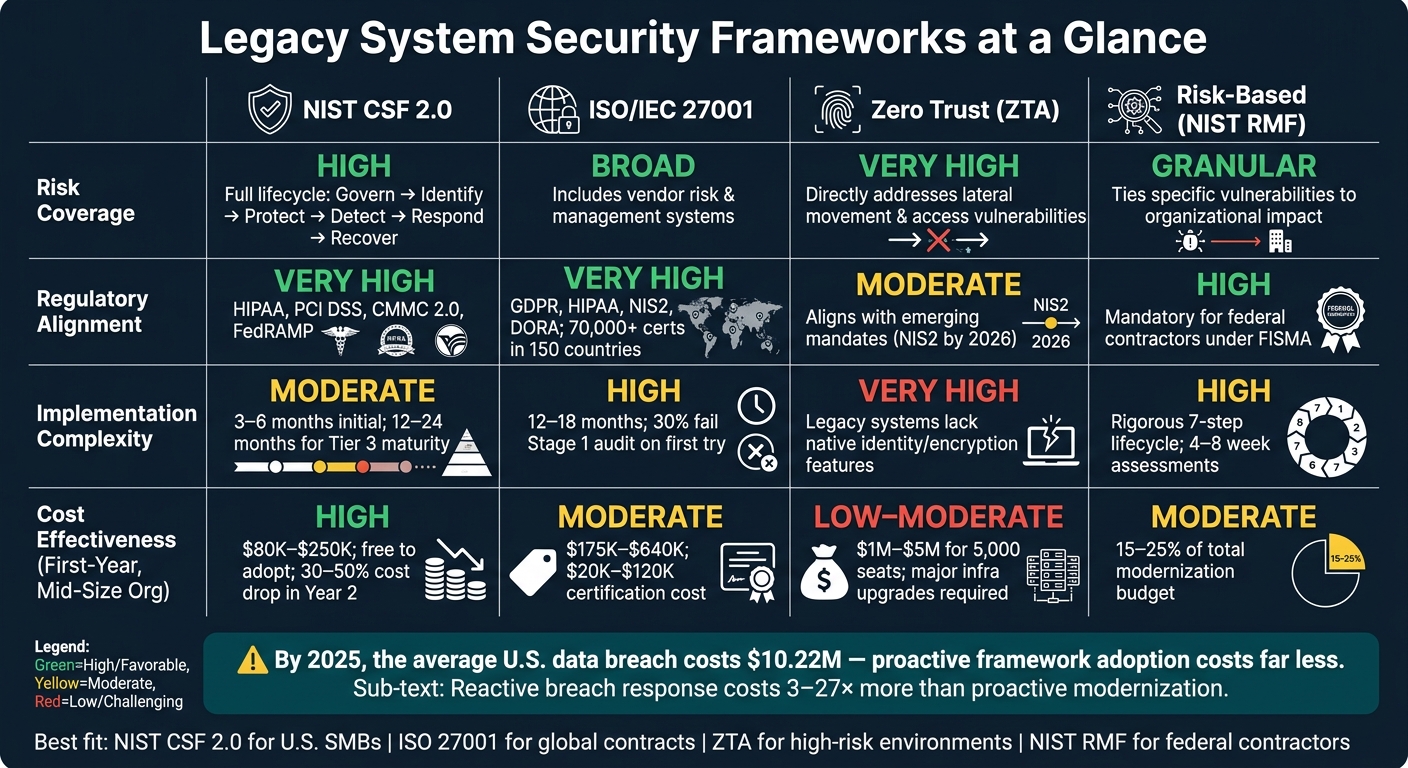
Legacy System Security Frameworks Compared: NIST CSF vs ISO 27001 vs ZTA vs Risk-Based
When it comes to safeguarding legacy systems, different security frameworks bring their own strengths and trade-offs. Here’s a side-by-side comparison of key factors that matter most:
| Framework | Risk Coverage | Regulatory Alignment | Implementation Complexity | Cost Effectiveness |
|---|---|---|---|---|
| NIST CSF 2.0 | High; spans the entire lifecycle from identification to recovery | Very high; aligns with U.S. federal requirements like CMMC and FedRAMP | Moderate; outcome-focused and scalable | High; free to adopt and prioritizes risk |
| ISO/IEC 27001 | Broad; includes vendor risk and management systems | Very high; internationally recognized as a standard of excellence | High; requires formal ISMS, audits, and extensive documentation (6–12 months) | Moderate; certification costs range from $20K–$120K |
| Zero Trust (ZTA) | Very high; directly addresses lateral movement and access vulnerabilities | Moderate; aligns with emerging mandates | Very high; legacy systems often lack identity and encryption features | Low to moderate; requires major infrastructure upgrades |
| Risk-Based (NIST RMF) | Granular; ties specific vulnerabilities to organizational impact | High; mandatory for federal contractors under FISMA | High; involves a rigorous 7-step lifecycle | Moderate; demanding assessment phases |
Key Takeaways
NIST CSF 2.0 stands out for its accessibility and cost-effectiveness. It’s widely adopted, especially by small businesses, whose adoption rates jumped from 29% to 42% between 2023 and 2025, largely due to cyber insurance requirements. However, its flexibility can lead to challenges - without strong internal governance, organizations may struggle to advance to higher maturity levels.
ISO/IEC 27001 is a go-to framework for companies involved in international contracts or enterprise-level procurement. With over 70,000 certificates issued across 150 countries as of 2022, it’s a trusted standard globally. That said, its implementation can be daunting, especially for organizations with legacy systems, given the significant time and financial investment required.
Zero Trust delivers excellent risk coverage but presents hurdles for legacy systems. Older platforms like Windows Server 2012 R2 lack the modern identity controls needed for Zero Trust. As a result, organizations often need to implement proxy layers and other compensating controls, which can drive up costs and delay results.
NIST RMF offers a robust, structured approach to system-level risk management. It’s particularly suited for organizations juggling both legacy and modern systems or those facing federal audits. However, its complexity and the disciplined execution it demands can make implementation challenging.
Conclusion
There’s no one-size-fits-all framework for every organization. The best choice depends on three key factors: the type of data you manage, the regulators you must comply with, and the extent of technical debt in your legacy systems.
For many U.S. companies, the logical first step is conducting a full asset inventory. This means identifying every legacy system, its dependencies, and its compliance requirements before deciding on a framework. As i3solutions emphasizes, regulatory compliance demands controls on existing systems - not just plans for future upgrades. This is especially critical when considering the rising stakes: by 2025, the average cost of a U.S. data breach is predicted to hit $10.22 million. This underscores the urgency for immediate compliance, which, in turn, increases scrutiny on legacy systems.
Regulatory bodies are now cracking down on outdated software, automatically flagging end-of-life systems and requiring concrete evidence of remediation. This heightened pressure makes it clear that organizations must address vulnerabilities in their older systems while planning for modernization.
Each framework has its strengths, but the key lies in balancing short-term security with long-term modernization. A dual approach is often the most effective strategy: running security programs alongside modernization efforts to safeguard current systems while preparing for the future. A great example of this is Pratt & Whitney’s collaboration with i3solutions. The aerospace company tackled 110 NIST 800-171 controls and documented 14 compensating controls for legacy SQL Server 2012 and Windows Server 2012 R2 systems - all while managing an 18-month cloud migration. This approach - protecting legacy systems today while transitioning to modern architecture - is one that other organizations can emulate.
For tailored advice on securing legacy systems and finding the right framework for your unique regulatory and technical needs, check out the Top Consulting Firms Directory.
FAQs
Which framework should we start with if we have many end-of-life systems?
Start by performing a thorough risk assessment using a well-known standard such as the NIST Risk Management Framework (RMF) or the NIST Cybersecurity Framework (CSF). These frameworks are designed to help you pinpoint vulnerabilities and prioritize them based on their potential impact. This process will guide your decisions on whether to retain, rehost, or replace legacy systems.
If you're unsure about the best approach, it might be worth reaching out to professionals who focus on managing legacy systems. Their expertise can provide valuable insights and help you navigate complex decisions effectively.
How do we prove compliance when a legacy system can’t support required controls?
If a legacy system falls short of supporting necessary controls, consider implementing compensating controls. These are alternative measures designed to achieve the same intent and level of protection as the original controls. Start by documenting the system’s limitations clearly and ensure the substitute measures directly address the identified risk.
To successfully pass an audit, your approach must meet a few key criteria: it should align with the specific risk, provide equivalent protection, include well-documented constraints, and add a layer of security that goes beyond basic requirements.
What’s the fastest way to reduce risk while we modernize legacy apps?
The fastest way to lower risk is by introducing additional security layers that don't require major overhauls and by updating systems step by step. Start by implementing an authorization or proxy layer at the network gateway. This enforces modern identity controls and applies Zero Trust principles - all without needing to modify the application's code. Combine this with a phased migration strategy, such as the Strangler Fig pattern, to gradually replace outdated modules. Kick things off with a code audit to identify and focus on high-risk areas first.