Automating vendor risk management can save time, cut costs, and improve oversight. Manual processes like spreadsheets and emails are slow, error-prone, and costly - averaging $200–$600 per vendor assessment and taking 30–45 days to complete. Automation reduces this to just $16 per assessment and under 2 minutes for initial analysis.
Key Benefits:
- Faster Assessments: Cut processing time by up to 90%.
- Cost Efficiency: Save hundreds of dollars per vendor.
- Real-Time Monitoring: Get instant alerts for new risks or compliance changes.
- Centralized Oversight: Manage risks across vendors with a single dashboard.
Switching to automated tools transforms vendor risk management from a slow, reactive process into a fast, continuous system. By integrating AI-driven workflows, organizations can handle more vendors, reduce errors, and meet regulatory requirements more efficiently.
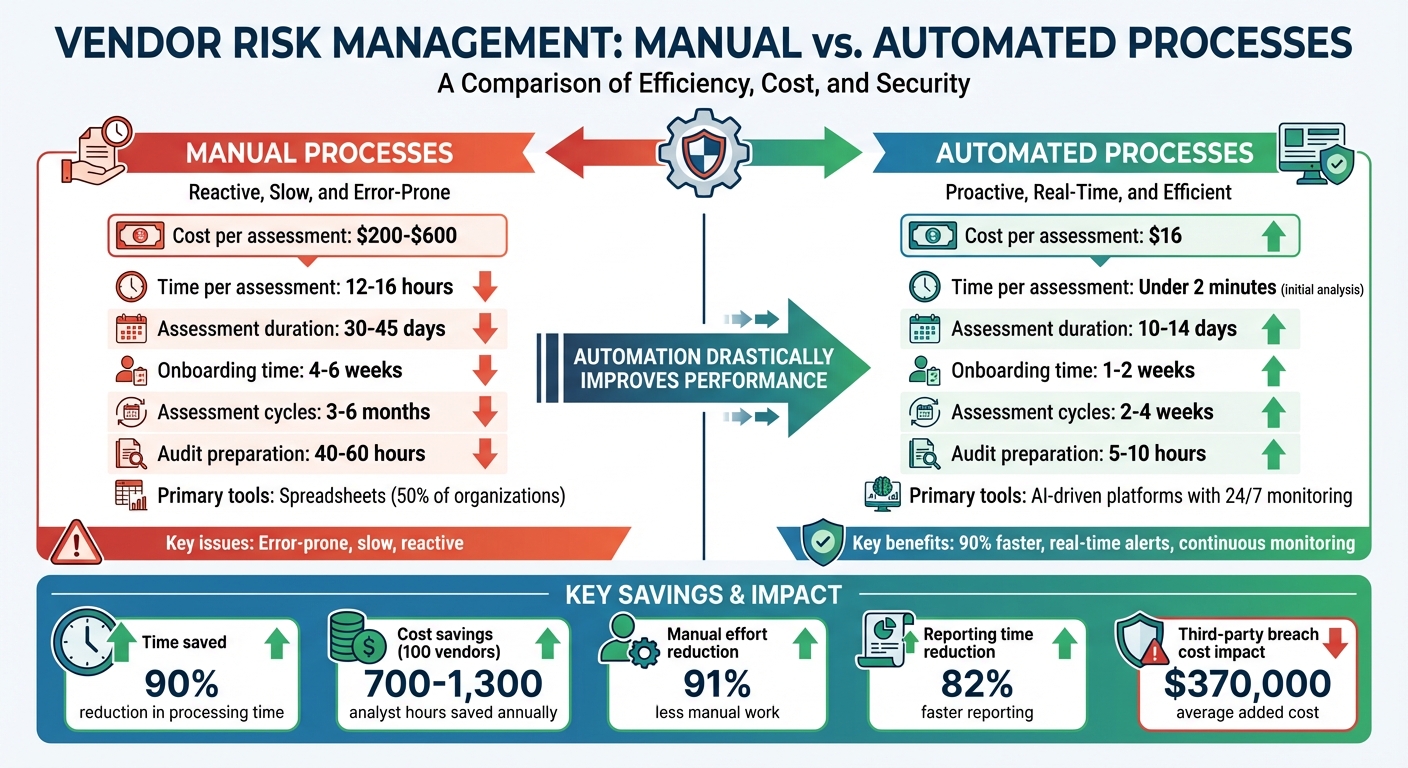
Manual vs Automated Vendor Risk Management: Cost and Time Comparison
What is an Automated Vendor Risk Assessment?
sbb-itb-97f6a47
Problems With Manual Vendor Risk Management
Managing vendor risk manually is both time-consuming and prone to mistakes, and these challenges grow as vendor networks expand. The root of the issue lies in the excessive coordination required. As Nasir R from Atlas Systems explains: "The work that drains your team isn't the analysis. It's the coordination. Chasing vendors for missing documents. Tracking down evidence that was supposed to arrive weeks ago."
Delays and Errors in Manual Workflows
Manual workflows create bottlenecks at nearly every step. A single vendor assessment typically takes 12–16 hours stretched over 30–45 days. When scaled to hundreds of vendors, these delays multiply quickly. Shockingly, 50% of organizations still use spreadsheets to manage their vendor data, a practice that increases the likelihood of errors. Analysts often miss critical security questions or apply inconsistent scoring, leading to unreliable results .
The financial toll is considerable. Performing due diligence manually costs between $200 and $600 per vendor, factoring in analyst rates of $50–$100 per hour. Preparing for audits adds another layer of inefficiency, with teams spending 40–60 hours gathering evidence and mapping it to compliance frameworks . These fragmented processes create blind spots, increasing the risk of non-compliance and undetected vulnerabilities. For instance, in industries like insurance, a single compliance lapse - such as an expired vendor license - can lead to penalties exceeding $100,000, when fines and remediation efforts are included.
Growing Complexity of Vendor Threats
The evolving threat landscape has outpaced manual processes. Cybercriminals increasingly exploit third-party vendors as a "backdoor" to breach larger organizations with stronger defenses. Data breaches caused by third-party vendors add an average of $370,000 to the total cost of an incident. Compounding the issue, manual assessments are often conducted quarterly or annually, leaving businesses exposed to new threats that arise between these static reviews .
Regulatory demands are also intensifying. Frameworks like GDPR, DORA, and ISO 27001 place greater accountability on third-party risk management . Keeping up with these changing requirements manually is nearly impossible when managing hundreds of vendors across various regions. What might work for 50 vendors becomes unmanageable with 300 or more . ProcessUnity Research captures the issue well: "Manual processes can't keep up with today's pace of business. Traditional risk management methods slow onboarding, leave vulnerabilities undetected, and delay responses to emerging threats."
The growing delays, rising costs, and increasing complexity of vendor threats highlight the pressing need for automation, which will be explored in the next section.
Benefits of Automated Vendor Risk Management
Switching to automation in vendor risk management can turn a tedious, error-prone process into a seamless operation with tangible results. By replacing manual workflows with automated systems, organizations gain speed, better oversight, and centralized control. Let’s break this down further.
Faster Processing and Managing More Vendors
Manual processes often create bottlenecks, with endless emails and spreadsheets slowing everything down. Automated platforms, on the other hand, simplify the process. These tools use AI-driven workflows to handle tasks like routing questionnaires based on vendor tiers, sending reminders, and flagging issues for review - all without human intervention. This efficiency reduces onboarding time from 4–6 weeks to just 1–2 weeks, and assessment cycles that once dragged on for 3–6 months can now wrap up in 2–4 weeks.
The cost savings are just as impressive. While manual due diligence can cost $200 to $600 per vendor in analyst time, automation slashes this to about $16 per assessment with tools like ThirdProof's starter plan. Some organizations have even reported cutting manual effort by 91% and reducing reporting time by 82%. Beyond speeding things up, automation ensures constant vigilance, as we’ll explore next.
Continuous Risk Monitoring and Instant Alerts
Manual processes often suffer from delays, but automated systems excel at real-time monitoring. These tools provide 24/7 visibility by pulling data from sources like threat feeds, financial ratings, and regulatory updates. If a vendor’s risk profile changes - whether due to a credit downgrade, a new sanction, or a security breach - the system sends instant alerts and prioritizes them by severity.
Automation also enables simultaneous checks across up to 24 different sources, offering a level of detail that manual methods can’t match. Advanced AI tools can analyze complex documents, such as SOC 2 Type II reports or ISO certifications, extracting key details and validating controls in minutes. This ongoing monitoring helps organizations catch emerging risks between formal review cycles. Considering third-party vendor breaches can add more than $370,000 to the cost of a data breach, this proactive approach is critical.
Single Dashboard for Complete Oversight
Automated platforms bring everything together with a unified dashboard. These dashboards compile risks across cyber, financial, and operational categories, making it easy to track and prioritize issues. By combining internal questionnaire responses with external security ratings and threat feeds, they turn raw data into actionable insights.
Tasks are automatically assigned and progress tracked through smart routing systems. Audit preparation becomes a breeze, with platforms generating compliance packs that align with frameworks like SOC 2, ISO 27001, HIPAA, and GDPR. What used to take 40–60 hours can now be done in just 5–10 hours. This centralized approach ensures consistency, which auditors value highly, by showcasing a repeatable and mature process rather than scattered, one-off efforts.
How to Implement Automated Vendor Risk Management
Switching to automated vendor risk management can greatly improve efficiency, but it’s not an overnight process. A well-planned approach ensures a smooth transition and successful integration. Here’s how to get started.
Step 1: Review Your Current Vendor Risk Program
Before diving into automation, take a close look at your existing vendor risk management process. Map out the entire workflow - from onboarding vendors to contract renewals. This step helps identify where your team spends the most time and where mistakes are most likely to occur.
Pinpoint bottlenecks, such as lengthy assessments, and evaluate the quality of your data. Also, assess whether your team has the skills to effectively manage automated systems. To test automation's effectiveness, consider running a pilot program with 3–5 vendors to compare results against your manual processes.
Step 2: Choose the Right Automation Software
Vendor risk management tools aren’t one-size-fits-all. There are three main types to consider:
- Investigation tools: Focused on detailed, point-in-time research.
- GRC platforms: Designed for managing workflows and storing documentation.
- Continuous monitoring tools: Track security trends between formal assessments.
Look for software that offers automated risk scoring, real-time monitoring, and integration with your existing procurement or GRC systems. Features like AI-driven analysis can save significant time by extracting key information from complex documents, such as SOC 2 Type II reports or ISO certifications, in minutes. Ensure the platform is scalable - whether you’re managing a handful of vendors or thousands - and provides comprehensive audit trails with timestamped records.
For instance, ThirdProof offers a starter plan at $399 per month for 25 vendor investigations, which works out to about $16 per assessment. Compare that to manual research costs, which can range from $200 to $600 per assessment.
Step 3: Integrate Automation
Focus on areas where automation can have the greatest impact. For example, use AI-driven questionnaires for self-service onboarding and set up automated triggers for reassessments when a vendor’s security score drops or a contract is up for renewal. These steps can drastically reduce onboarding time and minimize errors from manual data entry.
Categorize your vendors into tiers based on their level of access and importance:
- Tier 1: Vendors with critical data access.
- Tier 2: Vendors essential for operational needs.
- Tier 3: Vendors providing standard services.
Automation can handle the heavy lifting of fact-gathering, leaving your team free to focus on strategic decision-making.
Step 4: Track and Improve Your Automation System
Even the best automation systems need regular monitoring and updates. Set clear metrics to measure success, such as time saved per assessment or the speed of vendor approvals. For example, aim to reduce assessment times by 90% or cut vendor review cycles by 40%.
Plan periodic reviews of your system based on vendor criticality. For instance, Tier 1 vendors might require annual reviews, while Tier 3 vendors could be reviewed every two years. Use these reviews to refine your risk indicators and adjust thresholds for automated alerts. Revisit your metrics regularly to ensure the system continues to meet your goals and adapts to new risks as your vendor portfolio grows. This ongoing attention keeps your automation system effective and aligned with your organization’s needs.
How Top Consulting Firms Directory Can Help With Automation
Finding Specialized Consulting Firms
Implementing automated vendor risk management (VRM) can feel overwhelming without the right expertise. The Top Consulting Firms Directory (https://allconsultingfirms.com) connects businesses with consulting firms that specialize in cybersecurity and risk management, making the process much more manageable.
These firms guide organizations in moving from outdated, manual processes - like spreadsheets - to AI-driven workflows. Automation can significantly lighten the load when it comes to vendor assessments. Considering that nearly 60% of organizations lack full visibility into their third-party vendors, working with experts who understand both the technology and the regulatory environment is crucial. These firms are well-versed in navigating frameworks like DORA, GDPR, and SEC mandates.
The directory also highlights firms experienced in handling complex configurations for enterprise-grade platforms. These consultants bring the technical skills needed to integrate VRM automation with your existing systems, such as GRC platforms, procurement tools like SAP Ariba, and IT infrastructure. Their expertise ensures that automation delivers its full potential by seamlessly connecting technology with compliance needs.
Custom Solutions for Automation and Risk Management
One of the standout advantages of working with consulting firms from the directory is their ability to create tailored solutions. Instead of relying on generic approaches, they design vendor risk programs that align with your specific risk profile. This includes custom tiering, refined workflows, and remediation strategies designed to match your organization's tolerance for risk. For example, firms like C-Risk help prioritize vendors based on the assets most at risk.
These experts also configure automation platforms to support over 60 compliance frameworks. Whether it’s HIPAA for healthcare, PCI DSS for payment systems, or SOC 2 for SaaS providers, the consultants ensure that assessments meet industry-specific requirements. Their skill in control mapping allows a single vendor assessment to address multiple regulatory frameworks at once.
Beyond setting up the technology, these firms provide change management support to ensure smooth adoption by your teams. They help translate technical outputs into actionable insights for departments like procurement, legal, and governance. This combination of consulting expertise and automation transforms vendor risk management from a reactive chore into a proactive strategy that enhances your organization’s competitive edge.
Conclusion
Automation is reshaping vendor risk management in ways that save time, reduce costs, and improve oversight. By automating processes, organizations can cut assessment cycles from 30–45 days to just 10–14 days and reduce analyst effort from 12–16 hours per vendor to as little as 3–5 hours. Instead of relying on periodic reviews, automation enables continuous, real-time monitoring, allowing teams to address threats as they arise rather than months later during an annual audit. A centralized dashboard brings much-needed visibility, especially given that nearly 60% of organizations currently struggle to maintain full oversight of their third-party relationships.
The financial benefits are just as compelling. Manual vendor due diligence costs between $200 and $600 per vendor in analyst time, while automation slashes this to about $16 per assessment. For a portfolio of 100 vendors, this means saving between 700 and 1,300 analyst hours annually. Additionally, audit preparation time drops dramatically - from 40–60 hours to just 5–10 hours - thanks to automated reporting tools.
"Automation doesn't replace judgment. It removes the busywork so judgment can actually happen." - Nasir R, Atlas Systems
To make the most of automation, choose platforms that integrate seamlessly with your current systems and align with your vendor count and compliance needs. Selecting the right tools ensures you avoid unnecessary alerts or delays. Starting with a small pilot group can help fine-tune workflows before scaling up.
For expert support, resources like the Top Consulting Firms Directory (https://allconsultingfirms.com) can connect you with implementation partners to ensure your strategy aligns with both technical and business goals. By combining reliable tools with experienced guidance, vendor risk management evolves from a reactive task into a proactive approach - one that not only reduces costs but also enhances your organization's security against ever-changing vendor threats.
FAQs
What should I automate first in vendor risk management?
Automating vendor intake, assessment, and monitoring can save countless hours of manual effort while speeding up the process of evaluating risks. By shifting these tasks to automated systems, your team can dedicate more time to actually analyzing risks instead of spending energy on data collection. Additionally, automating due diligence tasks - like verifying security and compliance details - can drastically reduce the time it takes for assessments. This approach not only accelerates onboarding but also provides deeper insights and helps create a risk management program that can grow with your needs.
How does automated monitoring catch vendor risks between reviews?
Automated monitoring keeps an eye on vendor risks even between scheduled reviews. By constantly tracking their cybersecurity posture and analyzing real-time data, it helps spot vulnerabilities and new threats early. This way, potential issues can be tackled promptly, well before the next formal assessment rolls around.
What features should I require in a VRM automation tool?
When selecting a VRM (Vendor Risk Management) automation tool, focus on key features that can make a real difference in managing vendor risks. Real-time monitoring is a must-have for keeping tabs on vendors continuously, while AI-powered analysis can simplify and speed up risk assessments.
Choose a tool that integrates smoothly with your current systems, offers automated reporting, and sends alerts for new or evolving risks. It’s also important that the tool provides in-depth insights into vendors' security measures and compliance status, helping you stay ahead of potential third-party risks and work more efficiently.