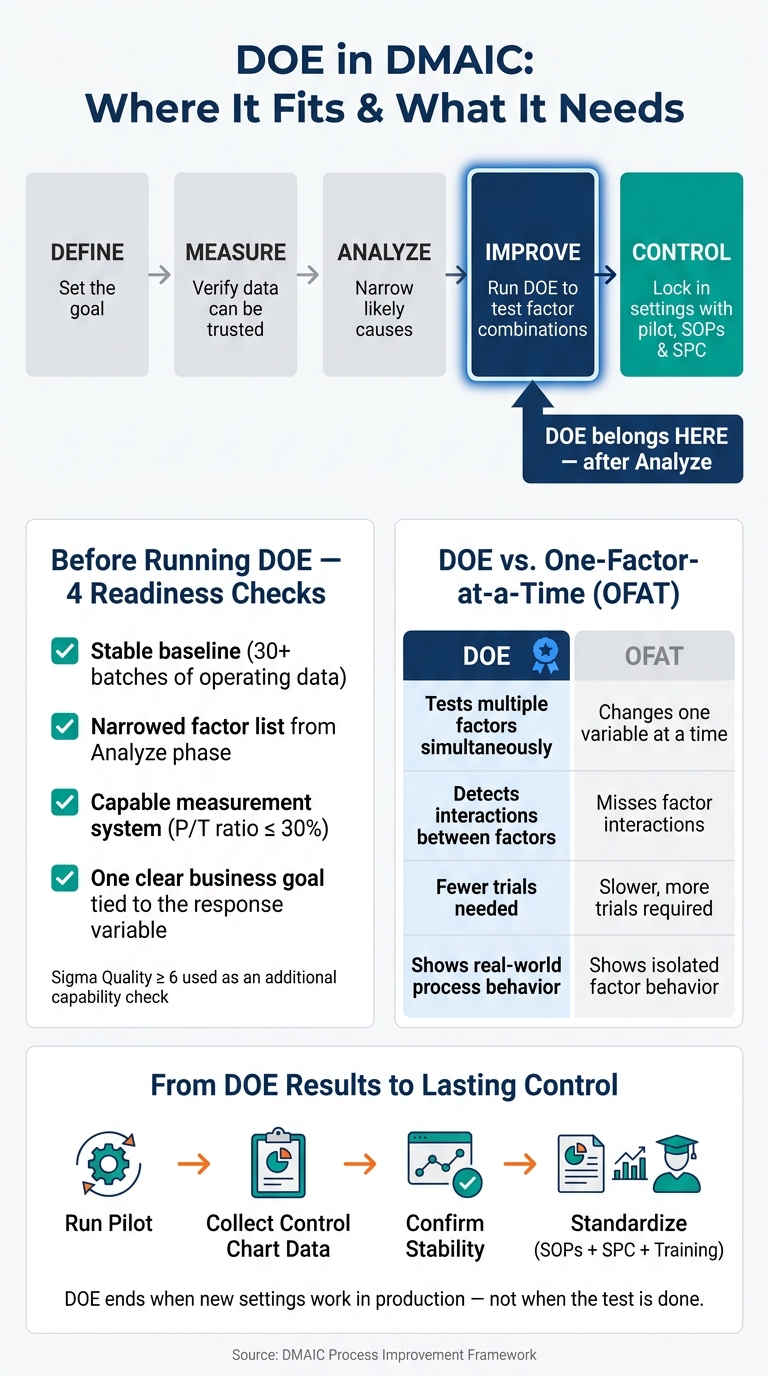
DOE fits in the Improve phase - not before. I’d use it only after the team has a stable baseline, a capable measurement system, and a short list of likely factors from Analyze.
Here’s the short version:
- Define sets the goal
- Measure checks whether the data can be trusted
- Analyze narrows the likely causes
- Improve uses DOE to test factor combinations
- Control locks in the new settings with pilot data, SOPs, and SPC
If I skip those steps and run DOE too early, I risk testing noise instead of process change. The article’s main point is simple: DOE works best when the problem is clear, the response is measurable, and the factor list is tight. It also lays out the minimum prep work - such as 30+ baseline batches, a P/T ratio at or below 30%, a clear response variable, and a pilot before full rollout.
So if you’re asking where DOE belongs in DMAIC, the answer is: after Analyze, inside Improve, then carried into Control with pilot proof and standard work.
DOE in DMAIC: Step-by-Step Placement & Readiness Checklist
Improve phase - A practical explanation
sbb-itb-97f6a47
When DOE Is the Right Tool
Once Analyze narrows the likely drivers, DOE becomes the next step when the team still needs to test combinations. Use DOE when process performance is still off target and the team needs to find which inputs move the result.
Use DOE When Multiple Inputs May Affect the Outcome
DOE fits when two or more controllable factors may affect quality, yield, cycle time, or cost - especially when the effect of one factor may shift at a different setting. That’s the key point. DOE tests combinations, not isolated inputs.
As a result, it shows how factors work together and helps teams choose settings that improve performance without adding rework or risk.
When DOE Is Not Necessary
Skip DOE when Analyze has already isolated one root cause and the fix is direct. Skip it when only one factor matters and interactions are unlikely. And if the process is unstable, get to a reliable baseline before trying to optimize anything.
How Consulting Teams Check DOE Readiness
Before designing the experiment, consulting teams usually confirm four things:
- A stable baseline
- A narrowed factor list from Analyze
- A capable measurement system
- One clear business goal tied to the response variable
These checks help avoid wasted trial runs and keep the experiment linked to a business decision. A P/T ratio above 30% signals that measurement error may hide real process changes. Once those checks pass, the team can define the baseline, response variable, and trial structure.
What Data DOE Needs Before the Improve Phase
Once DOE readiness is confirmed, the team needs three inputs: baseline, response, and factors.
Baseline, Response Variable, and Candidate Factors
The response variable is the outcome the team wants to move. It needs to be specific and measurable. The baseline should come from at least 30 batches of stable operating data. If that reference point is missing, the team has no clear way to tell whether the DOE changed the process for the better.
Candidate factors should come out of the Analyze phase. Keep them focused on the variables most likely to affect the response. The team also needs realistic factor levels and a clear view of any known operating constraints.
Before running the DOE, make sure the measurement system is capable. Otherwise, the trial may reflect measurement error instead of actual process change. A P/T ratio of 30% or less shows the measurement tool adds little to the variation being seen. Some teams also use Sigma Quality of 6 or higher as an extra capability check.
With those inputs in place, the team can build the trial plan.
Test Plan and Trial Data Structure
The trial plan should spell out the objective, likely sources of variation, required materials, fixtures, instruments, and the trial schedule. A consistent data entry form also matters more than people think. It helps the team record each run the same way every time, which keeps run records clean, speeds up analysis, and cuts down on reruns.
That setup gives the team a clear way to compare factor combinations in Improve.
How DOE Supports Process Optimization
Once the trial plan is in place, the next step is simple to ask and harder to answer: which settings give you the best process behavior? That’s where DOE starts to pay off. As runs begin, it shows which inputs shift the response and which settings move the process in the right direction.
Finding Main Effects and Interactions
Teams often start with a shortlist of likely drivers. DOE helps sort that list into what matters and what doesn’t. Main effects show how one factor changes the response on its own. Interactions show when the result changes only because two or more factors work together.
That distinction matters. A factor may look minor by itself but have a strong effect when paired with another setting. Once the team sees which factors drive the outcome, it can pick settings that improve the process without adding risk.
Choosing Settings That Reduce Risk and Rework
DOE helps teams choose settings that hit target performance with less variation, less rework, and lower defect risk. Instead of relying on trial-and-error, the team gets a data-backed way to pick operating conditions that protect yield and avoid failed scale-up.
DOE vs. One-Factor-at-a-Time Testing
The contrast with OFAT makes DOE’s value easier to see. OFAT changes one variable at a time, so it tends to be slower and can miss interactions between factors. DOE tests multiple factors together, which means teams can find better settings faster and with fewer trials.
Put plainly: OFAT can tell you what happens in isolation. DOE shows how the process behaves in real conditions, where factors often affect each other at the same time.
From Improve to Control
Pilot, Confirm, and Standardize the New Settings
DOE doesn’t end when the test is done. It ends when the new settings work in production.
Even if the optimized settings looked good during the experiment, they still need to perform under normal operating conditions before they become the new standard.
The pilot is the bridge between the experiment and standard work. Run a pilot to show that the new settings hold up in day-to-day production. During that pilot, collect control-chart data and confirm that the process is stable. Once the pilot shows stability, lock the settings into SOPs, training, and ongoing SPC.
That means the findings move out of the analysis phase and into day-to-day operations. They become updated SOPs, equipment parameter settings, and operator training. SPC tools then track performance over time, while capability statistics such as Cp and Cpk confirm that the process still meets spec.
Key Takeaways for Selecting Advisors and Operating Partners
DOE creates value only if the handoff from Improve to Control is done well. Once the pilot confirms stability, standardize the settings and monitor them with SPC.
For executives and PE-backed operators reviewing process improvement support, the practical test is simple: can the team move from data collection to DOE - and then into a Control plan that sticks?
The Top Consulting Firms Directory can help shortlist firms with Lean Six Sigma, process optimization, and value-creation experience. For firms building that team, the Top Consulting Firms Directory can help narrow the shortlist.
FAQs
Why shouldn’t DOE be used before Improve?
DOE shouldn’t be used before the Improve phase because DMAIC is a step-by-step, data-driven method. If you run DOE too early, the team may end up testing variables that aren’t the actual root causes.
By the time a team reaches Improve, it has already finished Define, Measure, and Analyze. That means the key variables and bottlenecks have been checked and confirmed. As a result, experiments stay focused on changes that matter most instead of wasting time on low-value tests.
How do I know if my process is ready for DOE?
Your process is ready for Design of Experiments (DOE) once you’ve gone past basic process mapping and need statistical analysis to cut variation or improve performance.
It makes the most sense when you already have a baseline, your data is reliable, and you need to understand how multiple variables interact in a manufacturing or business process.
What should happen after the DOE is finished?
After the Design of Experiments (DOE) is done, the team moves from Improve to Control. At this stage, the job changes: it's less about testing ideas and more about keeping results steady. That usually means putting simple controls in place, like dashboards and milestone tracking, so the team can see performance, spot drift, and act before small issues turn into bigger ones.
Consultants often support this part of the work by helping document the new process, train staff, and manage the changes across the team. The goal is simple - make sure the gains stick instead of fading after the project ends. Periodic benchmarking updates can also help track progress over time and point to new growth opportunities.