IT firms in 2026 face rising costs, with payroll and cloud hosting as the top expenses. Effective cost benchmarking helps identify overspending and underinvestment. Here's what you need to know:
- Cloud hosting is now the second-largest expense, accounting for 10% of revenue for midsize firms, with 27% of spending wasted on unused resources.
- AI and machine learning workloads make up 22% of cloud costs, complicating forecasting.
- Payroll dominates budgets, especially for startups, taking up 60–76% of operating costs. Mid-market firms spend $8,000–$13,000 per employee annually on IT, while enterprise firms spend $13,000–$20,000+.
- Cost control measures include regular cloud audits, renegotiating vendor contracts, and FinOps practices to reduce waste by 27%.
To stay competitive, firms must track metrics like IT spend per employee, cloud efficiency, and payroll-to-revenue ratios. Tailored benchmarking by company size and funding model is key to driving growth while managing costs.
| Firm Size | IT Spend per Employee | Cloud Efficiency | Key Challenge | Key Cost Driver |
|---|---|---|---|---|
| Startup | $3,000–$8,000 | Low (High Shadow IT) | High fixed costs strain capital | Payroll (60–76% of costs) |
| Mid-Market | $8,000–$13,000 | Moderate (27–30% waste) | Balancing AI/cloud cost increases | Cloud (10% of revenue) |
| Enterprise | $13,000–$20,000+ | High (Reserved/FinOps) | Infrastructure sprawl from developer freedom | Payroll (35–45% of salaries) |
Key takeaway: Benchmarking helps IT firms align spending with growth goals while avoiding waste.
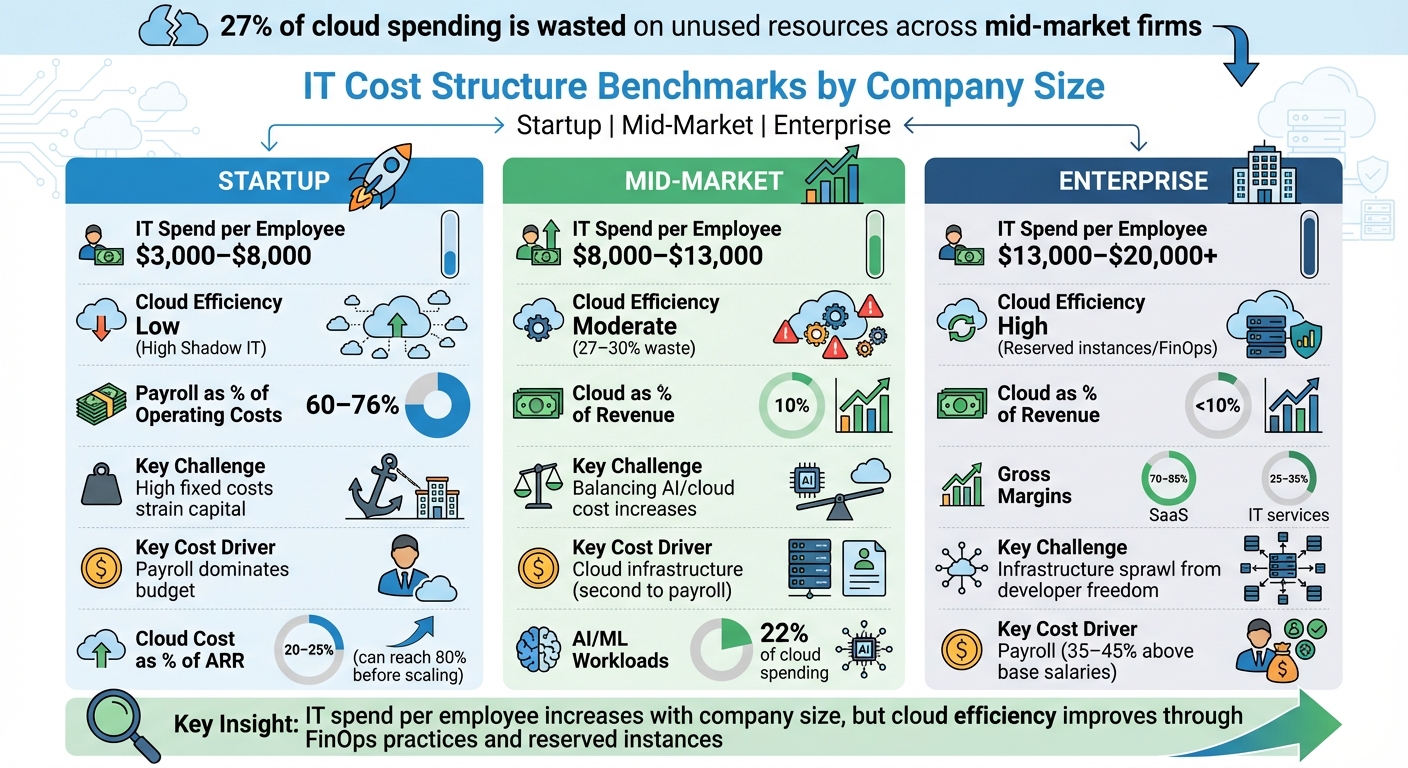
IT Cost Benchmarks by Company Size: Spending and Efficiency Comparison
1. Startup IT Firms
Payroll Costs
Payroll is the largest expense for startup IT firms, taking up a significant chunk of their budgets. According to Kruze Consulting, payroll-related expenses make up 76% of total operating costs for venture-backed startups. Even when factoring in Cost of Goods Sold (COGS), payroll still accounts for 68% of overall spending.
Breaking it down further, wages alone represent 51% of operating costs, while consultants take 12.5%, benefits account for 4.2%, and payroll taxes add another 3.9%. For tech startups, the payroll-to-revenue ratio is typically around 39%, much higher than the 15% to 30% range seen in other small businesses. As The Human Capital Hub notes:
"An attempt to lower the payroll expenses can result in the company losing its key employees or failing to attract top talent... a balance needs to be found".
On top of base salaries, hidden costs like benefits and taxes push the total employee expense 25% to 30% higher. For example, a senior engineer in San Francisco with a $140,000 base salary could cost anywhere from $175,000 to $182,000 annually when all expenses are included. Many startups also compensate for lower base salaries by offering equity. Early employees often receive between 4.75% (median) and 23% (90th percentile) of the company’s total equity.
Here’s a snapshot of typical salaries for key roles:
| Role | San Francisco / NYC | Austin / Remote |
|---|---|---|
| Junior Engineer | $100,000 – $135,000 | $90,000 – $120,000 |
| Senior Engineer | $140,000 – $185,000 | $125,000 – $162,000 |
| Product Manager | $125,000 – $165,000 | $110,000 – $150,000 |
Source: Kruze Consulting
After payroll, cloud infrastructure costs emerge as another significant challenge for IT startups.
Cloud Infrastructure Costs
Cloud hosting is the second-largest expense for growing IT startups, right after payroll. For businesses with less than $10 million in annual recurring revenue (ARR), cloud infrastructure can consume 20% to 25% of ARR. In some extreme cases, cloud costs can even reach 80% of gross revenue before the company scales.
The pricing model for cloud services, especially consumption-based pricing, adds to this unpredictability. AI and machine learning (AI/ML) workloads are a major factor, making up 22% of total cloud spending and contributing to nearly 27% of wasted costs. As Ed Frederici, CTO of Appfire, shares:
"When you're using consumption-based pricing, you can go from a few dollars a day to $1,000, so we're very diligent about keeping an eye on it".
Another source of waste comes from developer sprawl, where development and testing environments remain active long after their purpose is served. This volatility makes it tough for startups to benchmark costs, as traditional forecasting models struggle to keep up with the spikes caused by AI-driven workloads.
Gross Margins and Operating Expenses
When it comes to overall expenses, the funding model of a startup plays a big role in cost allocation. Venture capital-backed SaaS startups often have a very different cost structure compared to bootstrapped firms. For example, VC-backed startups often operate with total costs exceeding 108% of ARR, while bootstrapped companies typically keep costs closer to 80% of ARR.
This difference is clear across departments. VC-backed startups allocate 27% of ARR to research and development (R&D), compared to 17% for bootstrapped firms. Similarly, they spend 20% on sales (versus 10%) and 17% on general and administrative expenses (versus 10%). These variations mean startups need to tailor their financial benchmarks to their specific funding model.
For seed-stage startups, personnel costs usually take up 60% to 70% of the engineering budget, with infrastructure and tools accounting for 20% to 25% and 10% to 15%, respectively. By the time a company reaches Series A, infrastructure costs tend to rise, making up 25% to 30% of the budget.
sbb-itb-97f6a47
2. Mid-Market IT Firms
Payroll Costs
Managing payroll in mid-market IT firms is no small task. These companies often face the challenge of navigating multi-state payroll taxes, benefits coordination, and compliance requirements. Labor costs stand out as a major concern, with 41% of mid-market business leaders identifying them as a primary challenge for 2026.
Employer-paid payroll taxes alone add approximately 10% to gross payroll, with benefits and compliance driving costs even higher. Unlike startups that might use simpler platforms, mid-market firms typically require more robust Human Capital Management (HCM) systems. These systems handle multi-state tax filings, integrate benefits, and ensure labor law compliance.
The cost of payroll software for mid-market firms ranges from $200 to $500 per month as a base fee, plus $9 to $20 per employee. Additional features like time and attendance tracking ($2–$6 per employee), benefits administration ($3–$8), and compliance automation ($3–$6) further increase expenses. For a company with 500 employees, this translates to annual costs of $36,000 to $90,000 just for payroll software.
Despite these financial pressures, 43% of mid-market firms are prioritizing investments in talent acquisition and retention. As Jerry Grisko, President and CEO of CBIZ, puts it:
"The data shows that middle-market companies are approaching 2026 with a balance of cautious optimism and intent. They're not pulling back. Instead, they're prioritizing efficiency, investing in talent and moving deliberately on technology."
But payroll isn't the only area where these firms are feeling the pinch. Managing cloud infrastructure costs is another significant challenge.
Cloud Infrastructure Costs
Cloud infrastructure ranks as the second-largest expense for mid-market IT firms, right behind payroll. On average, these companies allocate about 10% of their annual revenue to cloud services. A notable portion - 22% - of this budget goes toward AI and machine learning workloads. Monthly fluctuations in cloud spending, ranging from 5% to 10%, are common due to workload spikes.
However, inefficiencies like unused licenses and sprawling developer environments contribute to roughly 27% of wasted cloud spending. Rick Clark, Global Head of Cloud Advisory at UST, explains:
"Cloud spend climbs toward 10% of revenue when consumption is disconnected from business value and when we confuse developer flexibility with productivity."
Mid-market firms must strike a balance between the agility of startups and the structured processes of larger enterprises. As Justin Leader, CEO of Human Renaissance, notes:
"In the mid-market, you cannot afford the bloat of the enterprise nor the starvation of the startup."
Healthy mid-market IT firms typically spend $8,000 to $13,000 per employee on IT infrastructure. High-growth firms often double this investment, using technology to drive productivity without increasing headcount proportionally. Remote-first companies, however, face even higher costs, spending nearly three times more per employee - around $17,100 compared to $6,400 for in-office firms.
Some companies have found ways to manage these costs effectively. For example, in January 2026, Appfire maintained cloud spending at just 1.6% of revenue by implementing automated alerts and shutting down non-production environments regularly.
Beyond payroll and cloud, the costs of software development also pose challenges for mid-market IT firms.
Software Development Costs
Building enterprise-grade systems on a mid-market budget is no easy feat. Creating integrated systems that link legacy ERPs to modern cloud platforms can cost between $120,000 and $300,000, with annual maintenance adding another 15% to 25%. Compliance requirements like SOC 2 or HIPAA certifications can tack on an additional $50,000 to $200,000.
Budget allocation for a typical mid-market software project breaks down as follows: 40–50% for frontend and backend development, 15–25% for quality assurance, 10–20% for design, 10–15% for project management, and 5–10% for DevOps and infrastructure. For instance, in January 2026, Keyhole Software partnered with a logistics company in the Midwest to modernize their warehouse management system. The initial investment of $280,000 allowed the client to integrate legacy Honeywell scanners and replicate a familiar user interface, reducing training costs. This modernization eliminated $85,000 in annual licensing fees, cutting the total cost of ownership by 35% by the second year compared to off-the-shelf alternatives.
Carefully benchmarking and managing these development costs is as critical as controlling payroll and cloud expenses for improving profitability.
Gross Margins and Operating Expenses
Mid-market IT firms must differentiate between "Production IT" (cloud hosting and DevOps tools that scale with revenue) and "Corporate IT" (laptops, email systems, and other fixed operating expenses). Inefficient code can lead to increased cloud consumption, which ultimately reduces gross margins over time.
For high-growth mid-market firms, IT spending should ideally fall between 7% and 8% of revenue. Justin Leader, CEO of Human Renaissance, cautions:
"If your IT spend is $4k/head at a SaaS company, your developers are likely building on workarounds that pose a security risk. If it's $25k/head, you have a governance issue."
Cybersecurity is another growing cost, now accounting for 10% to 15% of total IT budgets in well-managed mid-market firms - up from 5% to 7% in 2022. Software spend per employee often peaks during the Series B stage at around $18,000 annually, as companies transition to more robust systems like ERP platforms and SOC 2 compliance tools.
The shift from capital expenditures to operating expenses has also created challenges. Unused licenses and shadow IT can eat into profitability, with regular FinOps audits - conducted every 30 days - helping to recover approximately 15% of the IT budget by eliminating underutilized SaaS subscriptions.
3. Enterprise IT Firms
Payroll Costs
Enterprise IT firms face a unique set of challenges when it comes to managing payroll costs. For starters, employer expenses - like health benefits, payroll taxes, 401(k) matching, and paid time off - add 35% to 45% on top of base salaries. Yet, many businesses underestimate these costs by 40% to 60%, focusing solely on base pay. For example, an IT professional with an $85,000 salary actually costs the company about $117,125 when fully accounted for.
Recruitment is another major expense. Hiring a new IT professional can run between $8,000 and $25,000, factoring in recruiter fees (15%–25% of the salary), job postings, and lost productivity during onboarding. Additionally, training and certifications - such as those from Microsoft, Cisco, or CompTIA - add $4,000 to $12,000 per employee annually.
In the broader industry, labor costs for IT staff - whether internal or external - make up a median 11.2% of the total IT budget. With an annual turnover rate of 13.2%, companies must continuously reinvest in recruiting and onboarding efforts.
However, larger enterprises benefit from economies of scale. For instance, while a small 10-person company might pay $556 per endpoint per month for IT support, a 200-employee enterprise reduces this cost to about $185 per month. Larger firms can also afford to hire specialists in areas like security, networking, or AI, roles that smaller companies often outsource or consolidate into generalist positions.
Payroll is just one piece of the puzzle. For enterprise IT firms, managing cloud infrastructure is another critical cost area.
Cloud Infrastructure Costs
Cloud infrastructure ranks as the second-largest expense for enterprise IT firms, following payroll. At the enterprise level (businesses with $50 million or more in annual recurring revenue), cloud costs typically account for less than 10% of annual revenue - a big improvement compared to the 20% to 25% seen in smaller firms.
Still, managing cloud expenses effectively is a challenge. Around 74% of CFOs report monthly forecast variances of 5% to 10% or more. Enterprises that manage to keep variances under 5% - thanks to governance policies and real-time monitoring - see gross margins improve 2.8 times faster and experience 1.5 times greater margin growth through consistent forecasting.
AI and machine learning add another layer of complexity. While AI-related cloud costs remain at roughly 22% of total cloud spending, as seen in smaller firms, the absolute dollar impact is far greater for enterprises due to their scale. Ed Frederici, CTO of Appfire, highlights this challenge:
"The more AI knowledge you want to have, the more storage you're going to have. It's kind of this non-virtuous cycle - the more capable you make your AI, the more you drive up your two most expensive costs."
Cloud expenses have taken a toll, with 89% of CFOs stating that rising costs have hurt gross margins over the past year. Enterprises that implement strong governance and real-time visibility are 85% more likely to achieve predictable forecasts, helping them manage these costs more effectively.
Gross Margins and Operating Expenses
Enterprise IT firms operate with widely varying margin structures depending on their business model. Software and SaaS companies generally achieve gross margins between 70% and 85%, with pre-tax operating margins averaging 33%. In contrast, IT service-based firms typically see gross margins of 25% to 35%. On average, the software sector reports a gross profit margin of 71.72% and a net profit margin ranging from 19.14% to 25.49%.
Operating expenses break down into several key categories: SG&A (Selling, General, and Administrative) at 24.38% of sales, R&D at 15.98%, and Cost of Revenue, which includes hosting, customer support, onboarding services, and amortization of internal-use software.
SaaS companies often use the "Rule of 40" as a benchmark, which suggests that the sum of a company’s growth rate and profit margin should exceed 40%. Top-performing software and tech firms achieve gross margins of 85% or more. Paolo Mari, VP of Business Analytics and Commercial Management at Metro Supply Chain Group, underscores the importance of linking operational metrics to financial outcomes:
"Operational metrics are important, but the story is not complete until you can see how they impact your costs, revenue and EBITDA margins."
For accurate financial benchmarking, enterprises must categorize expenses consistently. Direct labor, hosting, and third-party fees should fall under Cost of Goods Sold, while R&D and marketing are tracked separately. Notably, 88% of venture-backed enterprise IT firms now rely on third-party cloud providers like AWS, Azure, or Google Cloud instead of managing their own hosting infrastructure.
These metrics highlight the importance of tailored approaches to benchmarking, reflecting the scale and complexity unique to enterprise IT operations.
Analyzing and Benchmarking: What It Is, Why It Matters, and How To Do It
Advantages and Disadvantages
Startups, mid-market companies, and enterprise IT firms each navigate unique challenges and benefits. The balance often comes down to agility, cost management, and expertise. Startups excel in maintaining control over their intellectual property and enjoy flexibility by focusing heavily on payroll. However, this approach quickly leads to fixed costs that can drain limited resources. Mid-market firms strike a balance with a diverse talent pool and the ability to afford specialized roles. Yet, they face a "non-virtuous cycle" where expanding AI capabilities drive up both labor and cloud storage costs, squeezing their profit margins. Enterprises, on the other hand, can hire dedicated specialists for areas like security and compliance. But they often struggle with unchecked developer freedom, leading to infrastructure sprawl and fragmented spending. The table below breaks down these trade-offs for a clearer comparison.
Cloud spending also varies significantly by company size. Startups typically allocate $3,000 to $8,000 per employee annually for IT. They often pay premium on-demand rates to maintain flexibility. Mid-market firms spend between $8,000 and $13,000 per employee, while enterprises spend $13,000 to over $20,000 per employee. Larger firms achieve better efficiency by leveraging reserved instances and dedicated FinOps teams, which can cut costs by 30% to 60% compared to on-demand pricing.
Development models further highlight the trade-offs. In-house teams provide strong intellectual property security but come with high costs - about 2.25 times the base salary when factoring in benefits, taxes, and overhead. Outsourcing reduces labor costs by 60%–70% and eliminates infrastructure expenses, though it can introduce challenges like time zone differences and communication barriers. Hybrid models, which combine in-house and outsourced teams, offer strategic control and operational flexibility. These models become particularly cost-effective for firms with 25 or more employees and are often the most economical choice for companies with over 150 staff.
These cost dynamics reinforce the earlier discussion on payroll and cloud efficiency, underlining the importance of tailored benchmarking.
| Firm Size | IT Spend per Employee | Cloud Efficiency | Key Advantage | Key Disadvantage |
|---|---|---|---|---|
| Startup | $3,000–$8,000 | Low (High Shadow IT) | Speed and flexibility | High fixed costs strain capital |
| Mid-Market | $8,000–$13,000 | Moderate (27–30% waste) | Balanced expertise pool | AI drives simultaneous labor/cloud cost increases |
| Enterprise | $13,000–$20,000+ | High (Reserved/FinOps) | Specialized roles, economies of scale | Infrastructure sprawl from unmonitored developer flexibility |
Conclusion
Research highlights that a company's industry sector, rather than its size, largely determines IT spending levels. For instance, financial services typically allocate between 4.4% and 11.4% of their revenue to IT, while manufacturing dedicates a more modest 1.4% to 3.2%. These sector-specific benchmarks provide essential context for businesses aiming to align their IT budgets with operational needs. Tailoring these insights to your organization’s unique structure is key to achieving cost efficiency.
A strategic approach to IT spending begins by distinguishing between "Run" (day-to-day operations) and "Grow/Transform" (innovation-focused initiatives) categories. High-growth companies, for example, invest nearly double the amount on software per employee compared to their slower-growing counterparts. This approach treats technology as a core enabler of growth rather than a static expense. Such strategies allow businesses to scale revenue without proportionally increasing headcount.
To optimize costs immediately, consider these actionable steps:
- Adopt FinOps practices to reduce cloud waste by approximately 27%.
- Renegotiate vendor contracts based on actual usage data.
- Implement governance for software purchases exceeding $500 per month to minimize redundancy and prevent unnecessary sprawl.
These measures can help transform IT from a cost center into a driver of growth.
"IT isn't a cost center - it's a growth engine." - Veroxos
Success should be measured using a triangulated view: IT spend per employee, IT spend as a percentage of revenue, and comparisons against industry-specific benchmarks. Avoid relying on averages, which can obscure meaningful insights; instead, focus on data from the 25th to 75th percentiles for a clearer perspective.
For expert guidance on cost optimization and digital transformation, consult the Top Consulting Firms Directory (https://allconsultingfirms.com).
FAQs
Which cost metrics should my IT firm benchmark first?
To get a handle on your IT investments, start by looking at IT spend as a percentage of revenue. This helps you see how your spending stacks up against industry norms and whether it supports your business goals. Then, check IT cost per employee - a great way to gauge how efficient and scalable your IT operations are. Lastly, dive into IT spending benchmarks by industry and company size to put your numbers in perspective. These metrics give you a solid foundation for analyzing and fine-tuning your company's cost structure.
How can we reduce cloud waste without slowing product delivery?
To cut down on cloud waste without slowing down delivery, it's all about managing resources smartly. Start by right-sizing instances to match your actual needs and shutting down any idle servers that aren't actively in use. Automating resource scheduling is another game-changer - this allows you to turn off non-essential environments during off-hours, saving both money and energy.
On top of that, you can implement lifecycle storage policies to shift less frequently accessed data (cold data) to more affordable storage options. For ongoing improvements, consider using AI-powered tools that continuously analyze and optimize your cloud usage. These strategies help you keep costs under control while still keeping your product development on track.
How should AI/ML usage change our cloud budgeting approach?
Integrating AI and machine learning into cloud environments calls for a more precise and forward-thinking approach to managing costs. AI-powered tools and FinOps strategies play a key role in tracking and fine-tuning cloud expenses in real time. To keep up with the changing costs of AI/ML, organizations need to adjust their budgets by using analytics to uncover savings opportunities, streamline resource usage, and maintain financial balance. The goal is to align spending with actual usage and the value delivered.