Implementing SAFe (Scaled Agile Framework) can transform how large organizations work, but it’s not without challenges. Here’s a quick breakdown of the most common obstacles and how to address them:
- Resistance to Change: Teams often struggle with shifting from traditional practices to Agile due to fear of role changes or loss of authority. Solution: Build executive support, use change management frameworks, and communicate clear benefits tied to business outcomes.
- Leadership Misalignment: Misaligned executives create decision bottlenecks. Solution: Host leadership workshops, clarify governance, and update reward systems to focus on value delivery.
- Poorly Defined Value Streams: Organizing Agile Release Trains (ARTs) around silos creates inefficiencies. Solution: Conduct value stream mapping workshops to structure ARTs around customer value flow.
- Skill Gaps: Teams often lack expertise in Agile practices, DevOps, or automation. Solution: Invest in role-specific training, certifications, and coaching.
- Legacy Systems: Outdated systems and technical debt slow progress. Solution: Modernize incrementally, implement CI/CD pipelines, and dedicate time for refactoring.
- Ineffective PI Planning: Poor planning leads to missed priorities and dependency issues. Solution: Prioritize features, include all stakeholders, and use tools like Jira Align for tracking.
- Metrics Misalignment: Traditional KPIs undermine Agile goals. Solution: Shift to flow and outcome-based metrics like lead time, deployment frequency, and customer satisfaction.
Key takeaway: Success with SAFe requires tackling resistance, aligning leadership, defining value streams, and addressing technical and skill gaps. Consulting firms can help streamline this process by tailoring solutions to your organization’s needs.
SAFe Implementation Roadmap Overview | Scaled Agile Framework | AgileFever

Main Challenges in SAFe Implementation and How to Solve Them
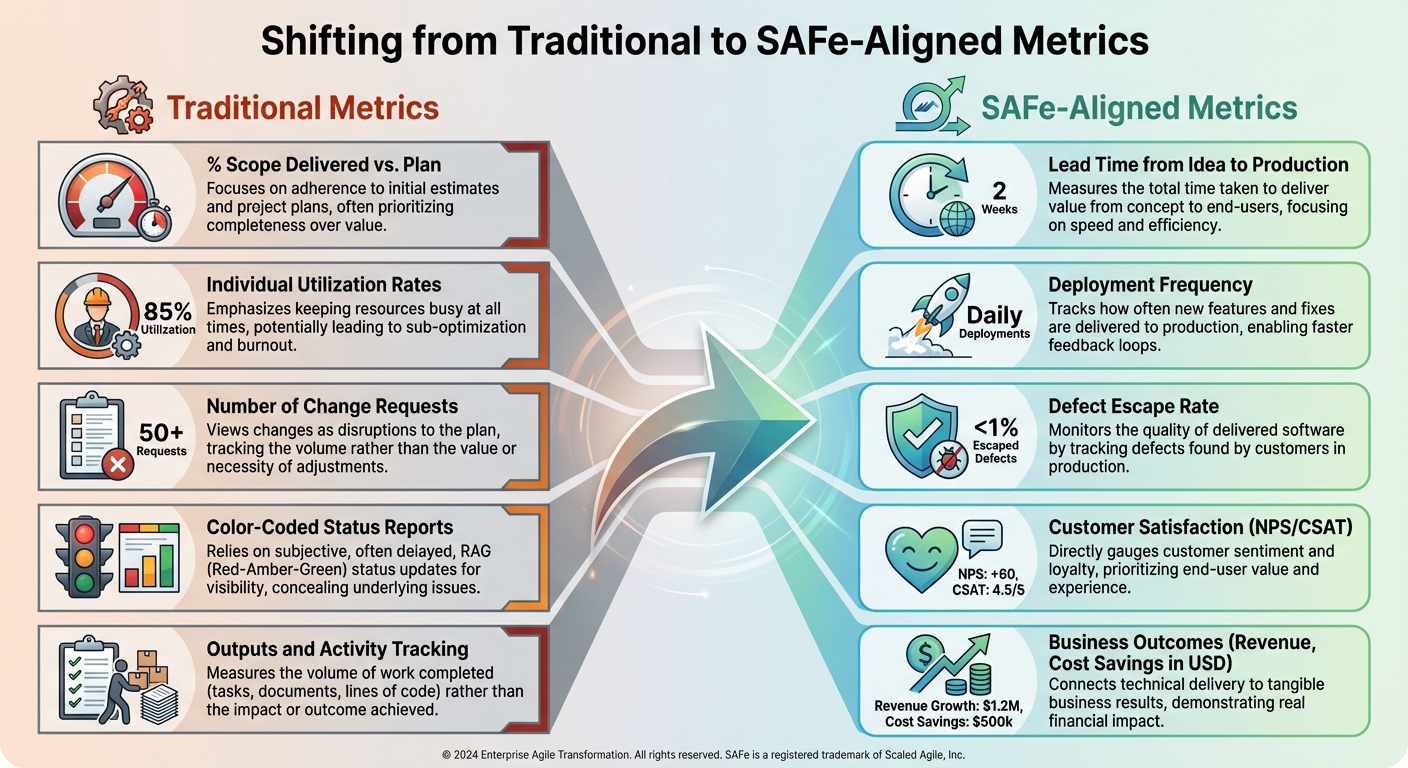
Traditional vs SAFe-Aligned Metrics Comparison
Resistance to Change
Resistance to change is one of the biggest hurdles in rolling out SAFe. It often stems from legacy command-and-control practices, fear of role changes, and middle management's reluctance to adapt as budgets and authority shift toward value streams. When teams start working faster, pre-existing problems tend to surface more clearly.
The solution lies in creating a strong sense of urgency tied to measurable business outcomes, like faster time-to-market, better quality, or higher customer satisfaction. Building a coalition of executive sponsors who visibly support the change is crucial. Using established change frameworks like Prosci or ADKAR can help, along with stakeholder mapping and targeted communication. Launching pilot programs to achieve early wins and sharing case studies relevant to U.S. businesses can build momentum. Regular surveys and listening sessions also provide valuable feedback to fine-tune the rollout. These efforts help pave the way for addressing leadership alignment issues.
Lack of Leadership Alignment
Misaligned leadership can derail SAFe initiatives. When executives lack clarity on governance or fail to embrace necessary behavioral changes, it can lead to decision-making bottlenecks and disengaged teams.
To tackle this, leadership workshops can be highly effective. These sessions should focus on defining business goals and aligning them with how SAFe can support those objectives. Starting small - perhaps with one or two value streams - can simplify the transition. Clearly define decision-making responsibilities at the portfolio, ART, and team levels. Update performance and reward systems to prioritize value delivery, and establish regular executive reviews to track SAFe metrics and adjust strategies as needed.
Poorly Defined Value Streams and Agile Release Trains (ARTs)
Even with aligned leadership, poorly structured Agile Release Trains (ARTs) can fragment value streams. Organizing ARTs within functional silos creates excessive dependencies and delays. Similarly, structuring ARTs by technology layers instead of focusing on the full customer value flow may require organizations to restart their SAFe journey after the first Program Increment.
The solution begins with value stream mapping workshops before launching ARTs. These workshops should analyze how value flows from idea to cash (or usage), focusing on customer segments, product lines, major steps, systems, and handoffs. Utilize current process maps, system architecture diagrams, organizational charts, and financial data (in U.S. dollars) to evaluate economic impact. This analysis helps design ARTs that deliver independent value, with boundaries adjusted iteratively after each PI.
Skill Gaps and Insufficient Training
SAFe success often stalls due to gaps in skills like Lean-Agile practices, product thinking, facilitation, CI/CD, test automation, and trunk-based development.
A structured training plan aligned with your SAFe roadmap can address these gaps. Start with an executive-level SAFe overview, followed by role-specific courses for RTEs, Product Owners, Product Managers, Scrum Masters, and System Architects. Provide additional coaching on Scrum or Kanban practices, SAFe ceremonies, and technical skills like automation and DevOps. Certification paths, such as SAFe Agilist, SAFe POPM, and SAFe RTE, can also be integrated. Allocate budgets (in U.S. dollars) for training, and time-box these efforts to avoid overloading teams during critical delivery periods.
Integration with Legacy Systems
Legacy systems and technical debt often slow down frequent releases, automated testing, and effective team collaboration. As teams speed up their work, they may encounter architectural roadblocks and outdated release processes that highlight non-agile structures in IT, HR, and finance.
To address these issues, adopt an incremental modernization approach rather than attempting a complete overhaul. Use strategies like the strangler pattern to gradually replace outdated components. Introduce CI/CD pipelines and test automation in phases, starting with the most critical areas. Where necessary, blend SAFe ceremonies with existing governance processes, such as regulatory sign-offs. Plan for technical debt reduction by dedicating a portion of each iteration to architecture and refactoring work. This gradual modernization ensures SAFe's agility is sustainable while delivering consistent value.
Ineffective PI Planning and Dependency Management
Poor PI Planning can derail progress. Issues like unclear business priorities, missing key stakeholders, and unmanaged cross-ART dependencies can block teams and slow delivery. Without proper tracking, these problems can spiral out of control.
To improve PI Planning, spend time upfront creating a clear vision and prioritizing well-defined features. Ensure all key roles - architects, security experts, and suppliers - are included in the process. Use facilitation techniques like timeboxing, visual boards, and structured risk management to address potential challenges. Tools like Jira Align can help maintain cross-team dependency boards, enabling real-time monitoring and resolution of issues throughout the PI.
Metrics Misalignment and Measuring Success
As other challenges are addressed, aligning metrics with Agile principles becomes essential. Traditional metrics - like scope vs. plan and individual utilization - often reinforce command-and-control mindsets, steering teams away from delivering real value.
Shift to metrics that focus on value flow and outcomes. Track indicators like lead time from idea to production, deployment frequency, defect escape rates, and customer satisfaction (using NPS or CSAT scores). Include business outcomes like revenue impact and cost savings (in U.S. dollars). Implement OKRs at the portfolio, value stream, and team levels, and use dashboards to visualize flow metrics (e.g., work in progress and throughput) alongside outcome metrics. This balanced approach helps align KPIs and incentives with Agile goals.
| Traditional Metrics | SAFe-Aligned Metrics |
|---|---|
| % scope delivered vs. plan | Lead time from idea to production |
| Individual utilization rates | Deployment frequency |
| Number of change requests | Defect escape rate |
| Color-coded status reports | Customer satisfaction (NPS/CSAT) |
| Outputs and activity tracking | Business outcomes (revenue, cost savings in USD) |
sbb-itb-97f6a47
Using Consulting Expertise for Successful SAFe Implementation
Why Consulting Firms Help with SAFe Success
Bringing in consulting firms can speed up SAFe adoption while helping organizations avoid costly mistakes. With their extensive experience, consultants can quickly spot patterns and potential pitfalls that internal teams might overlook. Acting as neutral facilitators, they bridge the gaps between business and IT, mediate leadership conflicts, and streamline decisions around value streams and funding models - challenges that often slow down in-house efforts.
Consultants go beyond just training. They offer role-specific coaching to address gaps across the organization. This could mean helping executives transition from project-based to product-focused thinking, guiding RTEs through their first PI Planning events, or supporting teams as they adopt technical practices like CI/CD and test automation. This comprehensive coaching ensures that change is implemented consistently across the organization, rather than being limited to isolated team-level efforts. For U.S. companies, consultants also ensure that SAFe practices align with local regulatory and financial requirements.
Another key advantage of consulting firms is their ability to customize SAFe implementations to fit an organization’s unique needs. Instead of rolling out every SAFe element, experienced consultants start by mapping business goals and constraints. They then select the essential components needed to achieve those objectives. This approach prevents the framework from becoming overly bureaucratic and keeps teams focused on delivering value. Consultants also help modernize legacy systems incrementally, establish meaningful flow metrics instead of relying on traditional KPIs, and integrate SAFe practices with existing governance processes. By addressing common hurdles with expert guidance, consultants turn potential challenges into opportunities, laying the groundwork for a smooth and effective SAFe journey.
Finding Experts Through the Top Consulting Firms Directory

Finding the right consulting partner for your SAFe implementation can be tricky, especially for mid-sized organizations without strong connections to global integrators. That’s where the Top Consulting Firms Directory (https://allconsultingfirms.com) comes in. This resource simplifies the search by offering a curated list of experts in IT, digital transformation, and strategic management. U.S. companies can filter and shortlist firms based on their expertise in large-scale agile, enterprise solution delivery, and business agility - skills that are directly tied to successful SAFe implementations.
The directory provides detailed profiles for each firm, highlighting their industry focus and transformation expertise. This saves time and allows organizations to compare firms based on relevant experience, size, and strategic fit - not just price. This is especially important when evaluating a firm’s ability to handle both organizational changes (like leadership alignment and funding models) and technical practices (like DevOps, CI/CD, and test automation) - not just basic training. By giving visibility into each firm’s specific capabilities, the directory helps businesses move quickly from initial research to discovery calls, where they can request tailored strategies, 90-day plans, and measurable success metrics for their SAFe adoption. This ensures your SAFe implementation stays aligned with your goals and delivers meaningful results.
Conclusion: Achieving Long-Term Success with SAFe
Main Takeaways
Implementing SAFe is not a one-and-done effort - it demands ongoing adjustments and a shift in mindset. Challenges like resistance to change, leadership misalignment, and unclear value streams highlight the need for a proactive, iterative approach. Addressing these obstacles is essential for creating meaningful, lasting improvements.
It's worth noting that SAFe implementations often bring underlying organizational issues to the surface. The accelerated workflows can reveal deep-seated challenges that must be resolved to achieve a lasting transformation. Research underscores that healthy team processes, strong management support, and effective inter-team collaboration are key to SAFe success. On the flip side, poor alignment can lead to inconsistent practices and resistance, which are common in 70-80% of initial implementations.
These findings emphasize the importance of deliberate, informed action.
Moving Forward
With these lessons in mind, the path ahead becomes clearer. Aligning leadership and redefining value streams remain top priorities. Long-term success requires a flexible framework supported by a well-defined roadmap, regular evaluations, and metrics that prioritize value delivery over simple resource utilization. Organizations that focus on improving end-to-end workflows, delivering frequently outside of PI boundaries, and fostering collaboration are better positioned for sustained progress.
For organizations looking to accelerate their SAFe journey, consulting firms can be invaluable. They help bridge skill gaps and provide objective, data-driven insights. U.S. businesses can explore the Top Consulting Firms Directory (https://allconsultingfirms.com) to connect with experts who craft tailored SAFe roadmaps, ensuring your transformation delivers measurable and impactful results.
FAQs
What are effective ways to address resistance to change during SAFe implementation?
Overcoming resistance to change during SAFe implementation takes thoughtful communication and active involvement. Start by clearly outlining the advantages of SAFe and how it supports the organization’s goals. When teams are included early in the decision-making process, they feel a sense of ownership, which helps reduce resistance.
Offer thorough training and accessible resources to ensure employees understand the new processes and their roles within the framework. Leadership plays a key role here - leaders should actively champion the change and demonstrate the behaviors they expect from others. Promote a mindset of continuous improvement by celebrating small achievements and addressing concerns as they come up. Building trust and fostering collaboration will make the transition smoother and set the stage for lasting success.
How can consulting firms support a smooth SAFe implementation?
Consulting firms play a key role in making SAFe implementation a seamless process. They bring specialized expertise and tailored strategies designed to fit the unique needs of your organization. Their support helps align teams, refine workflows, and tackle common hurdles like resistance to change or uncertainty about roles.
Leveraging their knowledge in change management and strategic planning, these firms equip your organization with the right tools and frameworks. This not only fosters collaboration but also lays the groundwork for successfully scaling Agile practices throughout your business.
How can companies overcome skill gaps in Agile practices when adopting SAFe?
To tackle skill gaps in Agile practices during SAFe adoption, businesses should invest in focused training and coaching that directly addresses the unique needs of their teams. This approach equips employees with the skills and confidence required to navigate the SAFe framework effectively.
Equally important is cultivating a mindset of continuous learning. Encourage team members to exchange knowledge, participate in workshops, and stay informed about the latest best practices. Supporting cross-functional collaboration is another key strategy, as it allows employees to learn from one another and gain a more hands-on understanding of Agile principles in practice.