Creating a thriving online community isn't just about technology - it’s about designing for how people naturally behave. By applying behavioral design principles, you can encourage participation, build trust, and retain members. Here’s a quick summary of the 10 tips:
- Social Proof: Show testimonials, active user counts, or top posts to build trust and encourage new members to join.
- Gamification: Use points, badges, and leaderboards to make participation engaging and rewarding.
- Reciprocity: Offer value upfront (like useful content or recognition) to motivate users to give back.
- Commitment & Consistency: Start with small actions (like quick comments) to build long-term engagement.
- Belonging: Represent diverse voices and involve members in shaping community rules.
- Feedback Loops: Provide instant responses (likes, comments) to reinforce positive behaviors.
- Simple Onboarding: Use guided tours and quick wins to make joining easy and rewarding.
- Positive Reinforcement: Recognize efforts with badges, reputation systems, and peer appreciation.
- User-Generated Content: Encourage members to contribute posts, reviews, or discussions to deepen their connection.
- Ownership: Involve members in leadership roles or decision-making to strengthen their investment.
Each of these strategies works together to create a community that’s engaging and sustainable. Start small, test what resonates with your members, and refine based on their feedback. Together, these tips can transform passive users into active, loyal participants.
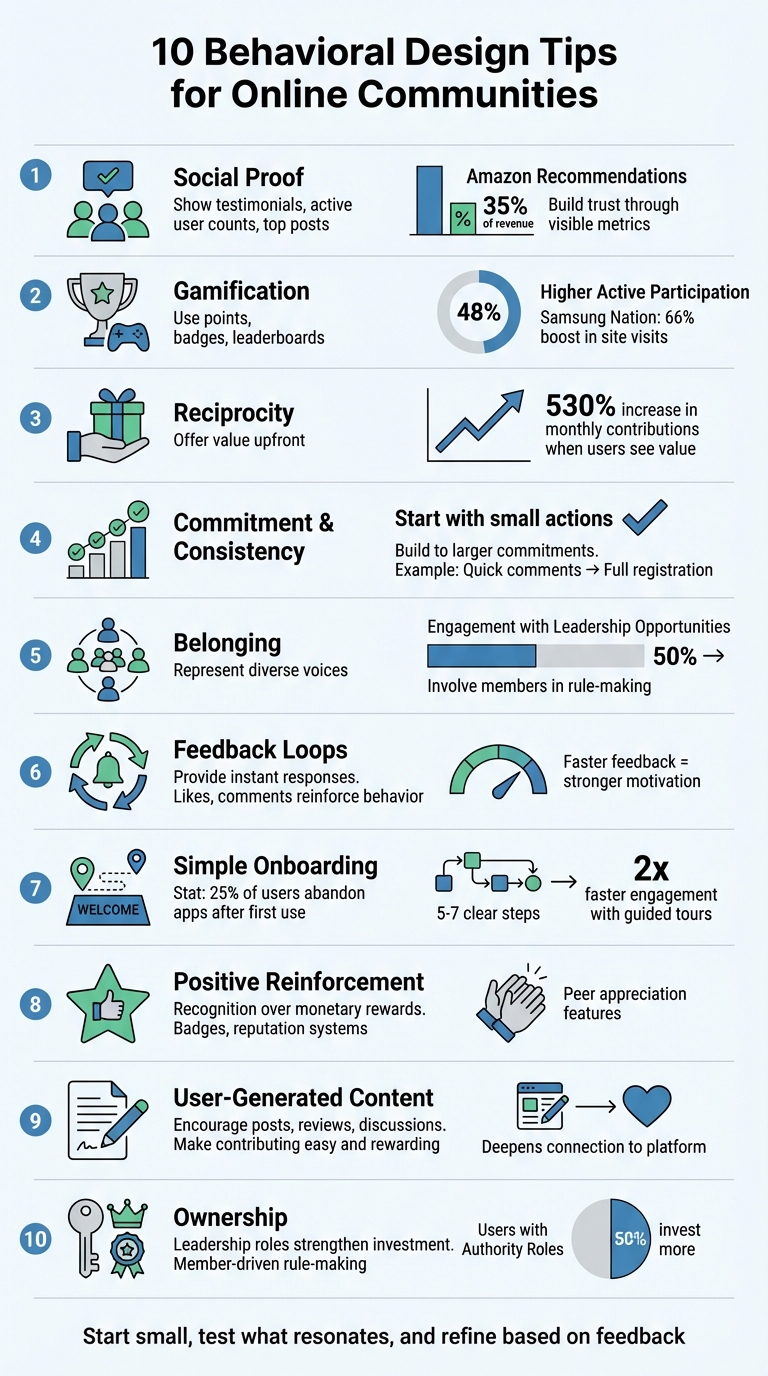
10 Behavioral Design Tips for Online Communities
EP48 - Amy Jo Kim Explains How Game Design Influences Online Social Behavior
1. Use Social Proof to Build Trust
Joining a new online community can feel like stepping into uncharted territory. People often wonder how to fit in or whether it's even worth their time. This is where social proof steps in - it reassures newcomers by showing that others have already found value in the community. When unsure, we tend to look at what others are doing and follow their lead. To make this work for your community, highlight visible metrics that demonstrate its worth.
Showcasing testimonials, reviews, and ratings is a great way to establish instant credibility. These elements act as social signals, proving that real people have benefited from being part of the group. For example, Amazon.com uses recommendations like "Customers who bought this item also bought", which accounts for a whopping 35% of its revenue. The same principle applies to online communities: highlighting popular content or showing the number of active members creates a magnetic appeal for newcomers.
But social proof does more than build trust - it also fosters accountability. By documenting member activity through reviews or reputation scores, you encourage thoughtful participation. Sociologist Peter Kollock from UCLA explains:
Knowing the identity and history of a person allows one to respond in an appropriate manner. If information about individuals and their actions is shared among the group, this also encourages the development of reputations, which can be a vital source of social information and control.
This insight underscores the importance of stable identities. Communities that limit anonymous participation often see higher-quality contributions because members feel more responsible for their actions.
The trick is making social proof visible and accessible. Showcase subscriber counts, highlight top contributors, and prominently display "most viewed" or "most commented" posts. Member testimonials should also take center stage. These small but impactful cues play a huge role in a newcomer's first impression. When they see clear evidence of an active, engaged community, they're much more likely to dive in and participate.
2. Add Gamification to Increase Engagement
Who doesn’t love a little friendly competition or seeing their progress laid out in a way that feels rewarding? Gamification - adding game-like features such as points, badges, leaderboards, and challenges - can turn routine participation into something exciting and enjoyable. When done right, this approach taps into our innate drive for achievement and recognition, making community engagement feel less like a task and more like a game worth playing.
The impact of gamification is hard to ignore. Communities that thoughtfully introduce these elements often see up to 48% higher active participation. Take Samsung Nation, for instance. By rewarding users for activities like watching videos, reviewing products, and engaging in Q&A discussions, the platform saw a 66% boost in site visits. Another standout example is the FullDive Browser App, led by Founder/CEO Eddie Ow, which used the Octalysis Framework to revamp user engagement. The results? A leap in app ratings from 4.1 to 4.7 stars, downloads skyrocketing from 600,000 to 2.7 million, and weekly retention doubling from 12% to 29%. These examples highlight how well-crafted gamification can reshape user behavior and drive meaningful growth.
To make gamification work, design a system that rewards the behaviors you want to encourage. For example, award 20 points for a verified solution and 5 points for a thoughtful comment. Introduce tiered badges - like Bronze, Silver, and Gold - to give members a sense of progression and keep them motivated over time. Leaderboards are another great tool, but they’re most effective when reset weekly or monthly. This ensures newcomers have a fair chance to compete and don’t feel overshadowed by long-time members.
The most successful systems don’t just rely on external rewards; they also tap into intrinsic motivation - our internal drive to learn, connect, and find purpose. Features like daily login streaks play on loss aversion, encouraging members to return regularly so they don’t lose their progress. Simple onboarding tasks, like an "Introduce Yourself" badge, can help new members feel accomplished and welcomed right away. These small wins lower the intimidation barrier and make it easier for people to stick around and engage.
Of course, gamification needs to be balanced with quality control. Include anti-spam safeguards like rate limits, minimum character counts, and moderator reviews to prevent low-effort participation aimed purely at racking up points. The goal is to encourage meaningful contributions, not just empty activity. When designed with both fun and value in mind, gamification becomes a powerful tool for turning occasional visitors into loyal, long-term participants.
3. Apply Reciprocity to Drive Participation
Reciprocity is a powerful motivator. When people receive something valuable, they often feel compelled to give back. Raluca Budiu from Nielsen Norman Group explains it well:
The reciprocity principle is one of the basic laws of social psychology: It says that in many social situations we pay back what we received from others.
In online communities, this concept can work wonders. By offering users something meaningful upfront - like helpful resources, exclusive insights, or public acknowledgment - you encourage them to engage and contribute in return.
For example, providing useful content before asking for participation can set the tone for honest and thoughtful interaction. Research shows that when users feel they’ve gained something of value first, they’re less likely to submit fake or placeholder data (like "Mickey Mouse") and more likely to share genuine responses.
The impact of this approach is striking. In one study of the MovieLens community, users who learned they were below the median for total movie ratings boosted their monthly contributions by an incredible 530%. This demonstrates how showing value can inspire a sense of obligation to reciprocate.
You can also encourage broader community engagement by introducing features like "Good Answer" badges or "Thank You" buttons. These tools promote a type of reciprocity where users feel motivated to give back to the community as a whole, rather than just to a specific individual .
The key takeaway? Don’t ask users to participate until you’ve delivered something valuable. By offering benefits and easy ways to acknowledge contributions, you can turn visitors into active, engaged members.
4. Apply Commitment and Consistency Principles
After leveraging reciprocity, the next step is to encourage small, manageable commitments that pave the way for deeper user engagement over time.
People naturally want to act in ways that align with their previous choices. Once someone takes a small step, they often feel an inner push to stay consistent and a social expectation to appear dependable. As Robert Cialdini puts it:
"Once we have made a choice or taken a stand, we will encounter personal and interpersonal pressures to behave consistently with that commitment. Those pressures will cause us to respond in ways that justify our earlier decision."
Take Yelp, for instance. They let users draft a review before prompting them to register, tapping into the fear of losing their effort to secure a sign-up. Similarly, Fitbit encourages users to set fitness goals during their first interaction, displaying progress visuals and notifications to reinforce the commitment. 23andMe adopts a similar strategy by starting users with a short health survey, followed by a progress bar and a "Continue answering" prompt, motivating them to stay engaged.
A smart approach is to start with low-effort actions - like rating content or leaving a quick comment - before asking for bigger commitments like registration or sharing personal details. This gradual process aligns with behavioral design principles and helps build a sense of loyalty within the community. You can also strengthen commitment by asking users to express their intentions directly, such as, "How many questions do you plan to answer this month?"
Therese Fessenden, Senior UX Specialist at Nielsen Norman Group, highlights this concept perfectly:
"Designs which allow users to make a small, low-cost commitment will be more likely to convert customers than ones that make commitment a costly process."
5. Design for Inclusivity and Belonging
Creating a sense of belonging is essential for building a thriving community. When people feel represented and know their voices matter, they’re more likely to stay engaged and actively participate. This sense of connection is just as important as the engagement strategies we’ve already covered.
The groundwork for inclusivity starts early. Mike Godwin, author and attorney, highlights the importance of this approach:
"Front-load your system with talkative, diverse people".
By introducing a mix of diverse, active voices from the beginning, you establish a culture where varied perspectives are the norm. Communities that delay addressing diversity often find it challenging to shift their culture later on.
Participatory governance is another key factor. The most successful communities allow members to have a hand in shaping the rules that govern them. This ensures that the guidelines reflect what the community actually needs, rather than what moderators assume they need. As Peter Kollock, Associate Professor of Sociology at UCLA, explains:
"The rights of community members to devise their own rules [should be] respected to some degree by external authorities".
Involving members in rule-making not only strengthens their commitment but also builds loyalty, reinforcing earlier engagement strategies.
Providing leadership opportunities is another effective way to empower users. Research shows that giving members pathways to leadership roles boosts engagement significantly - by as much as 50%. Flavia Stoian, Research Associate at Bentley University User Experience Center, observed:
"Regular users saw the opportunity of becoming a moderator as an incentive and they would strive towards it if they were engaged with the community as a whole".
Acknowledging and supporting power users also helps prevent disengagement.
Lastly, focus on cognitive accessibility to eliminate unnecessary barriers. Use clear, familiar language - stick to intuitive labels like "Topics" and "Sub-topics" instead of overly creative alternatives that might confuse users. Keep search bars visible and use standard symbols to make navigation effortless. When your interface aligns with how users naturally think, they feel more at ease and are more likely to participate actively.
sbb-itb-97f6a47
6. Build in Feedback Loops
Building on ideas like gamification and reciprocity, feedback loops play a key role in keeping users engaged within online communities. The concept is simple: when users take an action - whether it's posting a comment, sharing an idea, or updating their profile - they should see the results of that action immediately. This instant feedback creates a sense of accomplishment and encourages them to stay active. Timing is critical here, as the quicker the response, the stronger the motivation to repeat the behavior.
As Loren, a Product Design Lead, puts it:
"The longer it takes for feedback to arrive, the less it will influence future decisions".
This principle is rooted in operant conditioning, which shows that rewards are most effective when they closely follow the desired behavior. Think about social feedback like likes, comments, or replies - they act as instant rewards, spurring users to engage more. Push notifications are another great example. If a user receives a notification within minutes of someone responding to their post, it reinforces their action while the experience is still fresh in their mind.
Progress indicators are another powerful tool. For instance, instead of simply telling users, "You've made 15 posts", you could say, "This post puts you halfway to your next badge." Framing progress in this way makes it feel more tangible and motivating. Using scales that are easy to grasp, like 1–100, helps users see their achievements in a relatable way. These immediate rewards not only encourage participation but also create a visible track record of activity, strengthening user commitment over time.
Visible histories also play a big part in fostering trust and accountability. When users can see their own contributions and those of others, it reinforces a sense of responsibility. This ties back to the earlier discussion on social proof. Over time, this growing reputation encourages cooperation and helps build a strong, healthy community.
7. Simplify the Onboarding Process
First impressions matter, especially during onboarding. Here’s a striking fact: 25% of users abandon an app after using it just once. That means you have a very short window to show new users why your app or platform is worth their time. The goal isn’t to overwhelm them with every detail upfront - it’s to help them quickly see value and get started with ease.
Think of onboarding as a way to reduce friction. When users encounter too much complexity or information, it creates a mental roadblock. To avoid this, keep the onboarding process concise - somewhere between 5 to 7 clear steps is ideal. As Nuance Behavior explains:
"People don't have to know everything at once – your goal is to give them enough information and value to get them started."
– Nuance Behavior
A smart approach is progressive disclosure, which means introducing features gradually rather than dumping everything on users at once. For example, instead of showing all the tools and options, guide them through creating their first post before diving into advanced features like moderation tools. This method respects their time and keeps the focus on what’s immediately important.
Using tools like guided tours and conversation starters can speed up engagement significantly. Community builders who implement these strategies often see new members becoming active twice as fast. A dedicated "Start Here" space with a welcome message, a video walkthrough, and easy-to-find support resources can make a huge difference. Automated welcome sequences tailored to each user’s role or interests also help deliver relevant guidance without adding extra work for your team.
Finally, aim for quick wins. Encourage actions like completing a profile, making a first post, or replying to a comment. These small victories give users an immediate sense of accomplishment - what’s often called the "Aha!" moment. Adding visual progress indicators, like "50% completed", can further motivate users to stay engaged and explore more. These early successes lay the groundwork for deeper engagement strategies coming up next.
8. Use Positive Reinforcement
Acknowledging users' efforts can be a game-changer when it comes to boosting engagement. While rewards like money or gifts might create quick bursts of activity, they often diminish intrinsic motivation - the personal satisfaction users get from participating for its own sake. Building long-term loyalty requires fostering a sense of mastery, belonging, and recognition.
One effective approach is leveraging social comparison. For instance, a MovieLens study found that giving targeted feedback to underperforming users increased their contributions by an impressive 530%. On the flip side, high performers reduced their activity by 62% when exposed to similar comparisons. The takeaway? Tailor performance comparisons to users who are below average to inspire improvement. This kind of recognition not only motivates but also encourages accountability and personal growth.
Reputation systems are another powerful tool. When users have visible histories and consistent identities, it builds trust and accountability within the community. As sociologist Peter Kollock from UCLA puts it:
"Knowing the identity and history of a person allows one to respond in an appropriate manner".
An example of this in action is how SEOmoz (now Moz) encouraged participation by rewarding members who earned 200 "mozpoints" in a month with a free month of software access. This approach tied recognition to tangible benefits while reinforcing a sense of achievement.
Don't underestimate the value of peer-to-peer gratitude. Features like "Good Answer" badges or thumbs-up buttons create an atmosphere of appreciation without requiring moderator involvement. Even small gestures, like automated messages saying "You're doing great!", can go a long way in making users feel valued. These touches remind contributors that their efforts matter, reinforcing the behaviors you want to see more often.
9. Encourage User-Generated Content
Encouraging users to create their own content is a powerful way to deepen their connection to a platform. It builds on concepts like gamification and reciprocity, turning casual participation into a meaningful personal investment. When users contribute content - whether it’s reviews, discussions, or creative submissions - they feel a sense of ownership. This shift from passive observer to active participant strengthens their bond with the community and fosters loyalty. The trick is to make contributing feel effortless, rewarding, and aligned with their interests.
To get started, define the types of content you want to encourage. Maybe it’s product reviews, engaging discussions, or creative projects. Then, design features that naturally prompt users to contribute. As Flavia Stoian, Research Associate at Bentley University User Experience Center, puts it:
"Your goal is to trigger a sense of responsibility for sharing information and because every community is different, a subtle individualization can make for a highly-engaged forum".
Making it easy for users to contribute is just as important. Guided interfaces with helpful tips and examples of high-quality posts can lower barriers. Offering tools that allow users to personalize their profiles or launch custom discussions also enhances their experience. When people feel like they’re shaping their space, they naturally develop a stronger connection to it. It’s like helping to build a house - you care more about the result because you had a hand in creating it.
Another way to strengthen commitment is by involving users in shaping community guidelines. When members have a say in the rules that govern their interactions, those guidelines are more likely to reflect their needs and gain their support. This collaborative approach not only improves engagement but also creates a sense of shared responsibility within the community.
10. Build a Sense of Ownership
Encouraging a sense of ownership in your community goes beyond simple participation - it’s about giving members real influence over how things operate. When people feel they have a stake in something, their commitment naturally grows. In fact, studies have found that around 50% of users in community research said they’d invest more time and energy if they were given a role with authority. This means creating opportunities for members to take on responsibilities like setting rules, moderating discussions, and resolving conflicts. It’s a natural extension of strategies like positive reinforcement and fostering commitment.
One way to do this is by involving members in shaping the community’s rules. When users help define the guidelines that govern interactions, they’re more likely to follow and support them. This collaborative process turns passive participants into active contributors who feel invested in the community’s success.
Another approach is recognizing and rewarding your most engaged users. Offer leadership roles, such as becoming a moderator or serving as a community advisor. These roles not only deepen their connection but also reduce the risk of disengagement.
Finally, encourage self-governance by empowering members to monitor behavior and handle disputes. Implement systems like graduated sanctions, where consequences escalate based on the severity of an issue. This approach builds trust and a shared sense of responsibility among members.
Conclusion
Creating a thriving online community isn't a one-size-fits-all process - it’s about aligning individual actions with shared goals. Techniques like social proof, gamification, reciprocity, and commitment all work together to encourage participation and cooperation. As Peter Kollock from UCLA wisely observed:
"There is no algorithm for community. That is, there is no step-by-step recipe that can be followed that will guarantee a specific outcome".
Simplified onboarding, inclusive design, and opportunities for members to take ownership help foster an environment where collaboration can flourish. These approaches emphasize the importance of tailoring strategies to fit your community’s unique needs. For instance, what works for a professional network may not suit a hobbyist forum. Flavia Stoian from Bentley University's User Experience Center offers this valuable perspective:
"UX guidelines... should always be used for scaffolding community engagement and user goals... be part of the community and be nimble to change".
Experiment with different strategies, closely monitor member responses, and refine your approach based on real feedback. Keep in mind that your community members shape their behavior in response to the systems you establish. Regularly assess whether your rules and features align with your community's evolving goals. Involve members in revising rules that impact them, use graduated sanctions instead of severe penalties, and empower your most active users with meaningful roles.
Start small - focus on one or two techniques that address your community's most pressing challenges. Measure engagement, collect feedback, and adjust as needed. The balance of Trigger (the cue), Ability (ease of action), and Motivation (desire to participate) will guide you toward effective solutions. For more insights on building strong communities, visit the Top Consulting Firms Directory blog.
FAQs
How can I use social proof to boost engagement in my online community?
Social proof - our natural tendency to follow the actions of others - can play a big role in boosting engagement within online communities. It builds trust and creates a sense of activity, making people more likely to participate. A great starting point is showcasing real-time activity, like displaying "X members are online now" or highlighting recent contributions. Including user-generated content such as testimonials, reviews, or "member-spotlight" stories can also add a personal and relatable touch. Recognizing popular posts or rewarding top contributors with badges or leaderboards can further motivate members to get involved.
When deciding what kind of social proof to highlight, focus on specifics. For instance, phrases like "5,000 members completed this tutorial" or "1,200 users adopted this feature" spotlight actionable behaviors and inspire others to follow suit. Accuracy is key - always tie these figures to real, identifiable members rather than vague or anonymous data to keep it credible. You can also integrate these social proof elements into onboarding screens or call-to-action buttons, making them a natural part of the user experience.
If you're looking for tailored advice on leveraging social proof effectively, the Top Consulting Firms Directory connects you with experts in behavioral design and community growth who specialize in engaging U.S. audiences. They can help fine-tune your platform for maximum impact.
What are some effective examples of gamification in online communities?
Gamification has proven to be an effective way for platforms to increase user engagement and encourage community interaction. Take Duolingo, for instance - it uses streaks and leaderboards to keep language learners motivated. Similarly, platforms like Khoros use badges and ranking systems to recognize and reward active members. These features play on the natural human drive for achievement and acknowledgment, turning participation into a more enjoyable and fulfilling experience.
By weaving in elements like progress tracking, challenges, and rewards, online communities can create an interactive environment that keeps users engaged and encourages them to remain active and connected.
How does the principle of reciprocity encourage user engagement in online communities?
Reciprocity creates a natural give-and-take dynamic - when people receive assistance, acknowledgment, or useful content, they often feel inclined to return the favor. This might take the form of answering questions, sharing their knowledge, or offering helpful resources.
When online communities make room for these moments of reciprocity, they can strengthen relationships and inspire ongoing involvement. This, in turn, helps drive higher engagement and keeps members coming back.