When deciding how to fund your startup, the choice often comes down to angel investors or venture capitalists (VCs). Both offer funding but differ in approach, investment size, and involvement:
- Angel Investors: Individuals investing their own money, typically at early stages. They provide smaller amounts ($10,000–$500,000), close deals quickly (2–4 weeks), and usually act as informal mentors without demanding much control.
- Venture Capitalists: Firms managing pooled funds from institutions, investing larger amounts ($1M+). They focus on startups with proven traction, take months to finalize deals, and demand active involvement, often including board seats.
Quick Comparison
| Criteria | Angel Investors | Venture Capitalists |
|---|---|---|
| Funding Source | Personal funds | Institutional funds |
| Investment Size | $10,000–$500,000 | $1M+ |
| Stage of Investment | Early-stage (idea/seed) | Growth-stage (traction) |
| Decision Speed | 2–4 weeks | 3–6 months |
| Involvement | Light mentorship | Active, with board seats |
Key takeaway: Angel investors are ideal for early-stage startups needing quick, flexible funding. VCs are better suited for scaling businesses with proven revenue or user growth. Choose based on your startup's stage, funding needs, and willingness to share control.
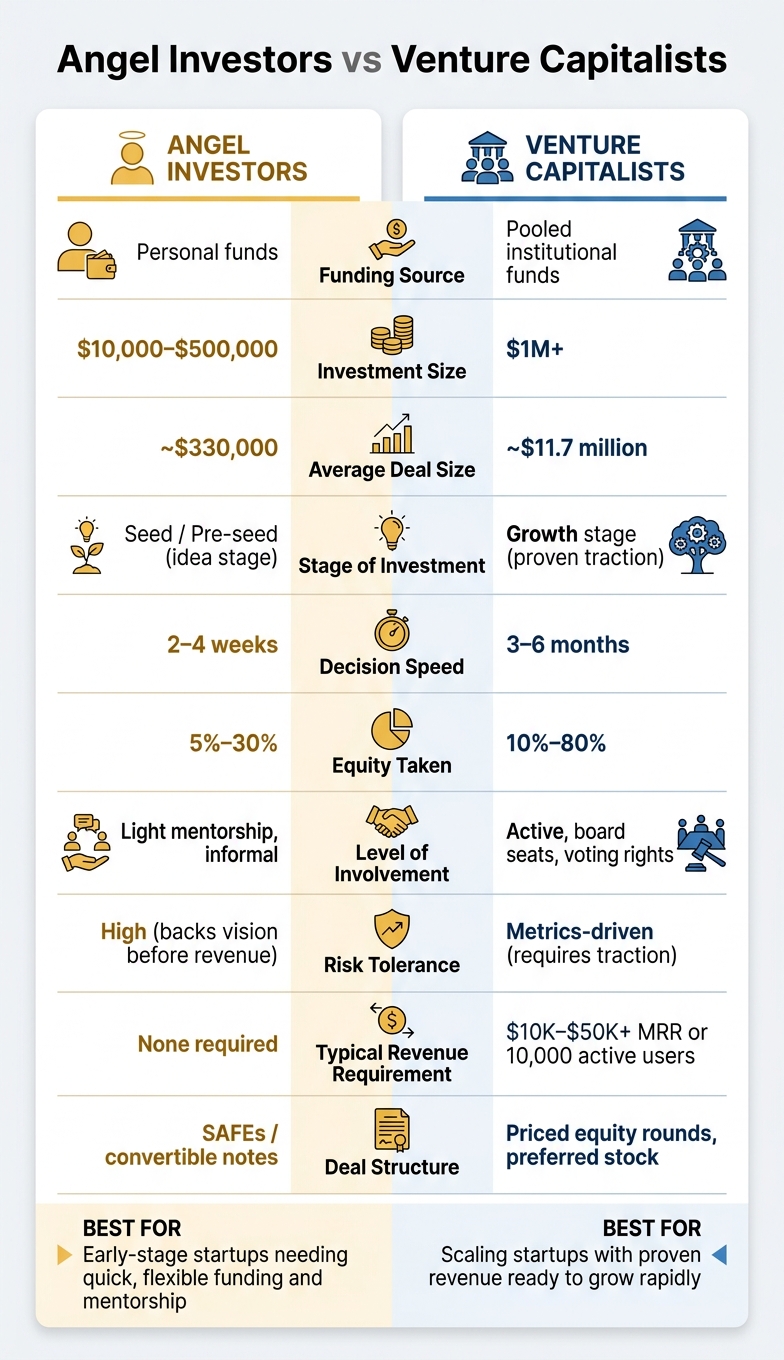
Angel Investors vs Venture Capitalists: Side-by-Side Comparison
Angel Investors
Who Are Angel Investors?
Angel investors are individuals with significant financial resources who invest in early-stage startups, usually in exchange for equity. Most of these investors meet the SEC's criteria for an accredited investor, which means they either have a net worth of at least $1 million (excluding their primary residence) or an annual income of $200,000 or more. Interestingly, about 59% of angel investors are former entrepreneurs or high-level executives, which means they often bring practical experience along with their funding. Bo Ren, Managing Director of Early-Stage Startups at SVB, highlights this unique combination:
"Angels are often a combination of operators, scouts, and investors, so you're really getting a lot out of them."
This mix of financial backing and hands-on expertise makes angel investors a critical resource for startups, especially during their earliest stages when institutional funding might not yet be available.
Investment Size and Approach
Angel investors don’t just contribute experience - they also bring flexibility in terms of investment size and speed. Their contributions typically range from $10,000 to $500,000, with pre-seed rounds often falling between $100,000 and $250,000. When angels collaborate through syndicates, the funding can grow, averaging around $600,000 per round.
One major benefit of angel funding is how quickly deals can happen. Since angels use their own money, they can close investments in as little as 2 to 4 weeks. Their process tends to be less formal, relying more on trust in the founder and their vision than on extensive financial evaluations. To keep things simple and cost-effective, they often use SAFEs (Simple Agreement for Future Equity) or convertible notes for structuring deals.
Angel investors generally take an equity share of 10% to 25% and aim for a return of 3x to 10x within 5 to 7 years. These returns are typically realized through acquisitions or IPOs.
Level of Involvement
Unlike venture capitalists, angel investors usually take a more relaxed approach to their involvement. They rarely demand a seat on the board unless their investment exceeds $250,000. Instead, they prefer to maintain informal communication, offering advice and guidance without the need for rigid formalities.
Even with a hands-off style, angel investors provide essential support. They often act as mentors, sharing their industry knowledge and opening doors through their networks. Their involvement also adds credibility to a startup, serving as a signal to later-stage investors that the venture is worth backing. Choosing angels who have expertise in your industry can be a game-changer, as their connections and insights can be far more impactful than financial support alone.
sbb-itb-97f6a47
Venture Capitalists
Who Are Venture Capitalists?
Venture capitalists (VCs) are professional investors who manage funds pooled from limited partners (LPs), such as pension funds and university endowments. Unlike angel investors, who invest their own money, VCs are accountable to their LPs to deliver strong returns. This responsibility significantly influences how they operate.
Bo Ren, Managing Director of Early-Stage Startups at SVB, captures the difference well:
"Angels are your goalkeepers... VCs are the adults in the room."
This highlights the more structured and accountable nature of VCs compared to the flexible and founder-friendly approach of angel investors. VCs typically operate within a formal fund structure, often with a 10-year lifecycle. Their primary goal? To identify "unicorns" - companies that can single-handedly return the value of an entire fund. Niclas Schlopsna, Managing Partner at Spectup, explains:
"VCs fund momentum, not potential. They want to see what's already working, then scale it."
This focus on scalability and proven performance shapes both their investment sizes and their methods.
Investment Size and Approach
VCs are known for writing much larger checks than angel investors, often starting in the multi-million-dollar range for early funding rounds. For example, in 2024, U.S. venture capital firms invested $209 billion across approximately 15,600 deals, with mega-rounds commanding a significant share of that capital.
These larger investments come with a rigorous due diligence process, which can take anywhere from 3 to 6 months. This process involves financial audits, customer reference checks, technical evaluations, and market analysis. Unlike angels, who often use SAFEs or convertible notes, VCs prefer priced equity rounds with preferred stock. They typically aim to secure equity stakes of 20% to 40%, depending on the company's stage and valuation.
Founders seeking Series A funding should be well-prepared. This means having a detailed "data room" ready, including documents like customer contracts, SaaS dashboards, audited financials, and a clean cap table. Additionally, most VCs expect startups to be incorporated as Delaware C corporations, which is the standard structure for institutional investments.
This thorough approach ensures VCs are deeply involved in the companies they back.
Level of Involvement
VCs don’t just provide funding - they actively shape the businesses they invest in. As Manas Sunita Pal, Co-Founder of PedalStart, puts it:
"VCs are looking for businesses that can become very large, very quickly... they are not paying for a dream alone. They want signs that the machine can actually run."
This involvement often includes a formal board seat, along with voting rights and protective provisions. VCs may even have veto power over key decisions, such as hiring or firing executives, taking on debt, pivoting the business model, or entering M&A negotiations. Founders can also expect structured reporting requirements, including regular financial updates and board presentations.
VC-backed startups are expected to achieve rapid growth - doubling or tripling revenue annually - and aim for a liquidity event, like an IPO or acquisition, within 5 to 7 years. This hands-on approach reflects the high stakes and expectations tied to venture capital investments.
Key Differences Between Angel Investors and Venture Capitalists
Comparison Table
Angel investors and venture capitalists (VCs) operate differently when it comes to funding, deal size, and involvement. Here's a quick breakdown:
| Criteria | Angel Investors | Venture Capitalists |
|---|---|---|
| Funding Source | Personal funds | Pooled/institutional funds |
| Investment Size | $10,000 – $500,000 | $1 million and above |
| Average Deal Size | ~$330,000 | ~$11.7 million |
| Stage of Investment | Seed/very early stage | Early growth/traction-backed rounds |
| Equity Expectations | 5% – 30% | 10% – 80% |
| Level of Involvement | Light; mentorship-focused | Active involvement; offers strategic guidance |
| Decision-Making Speed | Rapid and informal | Slower and more structured |
The stark contrast between the average angel deal size of ~$330,000 and a VC's ~$11.7 million highlights more than just the size of the checks. It reflects how their funding structures, accountability, and growth goals differ.
Risk Tolerance
Risk tolerance is another key factor that separates angel investors from VCs.
Angel investors typically use their own money to back a founder's vision, often before the business generates revenue. As SoFi explains, "Angel investors take on more risk than VCs and banks... since it is their money at stake and the target firm is in its infancy." This personal financial commitment allows them to make quick, instinct-driven decisions.
On the other hand, VCs are responsible for delivering returns to their limited partners, which include pension funds, university endowments, and corporations. This accountability drives a more metrics-focused approach. Leslie Feinzaig, Managing Director at Graham & Walker, explains:
"Every investment VCs make must have the potential to 'return the fund.' Outcomes that are great for angel investors may not be substantial enough for a VC."
This difference in risk tolerance often dictates which type of investor is appropriate for a business at a particular stage.
Angel Investor vs Venture Capital: The Honest Truth
Which Is Better for Your Startup?
Choosing the right investor depends on where your startup stands, how much capital you need, and the level of involvement you're looking for.
Factors to Consider
If your startup is still in the product development phase with little to no revenue, you probably won’t meet a VC’s expectations. VCs typically look for startups generating at least $50,000 in monthly recurring revenue (MRR) or with 10,000 active users showing strong month-over-month growth. On the other hand, angel investors often back founders based on their vision and expertise, even without these metrics.
Timing is another key difference. Angels usually close deals within 2–4 weeks, while VCs can take 3–6 months due to their more thorough due diligence and legal checks. If speed is a priority, angel funding might be the better choice. Another consideration is control: angels rarely demand board seats, while VCs almost always do, along with the expectation of an exit within their 10-year fund cycle.
These differences can help you decide whether you need the flexibility of angel investors or the structured involvement of venture capital.
When to Choose Angel Investors
Angel investors are often the best fit for startups in the idea, pre-seed, or seed stages, especially if you’re seeking between $10,000 and $500,000 to get started.
Bo Ren, Managing Director of Early-Stage Startups at SVB, describes angel investors this way:
"Angels are your goalkeepers... they tell you that what you're doing is valuable and empower you to keep creating."
In addition to funding, angels often provide informal guidance and useful industry connections. Many angels today are former founders - so-called operator-angels - who bring firsthand experience from building and selling companies. If you’re working with multiple angels, consider using a Special Purpose Vehicle (SPV) to consolidate them into one entry on your cap table. A cluttered cap table can deter future VCs.
Ultimately, angel investors are a great match for startups that need early-stage support and mentorship without significant strings attached.
When to Choose Venture Capitalists
Once your startup has proven its business model and is ready to scale, venture capital becomes a better option. VCs typically get involved when startups need $1 million or more to grow rapidly.
VCs offer more than just funding. They can connect you with recruiting networks, provide follow-on funding, and introduce you to enterprise clients. These resources are often beyond what angels can offer. As Bo Ren explains:
"Venture capital might be the push that allows you to sell upstream to much bigger Fortune 500 clients. When everything's working, and you just need to supercharge your startup, that's the time for venture capital."
However, timing is critical. Pitching VCs too early - before reaching $10,000–$50,000 in MRR - can leave you with a "not ready" label that’s hard to shake. Before reaching out, research the partner’s last 10 investments to ensure their focus aligns with your startup’s stage and industry.
Many startups follow a progression in their funding journey: raising $100,000–$250,000 from angels to build a minimum viable product (MVP), then securing $500,000–$2 million from a mix of angels and micro-VCs, and finally seeking institutional VC funding for a Series A once key metrics are in place. This sequential approach allows you to align funding sources with your startup's growth stage and needs.
Conclusion
Deciding on the right investor for your startup boils down to your company's stage and growth objectives. Angel investors are ideal for early-stage startups, offering smaller investments - typically between $10,000 and $500,000 - along with mentorship and flexibility. On the other hand, venture capitalists (VCs) are better suited for startups with proven traction, requiring larger investments of $1 million or more to scale quickly.
These funding sources often complement each other at different stages of growth. As Manas Sunita Pal, Co-Founder of PedalStart, wisely notes:
"Venture capital is not automatically the 'bigger and better' option just because the cheque has more zeros on it."
Ultimately, the best funding source aligns with your startup's current stage, revenue, traction, and your willingness to share control. Picking the right investor can set the foundation for sustainable growth.
For more personalized strategies and expert advice, check out the Top Consulting Firms Directory.
FAQs
Can I raise from angels and VCs at the same time?
Yes, it’s possible to secure funding from both angel investors and venture capitalists at the same time. These two types of investors often work well together. Angel investors typically step in during the early stages, helping you develop an MVP and gain initial traction. This early support can make your business more appealing to venture capitalists when you're ready to raise larger, later-stage funding. Interestingly, many angel investors also choose to participate in VC-led rounds to continue backing your growth.
What terms matter most when choosing an investor?
When choosing an investor, it's crucial to think about your company's current stage, how much funding you need, and how much control you want to maintain.
If you're in the early stages and need less than $500,000, angel investors might be the right fit. They often provide more flexibility and fewer formalities. On the other hand, if your business has already gained traction and you're seeking $1,000,000 or more, venture capitalists can be a better option. They typically offer structured support, which may include governance and taking a seat on your board.
Make sure your goals align with the investor’s priorities to build a partnership that works for both sides.
How do I know I’m “VC-ready”?
Your business is ready for venture capital when it operates in a large market - typically one with a total addressable market (TAM) of $1 billion or more - and demonstrates solid traction. This could mean having paying customers or showing consistent revenue growth. To attract investors, you'll also need a strong founding team, well-organized financial records, and clear, measurable metrics.
Keep in mind, venture capital comes with trade-offs. Be prepared for ownership dilution, increased board oversight, and the significant time commitment involved in both fundraising and managing investor relationships.