Local feedback helps businesses understand specific customer needs and address issues at the ground level. It’s more detailed than broad metrics and can lead to better decisions when analyzed properly. Here’s how to make the most of local feedback:
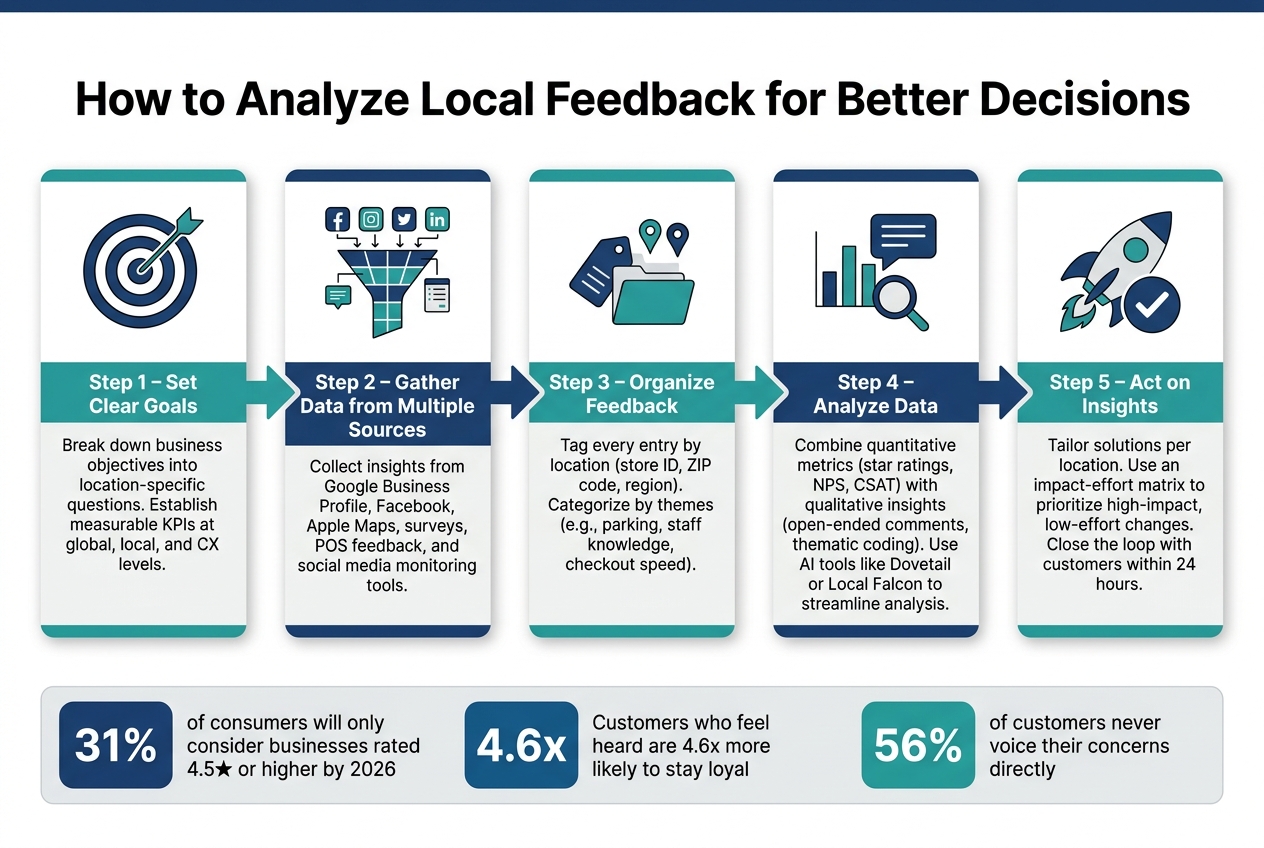
- Set Clear Goals: Break down business objectives into location-specific questions and establish measurable KPIs.
- Gather Data from Multiple Sources: Use online reviews, surveys, social media, and point-of-sale feedback to collect insights.
- Organize Feedback: Tag feedback by location and categorize it by themes to identify trends and issues.
- Analyze Data: Combine quantitative metrics (e.g., star ratings, NPS) with qualitative insights (e.g., customer comments) for a complete picture.
- Act on Insights: Tailor solutions to each location’s needs, prioritize high-impact changes, and follow up with customers to build trust.
Businesses that act on local feedback are more likely to improve customer satisfaction and drive growth. By focusing on actionable insights and location-specific strategies, you can turn feedback into meaningful improvements.
How to Analyze Local Feedback: A 5-Step Process for Better Decisions
The State of Reviews 2025: Local Consumer Review Survey Breakdown
sbb-itb-97f6a47
Setting Local Goals and Key Metrics
To create effective local strategies, you need clear objectives and measurable KPIs. Without these, local feedback can feel like random noise instead of actionable insights.
Setting Location-Based Business Objectives
Start by refining your overall business goals into specific, local-focused questions. For instance, if weekday sales differ between downtown and suburban locations, ask why that’s happening and dig into the data. This level of specificity helps you decide what to measure and how to interpret the results.
"National averages flatten regional variation. If your community reacts differently to pricing or product styles, lean into that uniqueness." - Greater Perimeter Chamber
A helpful approach here is the "Detect-Interpret-Decide-Act" loop. Here’s how it works: detect signals from sources like social media or field reports, interpret those signals by categorizing them (e.g., operational, economic, or behavioral), decide on a course of action based on your goals, and then test your decision with small-scale experiments. This method ensures your objectives align with real-world conditions instead of assumptions.
Identifying Relevant KPIs
Your KPIs should align with the unique context of each location. A downtown store will naturally see more foot traffic and calls than a rural one, so your metrics should reflect local demand rather than just overall marketing performance. To keep your analysis focused, divide metrics into two main levels:
| Metric Level | Examples | Best Used For |
|---|---|---|
| Global | Overall star rating, brand sentiment trends | Strategic planning, resolving regional reputation concerns |
| Local | Direction requests, calls, booking inquiries | Operational fixes, coaching for specific locations |
| CX | NPS, CSAT, Customer Effort Score (CES) | Benchmarking loyalty, identifying pain points |
By 2026, 31% of consumers will only consider businesses with a 4.5-star rating or higher, up from 17% in 2025. This makes reputation metrics - such as review volume, star ratings, and response rates - critical for any location-specific strategy.
"The problem usually isn't a lack of data; it's that the data doesn't easily translate into decisions." - Karushna Jeyakumar, SEO Expert
Building Time-Bound Baselines
A baseline is your reference point for tracking progress. Without one, it’s impossible to tell whether performance is improving or just fluctuating. For fast-paced industries like retail or food service, monthly comparisons are best for spotting early shifts in sentiment. For more stable sectors like B2B, quarterly reviews are the norm .
To ensure consistent reporting, use standardized date formats (e.g., March 05, 2026, vs. June 05, 2026). Before acting on any local insights, validate your findings with both quantitative and qualitative data to confirm patterns. This prevents overreacting to anomalies, like one bad week or a single vocal customer.
Establishing baselines and using tailored KPIs allows you to analyze local feedback effectively. With clear goals in place, you’ll be ready to collect and act on feedback that drives meaningful improvements.
Collecting Local Feedback from Multiple Sources
Once you've set clear local goals and KPIs, the next step is gathering feedback from various channels to get a complete picture. No single source can provide everything you need - pulling insights from multiple platforms is essential.
Using Online Review Platforms
Start with the big names like Google Business Profile, which is trusted by 50% of consumers. A one-star improvement here can boost engagement by 44%, while responding to reviews increases conversions by 16.4%. Facebook also plays a key role, with 55% of consumers relying on it for local recommendations. Don’t overlook Apple Business Connect, as 26% of users turn to Apple Maps to find businesses.
One thing to keep in mind: Yelp has strict rules against asking customers for reviews - no incentives or direct requests allowed. For other platforms, simplify the process by sharing direct review links via email, SMS, or even QR codes printed on receipts. This reduces barriers and makes it easier for customers to leave feedback. And remember, by 2026, your profile’s activity - like responding to reviews and posting updates - will matter as much as the star rating itself.
To go deeper, supplement online reviews with surveys that capture immediate, on-site customer experiences.
Running Surveys and Point-of-Sale Feedback
Surveys and point-of-sale feedback are great for gathering localized, real-time insights. Stick to the 2-Question Rule: ask for a quantitative rating (e.g., 1–10) and pair it with an open-ended question like, "What could we improve?". Keep surveys short - response rates drop by over 40% if you wait more than 24 hours after the customer experience.
Timing and delivery are critical. For physical locations, a QR code on the receipt lets customers respond right away without needing their contact information. For service businesses, automated SMS messages triggered by your POS or CRM system work well. Always tag feedback by location so you can identify whether an issue is specific to one store or part of a broader trend. This approach ensures you get actionable insights tailored to each location.
"Customers who feel heard are 4.6 times more likely to stay loyal." - Qualtrics XM Institute
Monitoring Social Media and Support Channels
Social media is a goldmine for customer feedback, whether or not you're actively monitoring it. Many complaints are posted publicly without tagging your brand, so tools like Sprout Social (starting at $79/month) can help you track mentions across platforms such as Facebook, X (formerly Twitter), Instagram, Reddit, and even local community groups.
When negative feedback appears, use the A.C.E. method: acknowledge the frustration, address the issue, and then move the conversation into private channels. Aim to respond to mentions within 24 hours. As Alvier Marqueses, Growth Marketing Manager at Resonate CX, puts it:
"A review response sent within 24 hours signals genuine attentiveness. A response sent four weeks later... signals the opposite."
Make sure location-specific complaints are routed to the appropriate store or regional manager instead of a central inbox. This ensures issues are resolved at the right level. By integrating social media feedback with reviews and survey data, you’ll create a well-rounded feedback strategy that sets the stage for effective analysis and action.
Organizing and Analyzing Local Feedback
Turning raw feedback into actionable strategies is where the real value lies. Once reviews, surveys, and social media comments start rolling in, the next challenge is making sense of it all. Without proper organization, feedback is just noise. Structuring it effectively allows you to uncover actionable insights, setting the stage for better decision-making at the local level.
Segmenting Feedback by Location and Theme
Every feedback entry should include a geographic tag - whether it's a store ID, ZIP code, or region. Without this information, it’s impossible to pinpoint whether an issue like slow service is specific to one location or part of a larger trend. In addition to tagging by location, standardize how feedback is categorized across all branches. This consistency makes it easier to identify patterns and differentiate between localized issues and broader, systemic problems.
"A satisfaction score of 78% means nothing until you know which customer cohort, which location, and which touchpoint is dragging it down." - Alvier Marqueses, Resonate CX
Here’s a practical tip: if a recurring negative theme appears in three or more locations and shows a growing trend, it could indicate a systemic issue that requires intervention at the corporate level. On the other hand, if the problem is confined to one or two locations, it’s likely a local operational or training issue.
Applying Quantitative Analysis
Quantitative analysis helps you track what’s happening by focusing on key metrics. Keep an eye on average ratings by location and monitor trends in NPS (Net Promoter Score) and CSAT (Customer Satisfaction) scores over time. By correlating feedback themes with metrics like revenue, you can prioritize issues based on their financial impact. For instance, a usability complaint tied to $80,000 in monthly recurring revenue (MRR) with a 10% churn risk demands more attention than a billing issue affecting $5,000 in MRR.
Custom anomaly thresholds are also crucial. A 20% increase in complaints might be normal for a busy store but could signal trouble for a smaller branch. Once you’ve identified the numerical trends, shift to qualitative analysis to uncover the "why" behind the data.
Conducting Qualitative Analysis
Numbers tell you what’s happening, but qualitative analysis explains why. Open-ended survey responses, review comments, and support transcripts provide the context behind customer feedback. Thematic coding is a powerful way to organize this information. By categorizing feedback into themes - like "parking", "staff knowledge", or "checkout speed" - and pairing it with sentiment analysis, you can avoid oversimplifying mixed reviews into a single score.
"The score says '72 CSAT.' It doesn't say '72 because checkout is fast but staff knowledge is poor, and it's getting worse since the March training cutbacks.'" - Swati Sharma, Zonka Feedback
Advanced AI tools, such as Dovetail or Local Falcon, can streamline thematic coding and SWOT analyses. These tools save time by automating much of the heavy lifting, allowing your team to focus on making strategic decisions instead of manually sorting through data.
Turning Feedback Insights into Local Actions
Once you've gathered local feedback, the next step is to put it into action. According to a Gartner study, fewer than 10% of companies actually act on the feedback they collect, and only 5% let customers know about the changes they’ve made based on that feedback. This disconnect between gathering insights and taking action is where many businesses falter.
"Insight without action erodes trust." - Franck Ardourel, CX Consultant
Building Location-Specific Strategies
To address customer concerns effectively, tailor your solutions to the specific needs of each location. For instance, a slow-checkout complaint at a busy store in Chicago might call for process improvements, while the same issue at a suburban location could point to a need for better staff training. Regional preferences also play a role - research shows that customers in the Northeast often value speed, while those in the Midwest may respond better to community-focused messaging. Adjust your strategies to reflect these differences.
Using an impact-effort matrix can help prioritize actions based on their potential customer impact and the ease of implementation. Focus first on high-impact, low-effort changes. For example, adjusting store hours to match local demand or hiring bilingual staff in diverse areas like Los Angeles are straightforward changes that can make a big difference. Similarly, inventory and pricing can be tailored to local purchasing habits, such as stocking lightweight clothing in warmer Southern states. Once these strategies are in place, create systems that allow for ongoing refinement and improvement.
Setting Up Feedback Loops for Continuous Improvement
A strong feedback loop ensures that customer concerns are addressed promptly and systematically. One approach is to have an inner loop for resolving individual complaints within 24 hours and an outer loop for tackling broader, systemic issues across locations. For example, if multiple branches in the same area report billing confusion, that signals an outer loop problem requiring a larger-scale solution, not just individual fixes.
A practical way to manage feedback is through a weekly 45-minute meeting, divided into three equal parts: reviewing recurring themes, assigning tasks, and evaluating the impact of completed actions. Every task should have a clear owner, a deadline, and a measurable success metric - otherwise, the feedback risks becoming useless data. Following up with customers is equally important; those who receive updates after giving feedback are 2.5 times more likely to recommend the brand. A simple "You spoke, we listened" email or social media post can go a long way.
If your team is stretched too thin to handle these efforts, it may be time to bring in outside help.
Getting Expert Help for Advanced Analysis
When internal resources are maxed out, external experts can step in to bridge the gap. Turning location-specific feedback into a cohesive strategy - especially across diverse U.S. markets with varying demographics and competition - often requires specialized knowledge. The Top Consulting Firms Directory is a great resource for finding experts with experience in areas like digital transformation, revenue growth, and strategic management. These are exactly the skills needed to build a scalable feedback-to-action system.
"The problem usually isn't a lack of data; it's that the data doesn't easily translate into decisions." - Karushna Jeyakumar, SEO Expert
For businesses not ready to commit to a full consulting engagement, even a short-term project can make a difference. For example, a 90-day roadmap could include a feedback audit in the first month, automated tagging and dashboards in the second, and close-the-loop communications in the third. This focused approach can create meaningful progress without overwhelming your team.
Conclusion: Making Better Decisions with Local Feedback
Local feedback analysis thrives on clear goals, diverse data collection, organized analysis, and decisive action. Following this guide can help ensure that feedback becomes a tool for continuous improvement.
One key takeaway: 56% of customers never voice their concerns directly. That means the feedback you gather is just a piece of the puzzle. Building systems that encourage customers to share their experiences - and ensuring your team acts on that feedback - helps bridge the gap. This highlights the importance of accountability in the process.
"The biggest risk isn't the negative feedback you get; it's the critical feedback you never hear." - SigOS
The businesses that grow and adapt often share one trait: accountability. Assigning someone to oversee feedback synthesis, setting a 14-day response SLA for high-priority feedback, and sticking to a weekly review process transforms raw data into meaningful action. Without this structure, even the best tools won't make a difference.
If you're ready to implement a robust, location-specific feedback system, the Top Consulting Firms Directory can connect you with experts in strategy, digital transformation, and revenue growth. With the right guidance, local customer feedback can become a powerful driver of competitive success.
FAQs
Which local KPIs should I track per location?
To connect your local marketing efforts directly to business outcomes, it's essential to focus on the right key performance indicators (KPIs). Start by tracking unit economics such as:
- Total revenue per site: How much each location contributes to overall revenue.
- Average transaction value: The average amount customers spend per visit.
- Customer acquisition cost (CAC): What it costs to bring in a new customer.
- Repeat purchase rate: How often customers return for more.
For digital engagement, monitor metrics like:
- Visibility: This includes rankings and impressions - how often your business appears in search results.
- Conversion rates: Pay attention to clicks, calls, and direction requests to measure how often visibility turns into action.
- Reputation signals: Review response times and overall sentiment in customer feedback can significantly impact trust and loyalty.
If you're unsure where to begin or want to fine-tune your approach, consulting with experts can provide valuable insights and help optimize your strategies for stronger results.
How do I combine reviews, surveys, and social feedback?
To bring together reviews, surveys, and social feedback, consolidate all the data into one place - whether that's a spreadsheet, a dashboard, or a dedicated feedback tool. Automation tools can help you collect inputs from multiple platforms efficiently. Once gathered, organize the data into segments, such as stages in the customer journey. Use quantitative metrics to identify trends and patterns, and pair them with qualitative feedback to uncover the reasons behind those trends. This method helps turn raw data into actionable insights, making it easier to make informed decisions.
How do I turn local feedback into actions fast?
To stay on top of local feedback, schedule a 30-minute weekly meeting with key team members. Use this time to go over recurring themes, feature requests, and potential risks. Make sure to assign clear owners and deadlines for each item, with the goal of turning feedback into action within 14 days or less.
Leverage automation tools to make feedback routing more efficient. And don't forget to close the loop with customers - let them know when their input leads to changes. This simple step not only builds trust but also strengthens customer loyalty.