When managing risks, combining qualitative and quantitative methods offers a balanced approach. Qualitative methods classify risks as low, medium, or high based on expert judgment, making them quick and useful when data is scarce. Quantitative methods, on the other hand, assign numerical values like probabilities or financial impacts, offering precision for decision-making when reliable data is available.
Here’s why and when to use both together:
- Start with qualitative methods for initial risk screening when time or resources are limited.
- Transition to quantitative analysis for high-priority risks, providing financial insights for major decisions.
- Use both for complex risks like cybersecurity breaches, compliance failures, or vendor evaluations to capture both context and measurable impacts.
The hybrid approach ensures no critical risks are overlooked, combining human expertise with data-driven accuracy for smarter decision-making.
Quantifying the Qualitative Risk Assessment
sbb-itb-97f6a47
Comparing Qualitative and Quantitative Risk Methods
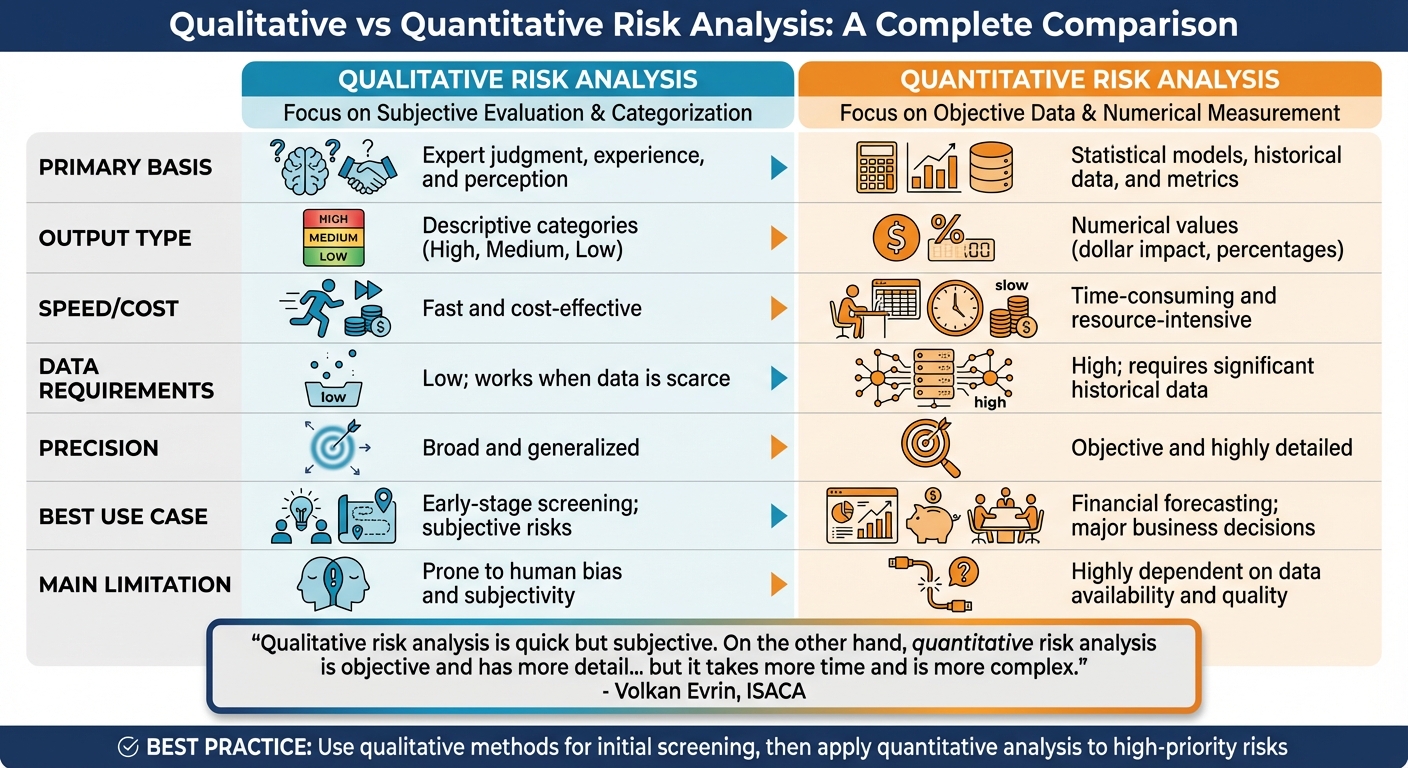
Qualitative vs Quantitative Risk Analysis Methods Comparison
Understanding these methods helps clarify when to use each for effective risk management. Qualitative methods rely on expert judgment to classify risks into categories, making them a quick and affordable choice when data is limited. On the other hand, quantitative methods use statistical models and historical data to assign numerical values, such as dollar impacts or probability percentages. While they demand more resources, they offer the precision needed for critical financial decisions.
Both methods have their drawbacks. Qualitative assessments can be influenced by human bias, leading to inconsistent results - different experts might rate the same risk differently. They also struggle to distinguish between risks that fall into the same category, like multiple "high" risks. Quantitative analysis, while providing clear numerical outputs, loses reliability when high-quality data is unavailable. As Volkan Evrin from ISACA explains:
"Qualitative risk analysis is quick but subjective. On the other hand, quantitative risk analysis is objective and has more detail... but it takes more time and is more complex."
Strengths and Weaknesses of Each Method
The table below highlights the core strengths and limitations of qualitative and quantitative approaches, offering a clear comparison to guide their application in risk management strategies.
| Aspect | Qualitative Risk Analysis | Quantitative Risk Analysis |
|---|---|---|
| Primary Basis | Expert judgment, experience, and perception | Statistical models, historical data, and metrics |
| Output Type | Descriptive categories (High, Medium, Low) | Numerical values (dollar impact, percentages) |
| Speed/Cost | Fast and cost-effective | Time-consuming and resource-intensive |
| Data Requirements | Low; works when data is scarce | High; requires significant historical data |
| Precision | Broad and generalized | Objective and highly detailed |
| Best Use Case | Early-stage screening; subjective risks | Financial forecasting; major business decisions |
| Main Limitation | Prone to human bias and subjectivity | Highly dependent on data availability and quality |
When to Start with Qualitative Methods
Early-Stage Risk Screening
Qualitative methods are a quick way to identify risks without requiring significant time or financial resources. They are especially useful when data is limited or resources are stretched thin. In fact, nearly 99% of organizations rely on qualitative assessments for fast and straightforward risk evaluations.
For smaller projects or teams with less experience, the KISS (Keep It Simple, Stupid) method is a practical choice. This approach involves rating risks on a simple scale - ranging from Very High to Very Low - to avoid unnecessary complications while still pinpointing potential threats. For larger or more intricate scenarios, a Probability/Impact Matrix offers a more detailed view by assessing both the likelihood and the potential consequences of each risk.
Qualitative analysis works as an initial filter, helping to prioritize resources by focusing on the most pressing risks and setting aside those that are less likely or less impactful. Experts agree that these methods are effective for identifying critical risk areas early on. This groundwork helps pave the way for a deeper, quantitative examination of high-priority risks.
Moving to Quantitative Analysis
Once qualitative assessments have flagged key risks, transitioning to quantitative methods becomes crucial for validating those initial findings. Quantitative analysis provides the hard numbers needed to back major decisions and allocate significant resources.
These methods are particularly important for high-stakes decisions, like determining whether to proceed with a complex project. However, this approach requires a solid foundation of clean, reliable historical data to be effective. Reserve quantitative analysis for the critical risks that exceed your organization's risk tolerance, ensuring that resources are directed where they matter most.
When Combined Methods Work Best
High-Impact Operational Risks
When it comes to high-impact risks - like supply chain disruptions, cybersecurity breaches, natural disasters, or compliance failures - a mix of qualitative and quantitative assessments is often the most effective approach. Qualitative analysis helps capture the broader context of risks that are tough to measure, such as reputational damage. Meanwhile, quantitative methods help assign a financial value to these risks, making it easier to prioritize them and communicate their significance to executives.
For operational risks, organizations often start with qualitative methods to identify and rank potential threats. Once the critical risks are flagged, quantitative techniques like Monte Carlo simulations are used to evaluate high-stakes scenarios. For example, imagine a fire destroys 75% of a $100,000 building - the Single Loss Expectancy (SLE) would be $75,000. Adding further depth, the Annual Loss Expectancy (ALE) is calculated by multiplying the frequency of such an event by the magnitude of the loss. This gives decision-makers a clearer picture of the financial exposure.
Major Business Decisions
Strategic decisions, such as mergers or major investments, also benefit from blending these methods. Qualitative insights can assess human factors, like whether company cultures align or if leadership styles are compatible. On the other hand, quantitative analysis provides the financial projections needed to justify decisions and estimate returns.
"The deepest insights come from the widest perspectives. For true risk assessment, perform both qualitative and quantitative risk assessments to gain real visibility into the overall organizational and cyber risk posture." – Patricia McParland, AVP, Product Marketing, MetricStream
This dual approach ensures decisions are informed by both hard data and a nuanced understanding of less tangible factors.
Vendor and Third-Party Risk Assessments
Evaluating vendors requires balancing efficiency with thoroughness. Start with qualitative tools, such as standardized questionnaires (like SIG Lite), to classify vendors into risk tiers. Then, use quantitative methods - like numerical scoring systems, security ratings, or financial models - to assess high-risk vendors more precisely.
A hybrid approach has proven essential in real-world scenarios. Take the MGM Casinos cyberattack, where weaknesses in third-party access controls led to an estimated $100 million loss. By translating vendor risks into financial terms using metrics like Annual Loss Expectancy, risk managers can communicate exposure in ways that resonate with executives.
"Associating a monetary value to risk equips chief risk officers to effectively communicate the risk exposure to the executive management in a language that is easy to interpret and act upon." – Patricia McParland, VP – Marketing, MetricStream
This method also helps ensure compliance with rigorous standards.
Meeting Compliance and Regulatory Standards
Regulators often require objective evidence rather than subjective opinions. While qualitative assessments might label a control as "effective", quantitative data - such as the number of high-priority incidents over a specific timeframe - provides the concrete proof auditors demand.
Quantitative models like FAIR (Factor Analysis of Information Risk) help organizations estimate the financial toll of non-compliance, including fines, penalties, and legal costs. This approach aligns with global standards such as ISO 31000, ISO 27005, and NIST SP 800-30. By centralizing qualitative rankings alongside quantitative data, organizations can streamline audits and maintain data integrity.
How to Combine Qualitative and Quantitative Methods
After narrowing down risks through initial screening, combining qualitative and quantitative methods can fine-tune your risk management approach.
Start with Qualitative Assessment
Kick things off with a qualitative screening to identify and categorize potential risks. This step involves gathering input from key stakeholders to create a comprehensive list of threats. Since this phase leans on expert judgment and past experiences, it’s relatively quick to execute.
Once risks are identified, use a likelihood–impact matrix to sort them. This tool helps prioritize by separating lower-level concerns from critical risks that require immediate attention. The highest-ranked risks - often labeled as "High" or "Critical" - then move forward for more detailed financial evaluation.
Apply Quantitative Analysis to Priority Risks
With the top risks identified, shift to quantitative analysis for a data-driven evaluation. Use models like Expected Monetary Value (EMV), which multiplies probability by impact to estimate financial exposure. For more complex situations, Monte Carlo simulations can provide a range of potential outcomes.
Different tools suit different types of risks. For operational risks, methods like Failure Mode and Effects Analysis (FMEA) or Business Impact Analysis (BIA) work well. Save Monte Carlo simulations for scenarios where variables are interconnected and require deeper modeling. Be sure to document all results thoroughly - this historical data will be invaluable for future risk assessments.
This quantitative step adds precision and clarity to your risk evaluation process.
Connect Results with Hybrid Models
To integrate both approaches, translate qualitative ratings into quantitative values using scoring matrices. For instance, a qualitative score of "4" might correspond to a 60–80% probability range, or risk categories like "High", "Medium", and "Low" could be assigned specific dollar thresholds. This step ensures consistency and avoids misinterpretation of risk exposure.
"A hybrid approach combining both Quantitative and Qualitative Risk Assessment methods can help build an effective cybersecurity risk assessment methodology." – CyberMindr
Always pair quantitative findings with qualitative context. For example, while an Annual Loss Expectancy figure might highlight potential financial exposure, qualitative insights can explain how such losses might disrupt operations, harm reputation, or lead to regulatory consequences. Combining these perspectives ensures a well-rounded understanding of risks.
Advantages of Using Both Methods
Complete Risk Management Coverage
Blending qualitative and quantitative methods helps tackle uncertainty from all angles by addressing both measurable and less tangible risks. Quantitative analysis is excellent for assessing financial threats based on historical data, while qualitative methods focus on subjective risks like reputational damage or legal challenges - areas that don’t have clear numerical data. By combining hard numbers with expert insights, organizations gain a well-rounded view of risks across their entire portfolio, reducing the chances of missing critical threats. This approach enables more accurate prioritization and smarter allocation of resources.
Better Decision-Making and Risk Prioritization
Quantitative methods bring clarity to risk ranking by attaching specific dollar values or probabilities to threats, whereas qualitative approaches often group risks together without precise metrics. This added level of detail helps organizations allocate resources more effectively and communicate risks more clearly to executives. For example, visual tools like risk maps paired with metrics such as potential financial loss or ROI make it easier to present a balanced perspective. The result? Decisions that reflect both data-driven insights and real-world context, leading to more effective risk management.
Finding the Right Consulting Support
Once decision-making improves, finding the right consulting expertise becomes essential. Implementing a combined risk approach often requires advanced skills, especially for sophisticated quantitative models like Monte Carlo simulations or Factor Analysis of Information Risk (FAIR). The Top Consulting Firms Directory is a valuable resource for connecting with experts who can adapt these methodologies to your industry’s regulations, whether you're aligning with ISO 31000, NIST, or other standards. These consultants can help ensure your strategy meets audit standards while promoting a culture of risk awareness throughout your organization.
Conclusion
Blending qualitative and quantitative methods is crucial for understanding the complete risk landscape. Qualitative assessments allow you to quickly identify emerging threats and subtle risks, such as reputational harm or shifts in regulations. On the other hand, quantitative analysis provides the precision needed to assign dollar values and probabilities to these risks, making it easier to present a clear case to executives and board members.
This combined approach builds on the initial risk screening process. Start with qualitative methods to identify potential risks, then use quantitative modeling for those with the highest potential impact. This layered strategy is particularly effective when both expert judgment and data-driven insights are required.
"The deepest insights come from the widest perspectives. For true risk assessment, perform both qualitative and quantitative risk assessments to gain real visibility into the overall organizational and cyber risk posture." - Patricia McParland, AVP, Product Marketing, MetricStream
The strength of this hybrid method lies in its balance: qualitative approaches provide context and nuance but can be subjective, while quantitative methods offer statistical accuracy but require robust data and expertise. Together, they create a comprehensive framework, combining narrative depth with analytical precision to support confident decision-making.
Using both methods ensures that no critical risks are missed. The challenge - and opportunity - is knowing when to use each approach and how to merge their findings into a single, cohesive risk profile. This unified perspective enables smarter resource allocation and enhances an organization’s ability to navigate uncertainty.
For more insights into expert risk management strategies, check out Top Consulting Firms Directory.
FAQs
How do I decide which risks need quantitative analysis?
When dealing with risks, it's best to focus on those that are clearly defined and can be measured in numbers. Quantitative analysis shines when there’s enough data to estimate probabilities and impacts - whether in monetary values or statistical terms. However, for risks that are more subjective or harder to quantify, qualitative methods might be the better choice. To get the most out of a quantitative approach, prioritize risks that come with sufficient data and measurable factors.
What can I do if I don’t have reliable data for quantitative risk models?
If you don't have access to reliable data, qualitative risk assessments can fill the gap. These assessments use descriptive ratings like high, medium, or low, relying on judgment and context instead of exact figures. To make them more effective, you can incorporate expert opinions, historical trends, or scenario-based evaluations. This method helps focus on the most pressing risks and opportunities, providing a framework to work with until more precise data is available. Pairing qualitative insights with whatever partial data you have can also strengthen your overall analysis.
How do I convert “High/Medium/Low” ratings into numbers executives trust?
To make "High/Medium/Low" ratings more actionable and reliable for decision-making, assign specific numerical values to each category. For instance:
- High: Assign a value like 3 or 5, reflecting greater severity or likelihood.
- Medium: Use a mid-range number, such as 2 or 3.
- Low: Map this to 1, indicating lower severity or likelihood.
The goal here is to establish a clear, standardized scale. This approach ensures that qualitative assessments are converted into consistent, measurable data executives can trust for informed decisions.