Six Sigma certification is a valuable credential for professionals aiming to improve processes and boost efficiency. Costs vary widely based on the certification level and provider. Here's a quick breakdown:
- Yellow Belt: $100–$1,000 (basic concepts, 8–20 hours of training)
- Green Belt: $400–$3,000 (statistical tools, 40–80 hours of training)
- Black Belt: $2,000–$8,000 (advanced methods, 140–200+ hours of training)
- Master Black Belt: $5,000–$15,000+ (enterprise-level strategy, weeks to months of training)
Factors influencing costs include training format (self-paced, virtual, or in-person), provider type (universities, professional bodies, private companies), and additional fees like exam retakes, software licenses, or recertification.
To save money, consider self-paced courses, employer sponsorships, group discounts, or certification bundles. Always check if exam fees, materials, or software access are included in the price.
This guide explores cost breakdowns, provider options, and tips to reduce expenses while achieving your Six Sigma goals.
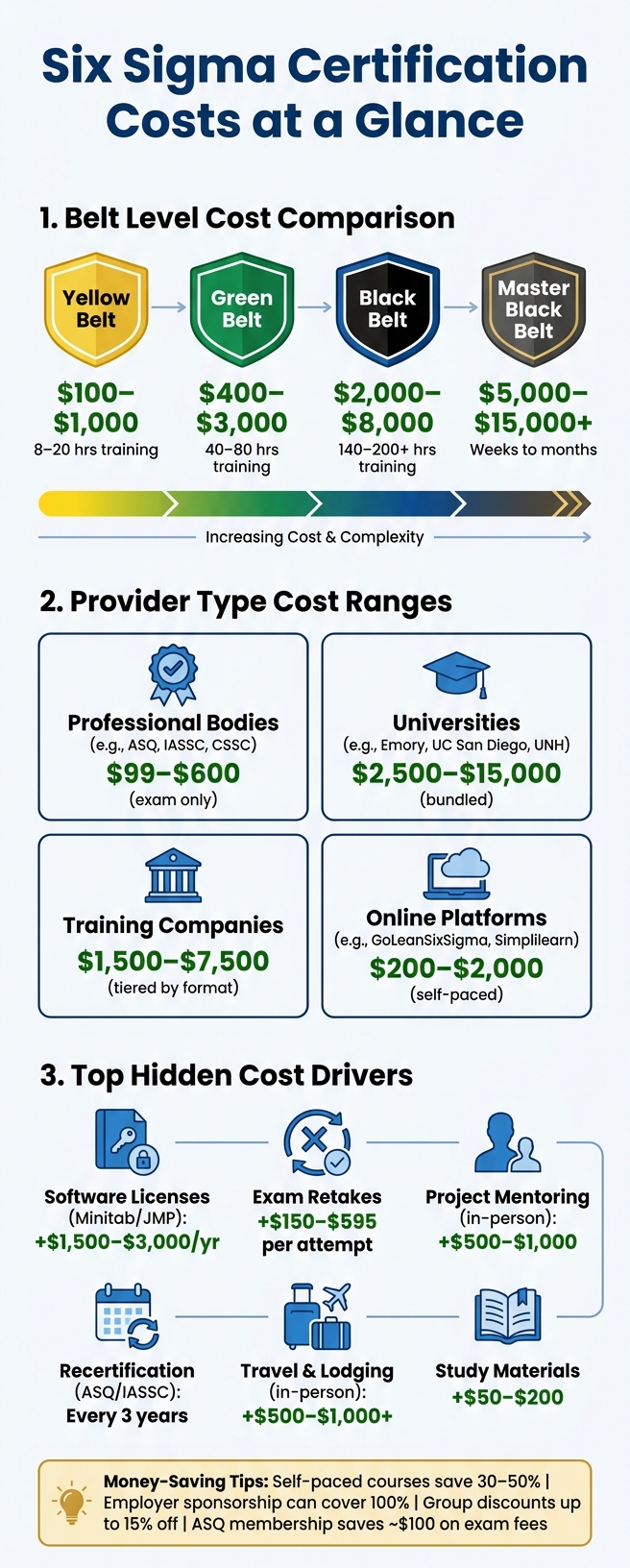
Six Sigma Certification Costs by Belt Level & Provider Type
Six Sigma Certification Costs by Belt Level
Cost Ranges for Each Belt Level
The cost of Six Sigma certifications varies depending on the belt level, with higher levels requiring a greater financial commitment. A Yellow Belt certification is often the most affordable, typically costing between $100 and $1,000. Moving up, Green Belt programs generally range from $400 to $3,000, while Black Belt certifications can cost anywhere from $2,000 to $8,000. At the top tier, Master Black Belt programs are priced between $5,000 and over $15,000, reflecting the advanced training and leadership skills they emphasize.
For example, SSGI offers Green Belt training for approximately $399 and Black Belt training for $499. On the other hand, institutions like Purdue University and the University of Georgia charge around $3,750 and $3,450 for Black Belt certifications, respectively. These prices typically include both training and exam fees, but the specifics may vary by provider.
What Is Included in the Cost?
The scope of training and what’s included in the fees differ significantly across belt levels and providers. Yellow Belt programs, which are entry-level, focus on foundational concepts like DMAIC (Define, Measure, Analyze, Improve, Control), basic process mapping, and often include the certification exam. These programs usually require between 8 and 20 hours of training.
Green Belt programs go further, offering instruction in statistical tools, root cause analysis, and project management skills. These courses typically require 40 to 80 hours of training.
Black Belt programs are even more intensive, covering advanced statistical methods like Design of Experiments (DOE) and Analysis of Variance (ANOVA). They also include mentoring and project coaching, with training durations ranging from 140 to over 200 hours. Some programs may offer access to statistical software like Minitab or SigmaXL, but if not included, obtaining a license separately can add to the overall expense.
For those pursuing a Master Black Belt, the focus shifts to enterprise-level strategy, coaching Black Belts, and overseeing program governance. These advanced programs often include portfolio reviews and board-level interviews.
Belt-Level Cost Comparison Table
Here’s a breakdown of costs, training durations, and key inclusions for each belt level:
| Belt Level | Typical Cost Range | Training Duration | Inclusions |
|---|---|---|---|
| Yellow Belt | $100 – $1,000 | 8 – 20 hours | DMAIC basics, terminology, process mapping, exam fee |
| Green Belt | $400 – $3,000 | 40 – 80 hours | Statistical tools, root cause analysis, project leadership, exam fee |
| Black Belt | $2,000 – $8,000 | 140 – 200+ hours | Advanced statistics (DOE, ANOVA), mentoring, project coaching |
| Master Black Belt | $5,000 – $15,000+ | Weeks to months | Strategic deployment, enterprise coaching, program design, portfolio review |
It’s worth noting that exam fees are not always included in the training cost. For instance, ASQ charges non-members $438 for the Green Belt exam and $585 for the Black Belt exam. IASSC offers slightly lower exam fees, with Green Belt exams costing about $350 and Black Belt exams priced at $450.
sbb-itb-97f6a47
Types of Training Providers and How They Price Certifications
Professional Bodies and Accreditation Organizations
Groups like ASQ (American Society for Quality), IASSC (International Association for Lean Six Sigma Certification), and CSSC (Council for Six Sigma Certification) focus on exam administration rather than training. Their fees generally cover the exam itself, so you'll need to arrange training separately unless it's bundled with an exam voucher.
Here's how their pricing stacks up: ASQ charges non-members $434 for the Yellow Belt, $483 for the Green Belt, and $585 for the Black Belt. IASSC offers a more affordable option at $195, $295, and $395 for the same belts. CSSC has the lowest rates, ranging from $99 to $529, depending on the certification level. If you're considering ASQ, purchasing an annual membership (around $100–$150) can save you money, as members get discounted exam fees.
Retake policies vary as well. ASQ allows retakes at a reduced rate - about $385 for the Black Belt exam - while IASSC requires you to pay the full exam fee again. This difference can add up if you're not confident about passing on your first attempt.
University and College Programs
Universities also offer Six Sigma programs, which often bundle tuition with training materials, instruction, and exam fees. While these programs can be pricier upfront, they simplify budgeting.
For example, Emory University offers an online Black Belt program for $3,595. UC San Diego charges $495 for a Yellow Belt and $5,695–$6,390 for a combined Green and Black Belt course. At the higher end, the University of New Hampshire prices its Black Belt program at $14,995, which includes up to 50 hours of one-on-one project guidance. Rutgers University provides a self-paced Black Belt program with coaching for $6,200. Many of these programs also award Continuing Education Units (CEUs) or Professional Development Units (PDUs), which can help with career advancement beyond the certification itself.
Dedicated Training Companies and Online Platforms
Private training companies and online platforms offer flexible options for Six Sigma certification, with a wide range of pricing based on the delivery method.
Dedicated training companies often charge more for live virtual or in-person training compared to self-paced online courses. Live virtual training typically costs 30–50% more due to real-time instructor access. Green Belt courses from these providers usually range from $1,200 to $3,800, while Black Belt programs can cost between $3,000 and $7,500. These companies often emphasize practical, business-focused training:
"Corporate trainers bring real-world operational insights." - Lean Six Sigma Experts
Online self-paced platforms are the most budget-friendly option, with prices ranging from $200 to $2,000 across all belt levels. For instance, GoLeanSixSigma offers Green Belt programs for around $299, while Simplilearn charges between $399–$999, depending on the program tier. Lower-cost platforms typically provide recorded videos and PDFs, while premium options often include extras like one-on-one project coaching and access to statistical software like Minitab, which alone can cost over $1,500.
| Provider Type | Typical Price Range (Green/Black Belt) | Pricing Structure | Inclusions |
|---|---|---|---|
| Professional Bodies | $150 – $600 (exam only) | Per-exam fee | Standardized exam, digital badge |
| Universities | $2,500 – $15,000 | Bundled tuition | Instruction, CEUs, software, exam fee |
| Training Companies | $1,500 – $7,500 | Tiered by delivery format | Coaching, exam vouchers, templates |
| Online Platforms | $200 – $2,000 | Flat fee or subscription | Recorded videos, PDFs |
What Drives Six Sigma Certification Costs
Main Factors That Affect Certification Costs
The cost of Six Sigma certification is influenced by several key factors, starting with the belt level. For example, Yellow Belt programs typically require 8–16 hours of study, while Black Belt programs demand a much larger commitment - 100–200 hours. This significant difference in time and complexity makes Black Belt certifications cost three to five times more than Yellow Belt certifications.
Another major factor is the training format. Self-paced online courses are usually the most budget-friendly option. However, live virtual classes can cost 30–50% more, and in-person sessions are the most expensive, often costing two to four times as much due to additional overhead expenses.
The expertise of the instructor also plays a role. Master Black Belts, for instance, charge between $150 and $250 per hour, compared to $75–$100 per hour for less experienced trainers.
"The statistical rigor and project complexity increase exponentially with each belt level, directly impacting the instruction hours and materials you receive." - Lean Six Sigma Experts
Lastly, project mentoring can add $500–$1,000 to your overall cost, depending on the level of guidance required.
Hidden and Additional Costs to Watch For
Beyond the core factors, there are several hidden and additional costs that can catch you off guard.
For instance, standalone software licenses for tools like Minitab or JMP can cost between $1,500 and $3,000 annually if they are not included as part of your training package.
Then there are exam retake fees, which vary by provider. ASQ charges around $385 for a Black Belt retake, while IASSC requires you to pay the full exam price again - approximately $395. ASQ also imposes a $130 fee for rescheduling an exam or processing an incomplete application.
Recertification is another long-term expense to consider. For example, ASQ requires Black Belt holders to recertify every three years, while IASSC charges around $290 to maintain a "Current" status for the same belt level. On the other hand, CSSC offers a lifetime certification with no renewal fees.
"A $2,500 Green Belt course becomes $3,000+ when you add ASQ exam fees ($438), annual membership dues ($169), and Minitab software access ($1,500 for a personal license)." - Lean Six Sigma Experts
Other smaller costs include physical study materials like handbooks and question banks, which range from $50 to $200. For in-person training, travel and lodging can add another $500–$1,000 or more to your total expense.
Cost Drivers Summary Table
| Cost Driver | Likely Impact | Key Detail |
|---|---|---|
| Belt Level | High | Black Belt costs are 3×–5× higher than Yellow Belt |
| Training Format | High | In-person training can be 2×–4× the cost of self-paced online |
| Instructor Expertise | Moderate to High | Master Black Belts charge $150–$250/hr vs. $75–$100/hr |
| Software Licenses | Moderate to High | Minitab/JMP adds $1,500–$3,000 if not bundled |
| Project Mentoring | Moderate | One-on-one coaching adds $500–$1,000 |
| Exam Retakes | Variable | $150–$595 per failed attempt depending on the provider |
| Membership Dues | Low to Moderate | ASQ charges $169/year, often needed for discounted exam rates |
| Recertification | Low to Moderate | Required every 3 years for ASQ and IASSC |
| Study Materials | Low | Handbooks and question banks cost $50–$200 |
| Travel & Lodging | Moderate | Can add $500–$1,000+ for in-person training |
How to Lower Your Six Sigma Certification Costs
Choose Cost-Effective Training Options
One of the easiest ways to save money is to start with the more affordable Yellow Belt certification, which typically costs between $99 and $250. This provides a solid introduction before committing to more advanced certifications like Green or Black Belts. If you already have relevant experience, you might be able to skip formal training altogether. Organizations such as IASSC and CSSC allow candidates to go straight to the exam, which means you’ll only need to cover the exam fee - $295 for the IASSC Green Belt and $395 for the Black Belt.
Self-paced online training is usually the most budget-friendly option, often costing 30–50% less than live virtual classes. For example, GoLeanSixSigma offers Green Belt courses starting at around $299. When comparing programs, look for bundled packages that include training, exam vouchers, and software access. This can help you avoid unexpected expenses, like purchasing a standalone Minitab license, which can cost over $1,500.
"The most valuable training packages include perpetual access to updated materials and alumni resources, not just 30-day course access that expires before you complete your certification project." - Lean Six Sigma Experts
These strategies can help you minimize upfront costs and set the stage for even more savings through employer support and group discounts.
Use Employer Support and Group Discounts
Beyond choosing affordable training formats, employer sponsorships and group discounts can significantly cut your costs. If your company is focused on process improvement, ask about sponsorship opportunities. Many U.S. companies cover the full cost of Six Sigma training when it supports measurable business goals. When making your case, highlight the potential return on investment - a company-sponsored Black Belt project can deliver savings of $75,000 to $125,000.
For teams, corporate onsite training is another cost-saving option. Training a group of 10–20 employees can cost $5,000–$15,000 in total, compared to the $1,500–$3,500 per person you’d spend on individual enrollment. Many online platforms also offer group discounts, such as 5% off for five or more seats, 10% for 10 or more, and up to 15% for groups of 15 or more. For larger groups, requesting a custom invoice can sometimes unlock additional savings.
Another way to save is through ASQ membership. For $169 per year, membership typically reduces exam fees by about $100. For example, the Black Belt exam fee drops from $585 to $485 with membership. If you’re planning to pursue multiple certifications or might need to retake an exam, this membership can quickly pay for itself.
These cost-sharing strategies can make Six Sigma certification far more affordable, especially when paired with consulting support.
Get More Value Through Consulting Support
Combining affordable training with employer discounts is just the start. Adding consulting support can help turn your certification costs into measurable business results. The Top Consulting Firms Directory is a great resource for finding firms that integrate Six Sigma training with hands-on consulting. This approach ties your training directly to real-world outcomes, making it easier to justify the expense and speed up your return on investment.
Conclusion: How to Plan a Cost-Effective Certification Path
A Step-by-Step Approach to Budget Planning
Start by aligning your current belt level with your career goals for the next year. For example, Yellow Belt suits team contributors, Green Belt is ideal for part-time project leaders, and Black Belt prepares you for cross-functional leadership roles. Once you’ve identified your target level, calculate the total cost: Training + Exam Fee + (Maintenance Fee × 3 Years) + Software Cost.
Before committing to any program, confirm that the certification is widely recognized. This ensures you won’t end up investing in credentials that hold little value.
"You need to weigh certification body reputation against exam cost because a $400 savings on testing fees means nothing if employers don't recognize your credential." - Lean Six Sigma Experts
This step helps you create a budget that’s both realistic and adaptable.
Revisit and Adjust Your Budget as Needed
As career goals shift, so should your budget. Plan for unexpected expenses by including a 15–20% buffer for items like exam retakes or additional study materials. If you’re aiming to progress quickly through multiple belt levels, consider "Career Track" bundles, which offer discounted pricing for combined certifications.
Here’s a checklist to make sure you don’t miss any potential costs:
| Cost Component | What to Check |
|---|---|
| Training Fee | Is it bundled with the exam, or is it separate? |
| Exam Fee | Are there member discounts (e.g., ASQ members save ~$100)? |
| Study Materials | Do they include practice exams and templates? |
| Retake Fee | What’s the cost if you need to retake the exam? |
| Renewal Fee | Does the certification expire, and what’s the renewal cost? |
| Project Costs | Does your belt level require a project using company resources? |
To reduce costs over time, look into providers like CSSC or ASQ for Yellow and Green Belt certifications. These organizations often offer lifetime certifications with no renewal fees.
Key Takeaways
Earning a certification can lead to higher salaries, making the investment worthwhile when planned carefully. By following these steps and leveraging cost-saving strategies like self-paced training, employer sponsorship, group discounts, and bundled packages, you can boost your certification ROI. For those looking to tie their certification to measurable business outcomes, the Top Consulting Firms Directory can connect you with firms that apply Six Sigma principles to real-world projects. This can strengthen your case for employer sponsorship and help you demonstrate tangible results.
How much does a Lean Six Sigma Certification Cost?
FAQs
Which Six Sigma belt should I start with?
For those just starting out, the Yellow Belt is a great entry point. It covers the basics of Six Sigma, including key terminology and the DMAIC framework, and doesn’t require any prior knowledge.
If you’re already involved in tasks like process reviews or assisting improvement teams, the Green Belt might be a better fit. Pick the belt that matches your current responsibilities and future ambitions, rather than focusing solely on your job title.
Do I need training, or can I just take the exam?
Whether or not training is necessary depends on the certifying organization and the certification level you're pursuing. For instance, some programs, such as those offered by ASQ, provide an exam-only option, allowing you to study on your own. On the other hand, certain certifications include training as part of the exam fee. Higher-level certifications might require you to have prior qualifications or verified project experience. It's essential to review the specific requirements of your chosen program to see if training is optional or mandatory.
What extra costs should I budget for besides the course price?
In addition to the course price, be prepared for extra expenses like exam fees, which can range from $295 to $538 depending on the certifying organization. You might also need software licenses for tools like Minitab, costing between $1,500 and $3,000 per year. Other possible costs include mentoring sessions, which typically run $500 to $1,000, and retake fees if you don’t pass the exam. Some course providers include these in their packages, while others list them as separate charges.