SaaS partner ecosystem cross-selling is a 2026 growth strategy where companies leverage partnerships with technology vendors, resellers, and service providers to sell complementary solutions. This approach builds on trust from existing partner relationships, speeding up sales cycles and increasing deal sizes. Unlike traditional cross-selling, which relies on direct sales teams, this method involves collaboration across multiple partners to deliver integrated solutions.
Key Highlights:
- Faster Sales: Partner-involved deals close 46% faster and are 53% more likely to succeed.
- Lower Costs: Partner-sourced pipelines can cut Customer Acquisition Costs (CAC) by 30–50%.
- Higher Retention: Customers using 4+ integrations are 58% less likely to churn.
- Revenue Growth: Ecosystems like Shopify and Salesforce generate significant revenue from partner-led efforts.
Partner Types:
- Technology Partners: Offer integrations to enhance product stickiness.
- Resellers: Expand into new regions or industries.
- Consulting Partners: Provide implementation and advisory services.
- Referral Partners: Warm leads through trusted introductions.
Success Checklist:
- Strong product-market fit and clear Ideal Customer Profiles (ICP).
- Clear partner agreements and incentives for internal teams.
- Tools like Partner Relationship Management (PRM) platforms for deal tracking and account mapping.
By focusing on collaboration, shared value propositions, and proper partner enablement, SaaS companies can scale efficiently while improving retention and reducing sales costs.
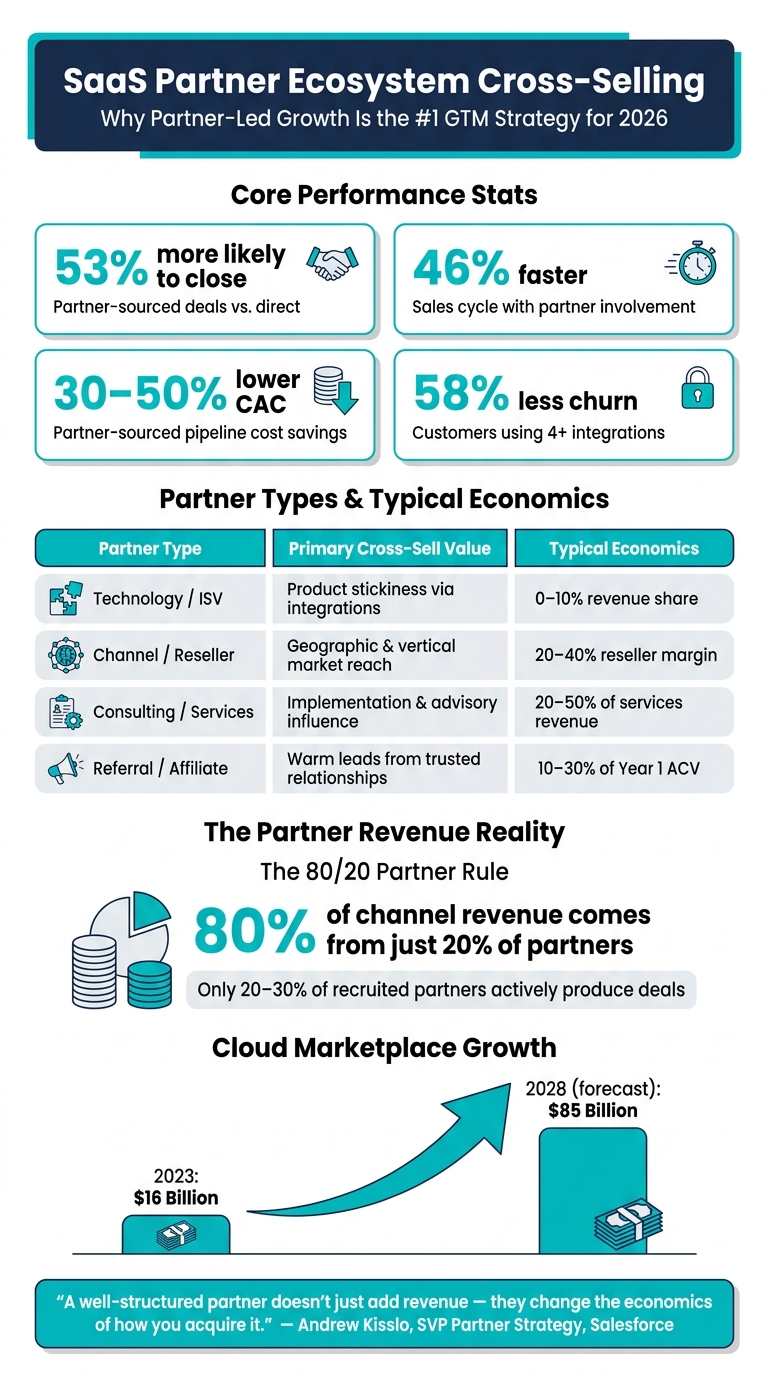
SaaS Partner Ecosystem Cross-Selling: Key Stats & Impact
How to Build a Partner Ecosystem That Sells for You | Brian Weinberger
sbb-itb-97f6a47
Key Foundations of SaaS Partner Ecosystems
Before diving into a partner cross-selling program, it’s crucial to understand the different types of partners, their roles, and whether your business is ready to support and benefit from these collaborations.
Partner Types That Support Cross-Selling
Each partner type brings something different to the table when it comes to cross-selling. Knowing how they contribute can help you build the right mix for your business.
- Technology/ISV partners: These partners create integrations that embed your product into a customer’s existing workflow. This not only makes your product more integral to their operations but also opens doors for co-marketing opportunities.
- Channel/reseller partners (VARs): These partners handle transactions and often bundle your product with their services. They’re especially helpful for expanding into new regions or industries where you don’t have a direct sales presence.
- Consulting and services partners: This group includes system integrators (SIs) and managed service providers (MSPs). They play an advisory role during implementation and often influence decisions about complementary tools.
- Referral and affiliate partners: These partners leverage their established customer trust to provide warm introductions to qualified buyers.
As James Doman-Pipe from GTM Playbook explains:
"The trust is inherited. Compare that to a cold sales call, which starts from zero."
The financial dynamics of each partner type vary significantly. Here’s a quick breakdown:
| Partner Type | Primary Cross-Sell Value | Typical Economics |
|---|---|---|
| Technology / ISV | Product stickiness via integrations | 0–10% revenue share |
| Channel / Reseller | Geographic and vertical market reach | 20–40% reseller margin |
| Consulting / Services | Implementation and advisory influence | 20–50% of services revenue |
| Referral / Affiliate | Warm leads from trusted relationships | 10–30% of Year 1 ACV |
One key insight: only 20–30% of recruited partners actively produce deals. So, recruiting more partners doesn’t guarantee more revenue - activation and quality matter far more than sheer numbers.
With partner roles clarified, it’s time to understand the broader ecosystem dynamics.
Core Ecosystem Concepts to Know
Partner ecosystems thrive on the unique contributions of each partner type, creating a growth cycle that reinforces itself over time.
Take the SaaS flywheel as an example. This cycle works by attracting more customers through integrations, which, in turn, draws in additional services partners to enable further integrations. Salesforce’s AppExchange is a prime example of this in action. As of 2026, it boasts over 4,000 apps, with 89% of Salesforce customers using at least one partner integration. This creates a competitive advantage that’s tough to match.
Another critical concept involves understanding sell-with, sell-through, and sell-to motions:
- Sell-with (co-selling): Your team and a partner collaborate on deals, often leading to higher win rates but requiring more coordination.
- Sell-through: The partner manages the entire sales cycle, offering scalability but with less direct visibility.
- Sell-to: You sell your product directly to partners for their internal use.
Each approach demands tailored tools, incentives, and processes to succeed.
Lastly, the joint value hypothesis is essential. This is a shared statement that clearly defines who your combined offering benefits and the outcomes it delivers. Without this clarity, partners may struggle to effectively position your product.
Cross-Selling Readiness Checklist
To make the most of these ecosystem principles and partner types, your organization needs to meet certain readiness criteria.
As Josh from Scayul puts it:
"Partners are an amplifier, not a remedy. They magnify what is already working."
Jamie Partridge of UpliftGTM echoes this sentiment:
"Channel doesn't fix a broken sales motion. If your direct team can't sell, partners won't either."
Here’s what to ensure before engaging partners:
- Product-market fit and strong NPS: If your current customers wouldn’t recommend your product due to issues like rough onboarding, partners will hesitate to back it.
- A clearly defined ICP (Ideal Customer Profile): Partners should be able to identify quality referrals based on a concise description of your ideal customer. If they can’t, your ICP needs work.
- An Ideal Partner Profile (IPP): Document what makes a partner a good fit - such as ICP overlap, company type, and commercial motivation - not just their size or reputation.
- A minimum enablement stack: Provide partners with tools like battle cards, discovery questions, objection-handling guides, and demo scripts to help them represent your product effectively.
- Commercial and legal agreements: Establish clear terms, including tiered margins, deal registration rules, and protection windows (60–90 days) to prevent conflicts with your direct sales team.
- Incentive alignment for your sales reps: Ensure your internal sales team gets credit for partner-involved deals. Without this, they might actively block those deals.
When evaluating potential partners, the 3R Framework can help. Assess each candidate based on:
- Reach: Can they access markets or personas you can’t?
- Revenue: Can they lower your cost of sales?
- Reputation: Do buyers already trust them?
Partners that score well across all three dimensions should be your top priorities.
How to Build a Partner Cross-Selling Strategy
Once you've identified the right types of partners and confirmed their readiness, the next step is to create a strategy that sets clear goals, selects the right collaborators, and develops joint offerings that actually generate sales.
Setting Goals and Metrics
Metrics should be tailored to match the role of each partner. For example, referral partners should be evaluated based on how many deals they introduce and the quality of those opportunities. On the other hand, consulting partners focused on expansion should be measured by attach rates and Net Revenue Retention (NRR) within their accounts.
Andrew Kisslo, SVP of Partner Strategy & Programs at Salesforce, highlights two key metrics:
"The two [metrics] that matter most are deal cycle time and revenue. If partners aren't helping you close bigger deals, move faster, or both, the program isn't working."
In addition to these primary metrics, it's important to differentiate between partner-sourced and partner-influenced revenue. Partner-sourced deals are those initiated by the partner, while partner-influenced deals involve partner contributions without them originating the opportunity. Combining these metrics can obscure the true value of your ecosystem. The numbers back this up: partner-sourced deals are 53% more likely to close, close 46% faster, and have a 40% higher average order value than deals without partner involvement.
Establish a monthly reporting routine to provide clear visibility into attributed revenue. This transparency is essential for securing the budget needed to expand your program. With these metrics in place, you can identify and prioritize the partners who align best with your goals.
Building a Cross-Sell-Ready Partner Portfolio
Not all partners will drive revenue, even if they've signed an agreement. In fact, 80% of channel-sourced revenue typically comes from just 20% of partners. This makes careful partner selection far more important than sheer numbers.
Using your readiness checklist, start with a 30-day diagnostic using account mapping. This will help you pinpoint high-overlap partners and distinguish active revenue generators from those who are dormant. Focus on accounts where partners are already engaged but your direct team hasn’t tapped into yet - these often hold the most valuable cross-sell opportunities.
Before fully onboarding a partner, run a 60-day pilot program targeting 20–50 mapped accounts with specific, qualified opportunities. This approach minimizes risk while confirming commercial potential. Prioritize partners whose accounts have at least 30% Ideal Customer Profile (ICP) overlap and who have an internal champion with the authority to allocate resources.
Crafting Joint Value Propositions and Bundles
Once you've strategically selected your partners, the next step is to define how your combined offerings deliver clear benefits to all parties. This involves assigning precise roles and crafting joint statements that go beyond mere co-branding to establish a shared vision.
A strong joint value proposition (JVP) is more than a marketing document. It’s a clear, shared statement that outlines who benefits from the combined solution and what specific outcomes they can expect. Without this, partners may default to promoting their own products and only briefly mention yours.
For each partner type, create a one-page JVP that answers three key questions: What does the customer gain from the combined solution? What does the partner gain financially? And what shared success metrics will you track? Angad Dhaliwal, a Strategic Consultant, explains the process well:
"A partnership should move in order: Outcome, fit, structure, execution, measurement, then scale."
When developing bundles, start by interviewing your top 10–15 customers to identify which tools they already use alongside your product. These insights reveal the best opportunities for bundling. Once you've identified the right combinations, assign clear roles for each step - discovery, demos, proposals, and closing - to ensure customers get a seamless experience. Finally, use deal registration windows of 60–90 days to protect partners from being undercut by your direct sales team, which is one of the quickest ways to lose their trust.
How to Run a Partner Cross-Selling Program
Partner Enablement and Sales Alignment
Even the best strategy can fall apart without proper alignment between your internal Account Executives (AEs) and partner contacts. The key? Build direct, frontline relationships. Pair each AE with a specific partner contact - whether that's a Customer Success Manager (CSM), AE, or solutions consultant. This kind of one-on-one connection helps deals move faster.
Another crucial piece is ensuring compensation neutrality. If your reps earn less on partner-assisted deals, they might unintentionally steer customers away from partner channels. To avoid this, make sure commissions are the same regardless of how the deal closes.
But enablement doesn’t end after onboarding. Partners need ongoing access to updated resources like playbooks, battlecards, and qualification criteria. Certified partners, for example, tend to close deals 38% faster than non-certified ones. Regular training and certification programs can directly boost your revenue.
Once internal alignment is solid, you’re ready to choose the tools that will make cross-selling successful.
Tools and Infrastructure for Cross-Selling
Without the right tools, managing partner cross-selling can feel like trying to run a marathon in flip-flops. A strong tech stack is essential, covering these four functional areas:
| Tool Category | Key Functions | Example Platforms |
|---|---|---|
| PRM Platform | Deal registration, content library, certification tracking, MDF management | Impartner, Allbound, PartnerStack, Channeltivity |
| Account Mapping | Comparing CRM data to uncover shared prospects and customers | Crossbeam, Reveal, Scayul |
| TCMA (Through-Channel Marketing Automation) | Running partner-led campaigns | Impartner, PartnerStack |
| Billing/Payouts | Automating commissions tied to subscription events | Stripe, Paddle, PayPal, Wise |
For SaaS companies, there’s a catch. Traditional PRM platforms were designed for one-time deals and often fall short when it comes to tracking subscription-based models like Annual Recurring Revenue (ARR), expansions, or renewals. That’s where platforms like xAmplify come in. They offer subscription-aware deal registration that tracks the entire lifecycle. As xAmplify explains:
"One-time deal registration doesn't map to subscription ARR. Legacy PRM tools weren't built for how SaaS channel programs actually work."
Integrating your PRM with your billing system can also save time and build trust. Manual commission reconciliation is tedious and error-prone, but connected systems can cut partner onboarding time by 60–80%.
With your systems in place, the next step is creating incentive models that encourage both your partners and internal teams to perform.
Incentive Structures and Commercial Models
Incentives are the glue that keeps your cross-selling program running smoothly. A straightforward commission model not only motivates your partners but also communicates your priorities clearly. Tailor the model to fit the type of partner you’re working with. Here’s a look at standard U.S. market ranges:
| Partner Type | Typical Commission / Margin |
|---|---|
| Referral / Affiliate | 10–25% of Year 1 ACV |
| Reseller / Channel | 20–40% margin off retail |
| Technology / ISV | 0–10% revenue share |
| Solution Partner | 20–50% of professional services revenue |
| Cloud Marketplace | 3–5% transaction fee (standard) or 20–30% listing-driven |
Market Development Funds (MDF) are another powerful tool. To make MDF more effective, release it in two stages: 50% upfront tied to a specific campaign plan, and the remaining 50% after proof of execution and lead reporting. This method keeps partners accountable and provides measurable data on what’s driving results.
Lastly, safeguard your program by requiring detailed deal registration criteria. This ensures that only engaged partners benefit from the system.
How to Measure, Improve, and Scale Cross-Selling Programs
Tracking Performance and Improving Results
When it comes to cross-selling programs, waiting until the end of the quarter to evaluate results is a common misstep. By then, it's often too late to make meaningful changes. Instead, focus on tracking effectiveness from the start.
To do this, use a mix of leading indicators, which predict revenue trends, and lagging indicators, which confirm outcomes. Leading indicators like partner engagement scores, portal logins, and training completions act as early warning signals. On the other hand, metrics like closed partner-sourced revenue provide a retrospective look at overall performance.
Here’s a breakdown of key metrics to monitor:
| Metric | Measured By | Why It Matters for Cross-Selling |
|---|---|---|
| Attach Rate | % of customers adding integrations or services via a partner | Shows success in bundling multiple products |
| Integration Adoption Rate | % of users with at least one active partner integration | Customers with 4+ integrations are 35–58% less likely to churn |
| Ecosystem NRR | Net Revenue Retention in partner-integrated accounts | Demonstrates long-term value of the partner ecosystem |
| Win-Rate Delta | Partner-led win rate vs. direct win rate | Highlights the trust transfer in cross-selling |
| Expansion Rate | % of partner accounts adding seats or features | Tracks cross-sell and upsell effectiveness |
It’s also important to differentiate partner-sourced revenue (deals initiated by a partner) from partner-influenced revenue (deals a partner helped accelerate or expand). Mixing these metrics can inflate numbers and complicate decisions about where to invest resources. Automating attribution in your CRM and PRM systems can help avoid disputes later on.
To stay on top of performance, implement monthly scorecards and quarterly business reviews (QBRs). These tools make it easier to spot and address underperformance early. Win/loss reviews are equally valuable - they uncover why deals stall and which partner combinations deliver the best results. For example, Census, a data activation platform, used partner overlap data in 2025 to prioritize accounts, boosting their average contract values (ACV) by 34%.
"The difference between a partner program that scales and one that stalls is almost always a measurement problem. When you can't show finance what the program is worth, you can't get the investment to make it worth more." - Alliantra Research
Once metrics are in place, the next step is addressing conflicts that can slow down progress.
Managing Channel Conflicts and Risks
Channel conflicts are bound to happen, but resolving them quickly is critical to maintaining momentum. Common issues include direct sales teams stepping in on partner-driven deals, duplicate registrations for the same opportunity, and disputes over attribution in multi-party co-selling scenarios. Luckily, these challenges have practical solutions:
| Conflict Source | Mechanical Fix |
|---|---|
| Undefined territory | Clear house-account rules and partner-first segments |
| No deal registration | "First to file" system with protection windows |
| Comp asymmetry | Compensation neutrality - paying reps fully on partner deals |
| No arbitration owner | Assign a channel-ops owner with authority for binding decisions |
For deal registration, ensure protection windows are renewed only when there’s active progress, like a confirmed meeting or milestone. Approvals or rejections should be made within 24–48 hours to avoid delays that can erode trust.
When conflicts arise, review the evidence, consider the customer’s preference, and apply your segment policy. Having a dedicated channel-ops owner with decision-making authority can eliminate politics and streamline the process.
Finally, tapping into external expertise can further strengthen your cross-selling efforts.
Using Consulting Partners to Drive Cross-Selling Success
Consulting partners can play a pivotal role in extending your partner ecosystem’s reach. Their value goes beyond referrals - they often design multi-vendor solutions where your product becomes a key component of a larger transformation project. This makes cross-selling feel more natural and integrated.
For instance, a consulting firm helping a mid-market company modernize its data infrastructure is well-positioned to recommend SaaS tools that work seamlessly together. Being part of these discussions through co-developed solution blueprints or joint delivery frameworks ensures your product gets considered at critical buying moments.
Finding the right consulting partners requires more than a quick online search. Resources like the Top Consulting Firms Directory can connect you with firms specializing in areas like revenue growth or digital transformation.
A practical starting point? Identify two or three consulting firms already serving your target market. Collaborate with them to develop a joint go-to-market strategy, including shared playbooks, co-branded solution briefs, and clear co-sell agreements. This approach transforms casual partnerships into repeatable cross-selling opportunities, reinforcing the importance of aligned, partner-led growth efforts.
Conclusion: Key Takeaways for SaaS Partner Ecosystem Cross-Selling
Partner ecosystem cross-selling represents a major evolution in go-to-market strategies. Partner collaboration doesn’t just help - it transforms outcomes. For instance, it can boost deal closures by 53% and speed up sales cycles by 46%. In ecosystems like HubSpot and Atlassian, partners already contribute to 30–50% of the total pipeline. This kind of impact comes from well-planned, strategic collaboration.
The most successful programs treat co-selling as a team effort. Instead of merely passing leads, they focus on shared accountability. These programs prioritize solving account visibility issues first, using shared data to identify overlapping customers before launching sales initiatives. Another critical element? Ensuring direct sales reps are financially incentivized for partner-sourced deals, rather than penalized. Andrew Kisslo, SVP of Partner Strategy at Salesforce, sums it up well:
"A well-structured partner doesn't just add revenue - they change the economics of how you acquire it."
Measurement is the backbone of successful programs. Programs that stand out provide clear, actionable insights. They differentiate between partner-sourced and partner-influenced revenue, deliver monthly reports in formats ready for finance teams, and segment partners based on their role - whether they generate pipeline, accelerate deals, drive expansion, or anchor retention. This level of detail helps leadership pinpoint what’s working and where further investment is needed.
The bigger picture is hard to ignore: Ecosystem-Led Growth (ELG) is becoming a dominant strategy. By 2026, it’s expected to be a primary go-to-market approach for top SaaS companies. With cloud marketplaces forecasted to grow from $16 billion in 2023 to $85 billion by 2028, the companies that build structured, measurable, and incentive-aligned partner programs will be the ones securing the most sustainable revenue.
FAQs
Am I ready to launch partner cross-selling?
If your product has earned customer trust to the point where you can confidently recommend it, and you can sum up your Ideal Customer Profile (ICP) in a single sentence, you’re in a strong position to start partner cross-selling. Before diving in, though, make sure your customer success metrics - like smooth onboarding processes and a solid Net Promoter Score (NPS) - are steady and reliable.
Once that foundation is in place, the next step is to build your ecosystem. This means defining your Ideal Partner Profile (IPP) and ensuring you have operational systems, such as CRM integrations, ready to track and convert revenue efficiently. These systems will help you manage partnerships and measure success as you scale.
How do I pick partners that will actually drive deals?
To build successful partnerships, start by crafting an Ideal Partner Profile (IPP) that matches your Ideal Customer Profile (ICP). This ensures alignment in goals and target audiences. Evaluate potential partners based on their commercial motivation and their ability to facilitate meaningful introductions.
Use the 3R framework - Reach, Revenue, and Reputation - to prioritize effectively:
- Reach: How well can the partner extend your market presence?
- Revenue: What financial opportunities can this partnership unlock?
- Reputation: Does the partner enhance your brand credibility?
Look for partners with active sales teams offering complementary products or services. Before committing to long-term agreements, conduct a 30-day pilot program to gauge their dedication and compatibility. This trial period helps confirm their readiness to collaborate toward shared goals.
How do I measure partner-sourced vs. partner-influenced revenue?
To gauge partner-sourced revenue, track net-new opportunities initiated by partners by using deal registration and marking them as Source = Partner in your CRM. For partner-influenced revenue, document deals where partners had a significant role, supported by evidence such as meeting notes or collaboration records. Implement look-back windows - like 120 days for sourced revenue and 90 days for influenced revenue - and use junction objects in your CRM to assign split-credit percentages when multiple partners are involved.