Additive manufacturing (AM), or 3D printing, is transforming how products are designed and made. Unlike subtractive methods that cut material away, AM builds objects layer by layer using digital models. This method minimizes waste (less than 10%) and enables complex designs like lattice structures that are difficult or impossible to achieve with other techniques. Industries like aerospace, healthcare, and automotive have adopted AM for faster production, cost savings, and customization.
Key Highlights:
- Techniques: FDM (affordable, low-resolution), SLA (high precision, smooth finish), SLS (durable, no support structures).
- Materials: Polymers like PLA and ABS dominate for affordability; metals like titanium and stainless steel shine in strength-demanding applications.
- Applications: Prototyping, functional parts, and supply chain optimization through on-demand, decentralized production.
- Future Trends: Automation, multi-material printing, and recycling are driving AM forward.
Quick Comparison of Techniques:
| Feature | FDM | SLA | SLS |
|---|---|---|---|
| Material Form | Plastic Filament | Liquid Resin | Polymer Powder |
| Resolution | Low to Moderate | Very High | High |
| Surface Finish | Layer Lines Visible | Smooth/Sleek | Slightly Grainy |
| Equipment Cost | $2,000–$8,000 | $2,500–$10,000 | $30,000–$60,000 |
| Material Cost | $50–$150/kg | $100–$200/L | ~$100/kg |
| Best For | Affordable Prototypes | High-Detail Models | Durable Components |
AM is reshaping industries by reducing waste, enabling intricate designs, and decentralizing production. The future promises even more possibilities with automation and sustainable materials.
3D Printing Explained | Additive Manufacturing Basics, Types & Future Trends
Main Additive Manufacturing Techniques
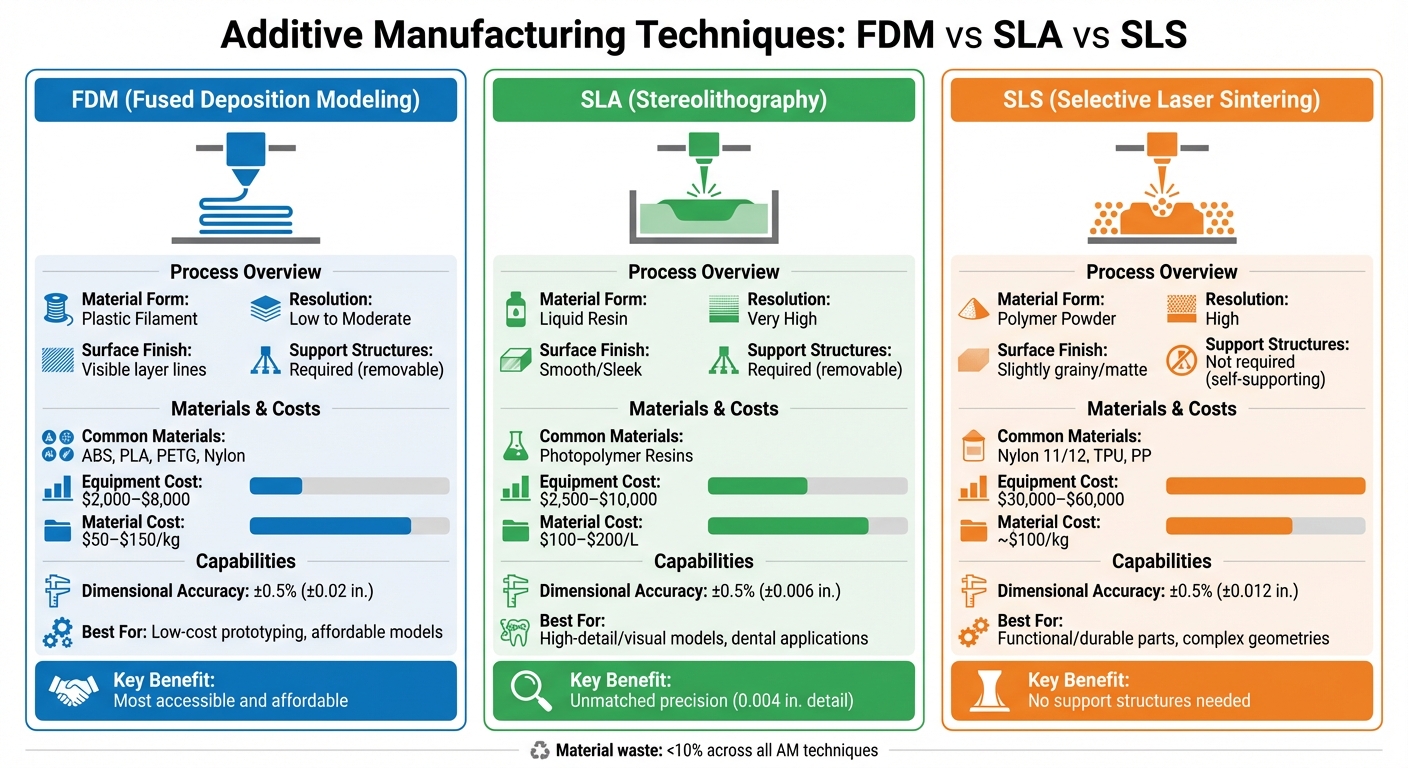
Comparison of FDM, SLA, and SLS 3D Printing Techniques
FDM, SLA, and SLS are essential processes in additive manufacturing, each tailored to address specific production needs. These methods demonstrate how technology adapts to different challenges, offering unique advantages depending on the application.
Fused Deposition Modeling (FDM)
FDM works by heating a thermoplastic filament and extruding it through a nozzle to build parts layer by layer. It's one of the most accessible and affordable 3D printing methods, with machines available for as little as $200. Professional-grade devices range from $2,000 to $8,000. Filament materials like ABS, PLA, PETG, and nylon cost between $50 and $150 per kilogram.
This method is perfect for creating proof-of-concept models and manufacturing tools where a high-quality surface finish isn't critical. For instance, Volkswagen uses FDM printers to produce tooling, jigs, and fixtures, saving approximately €250,000 annually. However, FDM parts are anisotropic, meaning they're generally weaker along the Z-axis due to less robust layer adhesion.
A notable example of FDM's practicality comes from Brent Wright of the LifeEnabled foundation, who utilized a farm of Bambu A1 FDM printers in Guatemala in January 2026. This setup allowed him to produce prosthetic feet for just $50 each, enabling same-day fittings for patients. This highlights FDM's ability to deliver cost-effective, high-throughput solutions.
In comparison, SLA offers unmatched precision for intricate designs.
Stereolithography (SLA)
SLA uses a laser, DLP, or LED to harden liquid photopolymer resin into solid plastic, layer by layer. It stands out for its precision, producing walls as thin as 0.008 inches (0.2 mm) and capturing details as small as 0.004 inches (0.1 mm).
"The precision of the UV laser is like drawing with a fine tipped artist's pen." - Chloe Vollaro, Applications Engineer, Protolabs
Professional SLA printers typically cost between $2,500 and $10,000, with resins priced at $100 to $200 per liter. For example, the Formlabs Form 4 achieved a 98.7% print success rate during independent testing, with over 99% of its dental models falling within 0.004 inches (100 μm) of their CAD designs.
SLA parts are isotropic, meaning they're equally strong in all directions due to covalent bonds formed between layers during curing. However, post-processing is required, including washing in a solvent and UV curing, to finalize the part's mechanical properties. Many modern SLA systems include automated washing and curing stations, making them ideal for applications like dental models, jewelry, high-detail prototypes, and parts requiring a smooth, injection-molded finish.
Selective Laser Sintering (SLS)
SLS uses a high-powered laser to fuse polymer powder particles into solid parts. Unlike FDM and SLA, SLS doesn't require support structures because the surrounding unfused powder naturally supports the part. This allows for the creation of complex internal geometries and efficient "nesting", where multiple parts are packed into a single build.
Benchtop SLS systems start at just under $30,000, while traditional industrial machines can exceed $200,000. Nylon powder, commonly used in SLS, costs around $100 per kilogram. The process achieves standard XY tolerances of ±0.5% or ±0.012 inches (0.3 mm), whichever is larger.
"SLS 3D printing is ideal for functional prototyping and is a cost-effective alternative to injection molding for low-volume or bridge manufacturing." - Formlabs
SLS produces strong, durable parts using materials like nylon 11/12, TPU, and polypropylene. These parts are isotropic and well-suited for functional prototypes, end-use components, and low-volume production runs. After printing, excess powder is removed and often recycled for future builds. The surface finish is slightly grainy, with a matte texture.
| Feature | FDM | SLA | SLS |
|---|---|---|---|
| Material Form | Plastic Filament | Liquid Resin | Polymer Powder |
| Resolution | Low to Moderate | Very High | High |
| Surface Finish | Visible layer lines | Smooth/Sleek | Slightly grainy/matte |
| Support Structures | Required (removable) | Required (removable) | Not required (self-supporting) |
| Common Materials | ABS, PLA, PETG, Nylon | Photopolymer Resins | Nylon 11/12, TPU, PP |
| Professional Equipment | $2,000–$8,000 | $2,500–$10,000 | $30,000–$60,000 |
| Material Cost | $50–$150/kg | $100–$200/L | ~$100/kg |
| Dimensional Accuracy | ±0.5% (±0.02 in.) | ±0.5% (±0.006 in.) | ±0.5% (±0.012 in.) |
| Best For | Low-cost prototyping | High-detail/visual models | Functional/durable parts |
Materials in Additive Manufacturing
After exploring various AM techniques, the next step is understanding how material selection shapes the final outcome. The choice of material is critical - it directly impacts the performance, durability, and application of the printed parts. Polymers are widely used for their affordability and adaptability, while metals stand out for their strength and resistance to extreme conditions.
Polymers and Composites
Polymers have become a cornerstone of additive manufacturing due to their cost-effectiveness, ease of use, and variety. These materials are divided into two main categories: thermoplastics, which can be melted and reshaped multiple times, and thermosets, which cure into a permanent form.
- PLA (Polylactic Acid): Known for its biodegradability, PLA is often used for prototypes and food-safe applications.
- ABS (Acrylonitrile Butadiene Styrene): Ideal for more demanding environments, ABS can handle temperatures ranging from -4°F to 176°F (-20°C to 80°C) and has a glass transition point around 221°F (105°C).
- High-performance thermoplastics: Materials like PEEK and PEI (Ultem) offer excellent mechanical properties and chemical resistance. However, they require high extrusion temperatures, typically above 644–662°F (340–350°C).
For added strength, polymers can be reinforced with materials like glass, carbon fibers, aluminum, or Kevlar. These composites improve stiffness and strength-to-weight ratios but may introduce challenges like increased brittleness or more complex extrusion processes. Selecting polymers with the right glass transition temperatures and moisture resistance is crucial for parts intended for long-term use.
While polymers dominate in accessibility and versatility, metals bring entirely different capabilities to the table.
Metals and Alloys
Metal additive manufacturing is in a league of its own, offering unparalleled strength, durability, and heat resistance. The market for metal AM is growing rapidly, valued at $4.55 billion in 2024 and projected to reach $19.24 billion by 2033. Powder Bed Fusion leads the industry, making up 54% of the market, while Directed Energy Deposition accounts for 16%.
Popular metal materials include:
- Titanium alloys (e.g., Ti-6Al-4V): Renowned for their high strength-to-weight ratio and biocompatibility, these alloys are widely used in aerospace and medical fields.
- Stainless steel and aluminum: Both are versatile and durable, suitable for various applications.
- Inconel: A go-to choice for extreme environments due to its exceptional heat resistance.
Real-world examples highlight the potential of metal AM. In 2012, Formula Student Germany used EOS DMLS technology to produce a lightweight steering knuckle, cutting its weight by 35% compared to traditional casting. Similarly, BMW Group leveraged HP Multi Jet Fusion to manufacture a window guide rail for the i8 Roadster, transitioning from prototyping to functional production.
Despite its advantages, metal AM comes with significant costs. Equipment and materials are expensive, and extensive post-processing - like heat treatment or machining - is often required to achieve the desired density and surface finish. Additionally, most metal parts need support structures during printing to prevent distortion, which adds time and labor.
Recycled and Bio-Based Materials
Sustainability is becoming a key focus in additive manufacturing. Recycled and bio-based materials offer an opportunity to reduce waste and align with circular economy principles.
- Recycled polymers: Materials like PET, PLA, and ABS can be reground into new filaments. With the help of chemical modifiers, these recycled materials can regain much of their original properties. For instance, recycled ABS retains over 90% of its tensile strength even after three processing cycles.
- Metal powder recycling: Reusing metal powders can cut lifecycle carbon emissions by up to 40%, but challenges like oxidation and impurity buildup can compromise quality. Preparing recycled metal feedstock is energy-intensive, often accounting for over 60% of energy consumption in metal AM systems.
"The trade-off between partial material performance and substantial environmental gain may well define the logic of recycled composite use in the next decade." - International Journal of Precision Engineering and Manufacturing-Green Technology
- Bio-based polymers: Materials like PLA and PHB are being enhanced with carbonized biomass or eco-friendly fillers. These options align with sustainable manufacturing goals but face hurdles like flammability and the need for additives that can weaken mechanical properties or clog nozzles.
The push for recycled and bio-based materials reflects a growing commitment to balancing performance with environmental responsibility, setting the stage for a more sustainable future in additive manufacturing.
sbb-itb-97f6a47
Applications of Additive Manufacturing
Additive manufacturing (AM) is reshaping industries by shortening development cycles and making previously unfeasible production methods a reality.
Prototyping and Design Iterations
One of AM's standout advantages is its ability to drastically reduce tooling costs and speed up design cycles. Traditional manufacturing often takes 1–2 months to produce a prototype; with AM, this timeline shrinks to just 1–2 days. This dramatic acceleration allows designers to test concepts, identify issues, update digital models, and print revised versions almost immediately - no waiting for molds or retooling.
"AM is extremely fast for prototyping but extremely slow for manufacturing." - David L. Bourell, Professor, The University of Texas at Austin
Another key benefit is that complex designs don't add extra production time. For example, a lattice structure with intricate internal features takes about the same effort to print as a simple cube. This freedom encourages experimentation without the high costs of traditional machining or molding. Additionally, AM reduces material waste by building parts layer-by-layer, using only what's needed instead of carving away from a solid block.
While AM's rapid prototyping capabilities are well-known, it's also becoming a go-to method for creating functional, end-use components across various industries.
End-Use Parts in Industries
What started as a tool for prototyping has grown into a reliable production method for functional parts. In aerospace - responsible for 17.7% of AM revenues as of 2018 - AM is used to create lightweight, durable components that enhance fuel efficiency and simplify production processes.
The automotive sector, contributing 14.8% of AM revenues, is also leveraging this technology. For instance, BMW Group used HP Multi Jet Fusion technology to produce a window guide rail for the i8 Roadster, transitioning from prototype to functional part. Similarly, Formula Student Germany used EOS DMLS technology to craft a lightweight steering knuckle, achieving a 35% weight reduction compared to the original cast version.
Healthcare and dental fields, which make up 14.1% of the AM market, benefit from its ability to create highly customized items like implants, prosthetics, and anatomical models for surgery. Post-processing treatments, such as UV curing, enhance the safety of 3D-printed medical parts by improving cell viability and reducing harmful resin monomers.
Beyond individual parts, AM is driving a shift in how supply chains operate.
Supply Chain Resilience
Additive manufacturing is revolutionizing supply chains by enabling distributed production. Instead of relying on centralized facilities and long shipping routes, parts can be printed on demand at local hubs. This approach dramatically reduces lead times for critical replacement parts, cuts delivery costs, and minimizes the need for large warehouses.
The idea of a "digital inventory" is also gaining traction. Rather than storing physical spare parts, companies can keep 3D design files and print parts locally when needed. This reduces storage costs and helps mitigate supply chain disruptions. By 2020, it was estimated that around 60% of 3D printing efforts would focus on commercial end-use production, marking a significant shift from prototyping to large-scale applications.
These examples highlight how AM is evolving from a niche tool into a transformative force across industries, with even greater possibilities on the horizon.
Future Trends in Additive Manufacturing
Additive manufacturing (AM) is no longer just an experimental technology. It's becoming a core part of industrial production. According to the Wohlers Report 2024, metal additive manufacturing alone has grown by 24.4%, highlighting its rapid integration into mainstream industries.
Industrial-Scale Automation
Automation is shaping the future of AM, pushing the boundaries of efficiency and independence. The industry is moving from Intelligent Additive Manufacturing (IAM), which relies on human oversight, to Autonomous Additive Manufacturing (AAM). In this next phase, AI-driven systems can independently observe, analyze, and execute tasks without human intervention. This approach is particularly useful for extreme environments like in-space manufacturing.
Real-time quality control is becoming a standard feature, thanks to tools like Convolutional Neural Networks (CNNs). These systems detect defects during production, helping to cut down on waste. Digital twins are also making waves, creating virtual replicas of manufacturing processes. These replicas allow engineers to predict maintenance needs and optimize parameters before actual production begins. For example, in September 2024, the European Space Agency (ESA) used Wire Arc Additive Manufacturing (WAAM) to produce a structural ring for the International Berthing Docking Mechanism (IBDM), proving the feasibility of Large-Format Additive Manufacturing (LFAM) for critical spaceflight structures.
"The future of AM will be characterized by a symbiotic relationship between human expertise and advanced autonomy, fostering a more adaptive, resilient manufacturing ecosystem." - International Journal of Extreme Manufacturing
Hybrid systems are also gaining popularity. These combine additive processes with subtractive CNC milling in a single workflow, offering both high production speeds and precise tolerances. Meanwhile, robotic systems with multi-axis arms are emerging as a flexible and cost-effective alternative to traditional gantry setups, especially for large-scale builds. The Directed Energy Deposition (DED) and LFAM market is set to grow significantly, from $117.7 million in 2021 to $619.3 million by 2030.
Multi-Material Printing
Advances in material integration are transforming what AM can achieve. Multi-material additive manufacturing (MMAM) allows the combination of different material types - like polymers, metals, and ceramics - into a single structure, enabling functionalities that traditional manufacturing can't match.
"Future AM systems that offer simultaneous processing of multiple materials in a single build open opportunities for new product functionality that cannot be achieved by traditional manufacturing methods." - Journal of Materials Research
This technology has unlocked possibilities like embedding electronics, sensors, batteries, and antennas directly into components. Techniques using magnetic, acoustic, or electric fields during printing now allow precise alignment of micro-scale inclusions, enabling custom material properties. This opens the door to "4D printing", where objects are designed to change shape or properties over time in response to external forces. Applications include soft robotics and medical devices like stents. MMAM also resolves traditional design trade-offs, such as balancing stiffness and energy absorption, by incorporating softer materials into rigid structures. Additionally, the AM software segment is expected to grow at an annual rate of 21.7% through 2030, reflecting the increasing complexity of multi-material designs.
Circular Manufacturing and Recycling
Sustainability is becoming a key focus for additive manufacturing. Instead of relying on new raw materials, the industry is turning to recycled inputs like waste plastics, machining scrap, and post-consumer composites. AM processes already boast material utilization rates exceeding 90%, far outpacing traditional methods. In aerospace, for instance, AM parts achieve Buy-to-Fly ratios of 1:1 to 3:1, compared to the waste-heavy 10:1 to 40:1 ratios of subtractive manufacturing.
However, using recycled materials comes with challenges. For polymers, inconsistent melting behavior can cause issues, while metals face risks like oxidation and impurities. To address this, manufacturers are focusing on advanced quality control and process monitoring. Some companies are even developing closed-loop systems where production waste is immediately recycled into new feedstock, reducing both material loss and reliance on virgin resources. These innovations are paving the way for a more resource-efficient future in additive manufacturing.
Conclusion
Additive manufacturing (AM) has grown far beyond its origins as a prototyping tool. Today, it's a production-ready technology that's reshaping how we approach design, manufacturing, and supply chains. To put its growth into perspective, the global AM market expanded from $13.89 billion in 2021 and is projected to hit $76.20 billion by 2030.
What sets AM apart is its ability to create intricate geometries and internal structures that traditional methods simply can't achieve. Real-world examples show how AM reduces component complexity, boosts efficiency, and significantly cuts material waste - by as much as 90% compared to subtractive methods. These advantages make it a game-changer across industries.
However, the choice of materials plays a pivotal role in AM's success. From high-performance materials like PEEK, which offer thermal stability for aerospace applications, to bio-based options like PLA that align with circular manufacturing goals, selecting the right material directly affects performance, cost, and sustainability.
As AM continues to evolve, businesses should look to industrial-scale automation, multi-material printing, and circular manufacturing to stay ahead. The future also points toward integrating advanced digital technologies and hybrid systems that combine additive and subtractive processes. Adopting a “Design for AM” approach can unlock significant value. Starting with small-scale applications like in-house tooling and fixtures can deliver immediate returns, while scaling up expertise opens the door to even greater possibilities[41,43].
Whether it's consolidating parts, mitigating supply chain risks, or enabling mass customization, AM has proven its worth. It’s not just a tool for innovation; it’s a strategic advantage that traditional methods simply can’t match.
FAQs
What are the key differences between FDM, SLA, and SLS in terms of cost and usage?
The key differences between FDM, SLA, and SLS come down to cost, materials, and their best uses.
- FDM (Fused Deposition Modeling) is the most affordable option. It’s great for creating larger, less intricate parts using thermoplastic filaments like PLA or ABS. This method is commonly chosen for prototyping and functional components that don’t require a polished finish.
- SLA (Stereolithography) stands out for its high precision and smooth surface quality. It’s ideal for detailed prototypes, dental models, and jewelry. However, it’s more expensive due to the cost of resin and the extra steps needed for post-processing.
- SLS (Selective Laser Sintering) is pricier than FDM but shines when it comes to producing durable, complex parts without needing support structures. It’s often used in industries like aerospace and automotive for functional, end-use components.
Each method has its strengths: FDM works best for budget-friendly prototyping, SLA is perfect for detailed designs, and SLS is the go-to for strong, intricate parts.
How does additive manufacturing promote sustainability and reduce waste?
Additive manufacturing (AM) takes a big step toward reducing waste and promoting more eco-conscious production methods. Unlike traditional manufacturing, which often involves carving out parts from larger blocks of material (leaving significant waste), AM builds items layer by layer. This method drastically cuts down on material waste. Plus, it enables smarter designs like topology optimization and part consolidation, which not only use less material but also make products stronger and longer-lasting.
On top of that, AM supports energy-efficient production and contributes to a circular economy. How? By making it easier to repair, remanufacture, and recycle parts. These features help lower the environmental footprint, making AM a standout technology for more sustainable and responsible manufacturing.
What are the key future trends in additive manufacturing that industries should be aware of?
The future of additive manufacturing (AM) is poised to reshape industries like aerospace, automotive, healthcare, energy, and consumer products. With the global AM market expected to near $100 billion by 2033, advancements in materials, processes, and stricter safety and certification standards are fueling its growth.
There's also a rising emphasis on sustainability. By adopting more efficient production methods that cut down on material waste, AM is helping industries reduce carbon emissions. Emerging technologies, such as hybrid manufacturing and large-format AM systems, are expanding possibilities, allowing for more applications and improved scalability. As these technologies continue to evolve, additive manufacturing is set to have an even bigger impact on industries across the globe.