Reducing Time-to-Value (TTV) is about helping customers experience the benefits of your product as quickly as possible. It's critical because customers who don’t see value early are far more likely to churn. Here’s what you need to know:
- What is TTV? The time it takes for a customer to achieve their first meaningful result after engaging with your product.
- Why does it matter? Faster TTV improves retention, builds trust, and accelerates revenue growth. For SaaS companies, the first 90 days are crucial.
- How to measure it: Define start and end points (e.g., sign-up to first value event), analyze metrics, and compare against industry benchmarks.
- Strategies to reduce TTV:
- Align sales and onboarding to avoid delays.
- Deliver value in smaller, faster phases.
- Use Customer Success Managers to guide customers.
- Create Mutual Action Plans to set clear expectations.
- Integrate your product into customers' existing workflows.
- Industry benchmarks: Median TTV for SaaS is about 1 day, but top companies aim for under an hour for simple tools.
Measuring Your Current TTV
Define Start and End Points
To effectively measure Time to Value (TTV), you need to establish clear start and end points. The starting point is usually your user's first significant interaction with your product - this could be account creation, sign-up, first login, or the beginning of the onboarding process. It's not about when they first hear about your product but when they actively start engaging with it.
The end point, on the other hand, should focus on an outcome rather than a simple activity. For example, instead of measuring a login, look for the first action that delivers real value, like sending their first campaign on a marketing automation platform or generating their first report with an analytics tool [8, 10]. The goal is to identify the moment when your product clearly starts solving a problem for the user.
Use Metrics and Feedback
Once you've nailed down your start and end points, you can calculate TTV by subtracting the signup time from the time of the first meaningful value event. However, numbers alone don't paint the full picture. To get deeper insights, segment your data by user persona, industry, pricing tier, or acquisition channel. Using cohort analysis can also help you spot behavioral trends across different user groups.
But don't stop at the data. Pair these insights with customer feedback to validate your assumptions about the "value moment." For instance, if your analytics show quick value delivery but your users report ongoing frustration, it’s a sign you may need to rethink what success looks like.
Finally, compare your metrics against industry benchmarks to uncover areas for improvement.
Compare Against Industry Standards
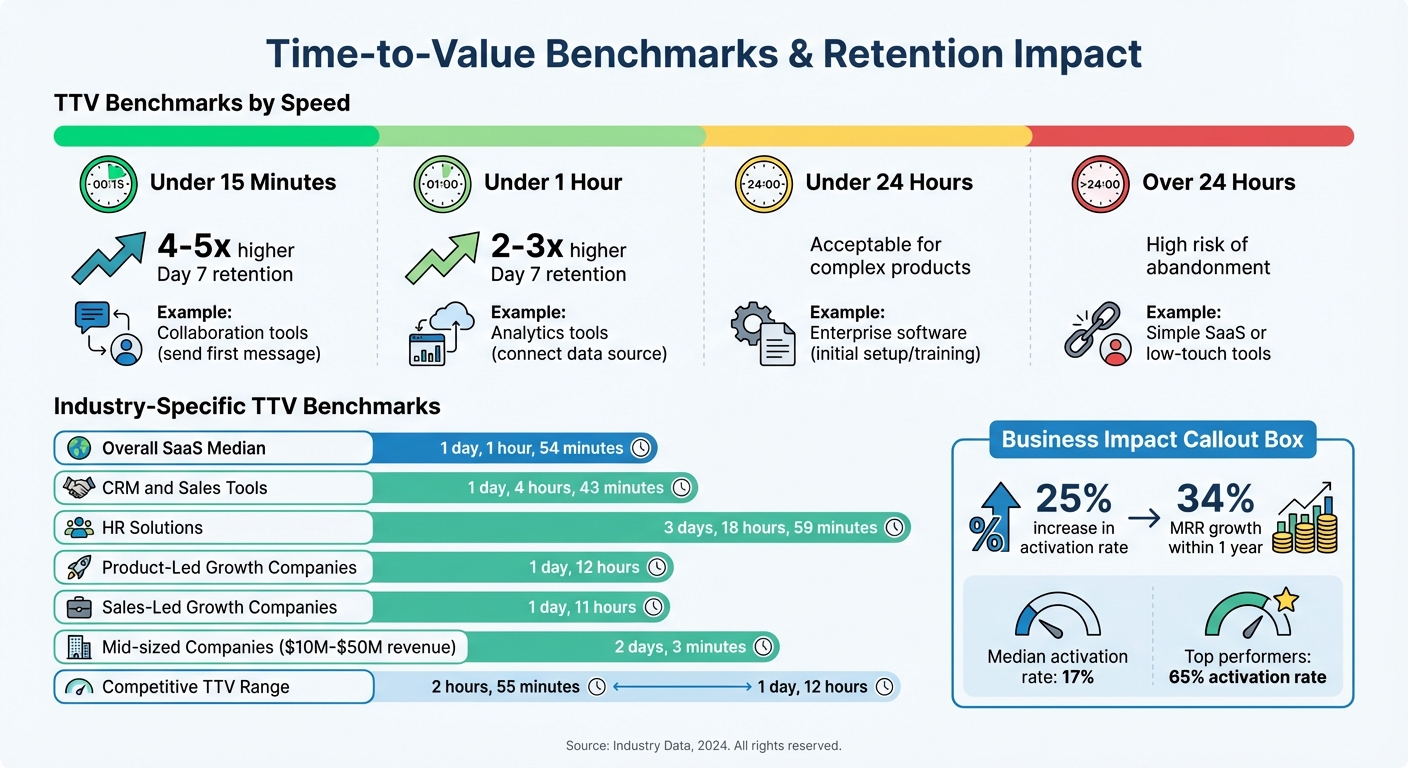
Benchmarking helps you see how your TTV stacks up against others in your space. For SaaS companies, the median TTV is 1 day, 1 hour, and 54 minutes. That said, the numbers can vary by industry: CRM and Sales tools often deliver value around 1 day, 4 hours, and 43 minutes, while HR solutions may take up to 3 days, 18 hours, and 59 minutes.
Mid-sized companies, those with $10 million to $50 million in revenue, usually experience longer TTV - about 2 days and 3 minutes - due to scaling complexities. For most SaaS products, a competitive TTV falls within a range of about 2 hours, 55 minutes to 1 day, 12 hours. If your TTV is significantly outside this range, it may signal the need to refine your onboarding process or adjust your product strategy.
For more precise comparisons, consulting firms often provide industry-specific benchmarks. For instance, Product-Led Growth companies average a TTV of about 1 day, 12 hours, while Sales-Led Growth companies hover around 1 day, 11 hours.
"Time to value is a trust metric, not just an onboarding metric. The longer it takes to reach, the higher the risk of churn."
– Userpilot Team
How to Shorten Time to Value With Better User Onboarding
Proven Strategies to Reduce TTV
Time-to-Value Benchmarks and Retention Impact for SaaS Companies
Refine the Sales Process
The sales process is where the journey to customer success begins. A thorough discovery phase helps your sales team uncover customer pain points and tailor solutions that directly address their needs. By documenting these insights in a shared workspace - like a digital sales room - your Customer Success team can hit the ground running, avoiding redundant discovery steps.
Setting clear expectations upfront is crucial to avoiding churn. When customers know exactly what to expect and how long it will take, they’re more likely to achieve value quickly. For instance, a landing page promise like "Create your first project in under 5 minutes" immediately sets the right tone.
The handoff between Sales and Customer Success is another critical moment. Administrative tasks like security signoffs and legal approvals should be completed during the sales cycle, not after onboarding begins. This prevents unnecessary delays. Additionally, sales teams must avoid overselling or making unrealistic promises, as this can lead to friction during implementation and, ultimately, higher churn rates.
"If your sales team is boosting their conversion rates by misleading customers about your product, it's going to be difficult for your customer success team to onboard them and keep them satisfied." - Daniel Zarick, Arrows
Aligning sales promises with onboarding execution is key. Companies that achieve a 25% increase in user activation rates can see Monthly Recurring Revenue grow by 34% within a year. While the median activation rate hovers around 17%, top-performing businesses reach as high as 65%.
Once the sales process is solid, the next step is breaking onboarding into manageable phases to accelerate value delivery.
Deliver Value in Phases
Long, drawn-out implementations can kill momentum. Instead, breaking the process into smaller, achievable phases ensures customers see results faster. Start by focusing on Time to Basic Value (TTBV) - the first glimpse of value - before moving on to more advanced outcomes.
For example, aim for a minimal "Go-Live" scope, allowing users to access core functionality without requiring them to complete every setup task upfront. Smart defaults and pre-selected options can also reduce the time spent configuring the product.
The impact of reducing TTV is substantial. Achieving TTV in under an hour can result in 2–3x higher Day 7 retention, while cutting it to under 15 minutes can lead to 4–5x higher retention. Non-essential steps, like profile completion or team invitations, can wait until after users experience their first "Aha!" moment.
| TTV Benchmark | Retention Impact | Example |
|---|---|---|
| Under 15 Minutes | 4–5x higher Day 7 retention | Collaboration tools (send first message) |
| Under 1 Hour | 2–3x higher Day 7 retention | Analytics tools (connect data source) |
| Under 24 Hours | Acceptable for complex products | Enterprise software (initial setup/training) |
| Over 24 Hours | High risk of abandonment | Simple SaaS or low-touch tools |
Use Customer Success Managers
Customer Success Managers (CSMs) play a vital role in reducing delays during onboarding. Acting as hands-on guides, they ensure smooth product adoption by addressing questions in real-time and resolving roadblocks before they escalate. For high-touch products, CSMs can provide personalized roadmaps and consulting sessions to keep the process on track.
CSMs also bridge the gap between sales promises and actual delivery, maintaining momentum and ensuring milestones are met. Their involvement keeps stakeholders engaged and helps customers reach their "Aha!" moment more quickly.
Create Mutual Action Plans
Structured collaboration through Mutual Action Plans (MAPs) can further streamline onboarding. A MAP is a shared document that outlines tasks, timelines, and responsibilities for both your team and the customer. This eliminates the back-and-forth of chasing approvals or information.
MAPs work because they create accountability on both sides. When onboarding involves five or more stakeholders, projects are completed on time 91% of the time. Given that most B2B purchases involve 6 to 10 decision-makers, having a centralized tool like this is essential. Additionally, 95% of purchasing groups reevaluate their decisions when new information arises, making it crucial to maintain momentum.
Position the MAP as a helpful resource for navigating internal complexities, not a sales tool. Use customer-friendly language like "First Value Realized" instead of "Contract Signed" to focus on outcomes that matter to them. Companies using structured onboarding approaches have reduced time-to-first-value by an average of 30%.
"A sale is something that happens when you are immersed in helping your buyers to get what they want." - Graham Hawkins
Integrate with Customer Workflows
One of the fastest ways to accelerate value is by integrating your product into the tools and workflows your customers already use. Whether it’s Slack, Trello, Microsoft Teams, or Salesforce, meeting customers where they work removes adoption barriers. Users can access your product’s features without disrupting their existing habits.
This seamless integration reduces friction, speeds up activation, and makes it easier for customers to reach their "Aha!" moment. By fitting naturally into their processes, you eliminate the learning curve that often slows down adoption, ensuring a smoother path to success.
sbb-itb-97f6a47
The Role of Consulting Expertise in Optimizing TTV
Partnering with Consulting Firms
When internal improvements hit their ceiling, bringing in external consultants can be the key to accelerating time-to-value (TTV). These experts offer a fresh, unbiased perspective, using in-depth process analysis and specialized methods to identify inefficiencies and streamline workflows. For instance, in 2024, a regional spirits manufacturer partnered with BCG to optimize its supply chain. The result? They uncovered potential inventory reductions worth $70 million to $80 million and cost savings between $11 million and $13 million.
Comprehensive operational improvement efforts often lead to significant gains. End-to-end initiatives can increase EBITA by 5% to 15%, while strategic changes may cut operational overhead by 15% to 30%. A great example is British Airways, which collaborated with BCG in 2024 to revamp its Heathrow operations. The partnership led to stronger teams and sharper performance, all within less than a year.
Consultants also play a critical role in refining your technology stack, closing gaps, and eliminating manual processes. Companies that fail to embrace digital transformation risk losing up to 43% of their revenue. Automating routine tasks, like invoice processing, can drastically cut cycle times - from weeks to just days or even hours.
When choosing a consulting partner, prioritize firms with expertise in Lean Six Sigma and Agile methodologies. These frameworks are invaluable for reducing waste and speeding up delivery. The right consultant doesn’t just diagnose problems - they roll up their sleeves, implement solutions, train your team, and ensure the improvements last long after their engagement ends. By zeroing in on inefficiencies, consultants pave the way for precise, impactful changes.
Using the Top Consulting Firms Directory

To make the most of consulting expertise, the Top Consulting Firms Directory (https://allconsultingfirms.com) offers a streamlined way to find the right partners for optimizing TTV. This resource connects businesses with specialists in areas like digital transformation, operational efficiency, and TTV optimization.
The directory allows you to filter firms based on their expertise, helping you find those with proven success in tackling challenges like process mapping, technology integration, and change management. Look for firms offering services such as CIO advisory and business process mapping to ensure their strategies align with your goals.
When evaluating potential partners, focus on firms with at least a decade of industry experience. These firms are better equipped to identify sector-specific bottlenecks that less experienced consultants might overlook. Additionally, check for expertise in "shift-left" strategies, where cost awareness and quality testing are integrated earlier in the cycle to prevent delays down the line.
The impact of choosing the right consultant is clear. Business transformations often deliver 57% of their total value within the first six months and achieve 74% of their full potential by the end of the year. High-performing IT organizations - those in the top 25% for technology maturity - report up to 35% higher revenue growth and 10% higher profit margins. As McKinsey Technology highlights:
"Time-to-market is the metric that matters most in evaluating IT productivity. It correlates more strongly with higher profit margins than any other frequently used business performance metric."
The directory simplifies the search for consultants who can help your business achieve these results, turning TTV reduction from an abstract goal into tangible outcomes.
Conclusion
Key Takeaways
Reducing time-to-value (TTV) isn’t something you fix once and forget - it’s an ongoing effort that directly influences your revenue. Customers who don’t quickly see the value in your product are far more likely to churn, making those first 90 days crucial. For example, improving your activation rate by just 25% can lead to a 34% increase in Monthly Recurring Revenue over a year.
The challenge lies in balancing speed and quality. Rushing to deliver value without maintaining quality can lead to expensive rework and a loss of trust. A better approach is phased value delivery - breaking down the implementation into smaller, manageable steps that provide quick wins while working toward the larger goal. Collaboration across teams like Sales, Product, and Customer Success is also essential to avoid the silos that often slow progress.
Leadership plays a pivotal role in this process by empowering teams to make decisions and cutting through unnecessary red tape that delays action. Regular retrospectives, data-driven feedback, and predictive analytics ensure your TTV strategies stay effective. While many SaaS companies struggle with modest activation rates, the best performers achieve much higher results, showing there’s room to refine and strengthen your onboarding process.
Next Steps for Businesses
To build on these insights, here are some actionable steps to reduce your TTV:
- Define your TTV metrics: Identify your customer’s “Aha! Moment” and measure how long it takes for users to reach it. Use tools like Customer Effort Score (CES), feature adoption rates, and onboarding completion metrics to pinpoint friction points.
- Leverage automation: Automate repetitive tasks using Robotic Process Automation (RPA) to free up your team for higher-value work.
- Adopt Agile practices: Use 2-to-4-week sprints to deliver functional features faster and gather early feedback.
When internal resources are stretched thin, consider bringing in outside expertise. The Top Consulting Firms Directory (https://allconsultingfirms.com) connects you with specialists in areas like operational efficiency and digital transformation. Look for firms with at least a decade of experience and certifications in Lean Six Sigma or Agile methodologies. A skilled consulting partner can provide proven frameworks and hands-on support to turn your TTV goals into measurable results.
FAQs
How does aligning sales and onboarding processes help reduce time-to-value (TTV)?
Aligning sales and onboarding is key to creating a seamless handoff from signing the contract to delivering real value. This alignment can significantly cut down on time-to-value (TTV). When sales teams provide the onboarding team with clear and detailed insights into a customer’s goals, timelines, and expectations, there’s no need to waste time rediscovering this information. Instead, onboarding can dive straight into the most relevant setup steps, helping customers hit their first "aha" moment much faster.
This unified approach also ensures that commitments made during the sales process are backed up with intentional and targeted onboarding actions. The result? Happier customers and lower churn rates. For instance, integrating sales-driven metrics, like expected ROI timelines, into onboarding plans or focusing on quick-win activities early on can make a noticeable difference. Assigning customer success managers to guide the process further strengthens this transition. Additionally, consulting firms listed in the Top Consulting Firms Directory can help businesses refine these handoffs, build collaborative playbooks, and track key metrics to keep improving TTV.
How do Customer Success Managers help reduce Time-to-Value?
Customer Success Managers (CSMs) are essential in helping customers achieve results quickly after making a purchase. Their job is to create smooth onboarding experiences with clear, goal-oriented steps. By using tools like automation and offering proactive support, they work to remove any delays. Tracking metrics like adoption rates and time-to-first-value allows them to spot and fix issues early, ensuring customers see results faster.
CSMs don’t stop at onboarding. They become trusted partners, aligning the product’s features with the specific goals of each customer. Through regular check-ins, tailored success plans, and resolving issues promptly, they not only speed up ROI but also build stronger customer satisfaction and loyalty. For businesses aiming to expand these efforts, working with consultants experienced in optimizing Time-to-Value (TTV) can help implement effective strategies seamlessly.
Why is it important to integrate products into customers' existing workflows to reduce time-to-value?
Integrating your product into a customer’s existing workflows is key to making their experience as smooth as possible. When your solution fits naturally into the processes they already know, it minimizes disruptions and lets them see its benefits right away. This approach reduces the time it takes for users to learn the product, encourages quicker adoption, and helps them achieve their goals more efficiently.
By aligning your product with their current systems, you create a frictionless experience. This not only speeds up how quickly they realize its value but also strengthens their trust and satisfaction with your solution.