Struggling to pick between Nexus and SAFe for scaling Agile? Here’s the bottom line:
- Nexus is ideal for smaller setups (3–9 Scrum teams) working on a single product. It’s simple, sticks closely to Scrum, and focuses on integration with minimal added roles and events.
- SAFe suits large enterprises managing multiple products or portfolios. It’s highly structured, designed for scaling across thousands of practitioners, and includes layers for governance, budgeting, and alignment.
Quick Comparison
| Factor | Nexus | SAFe (Essential Level) |
|---|---|---|
| Team Size | 3–9 Scrum Teams | 5–12 Agile Teams |
| Scope | Single product | Enterprise-wide (Portfolio to Team) |
| Roles | Product Owner, NIT, Scrum Master | RTE, Product Management, System Architect |
| Planning Cadence | Sprint-based | Program Increment (8–12 weeks) |
| Best For | 30–100 people, strong Scrum teams | 50–125+ people per ART, enterprise needs |
Key takeaway: Choose Nexus for simplicity and smaller-scale efforts. Opt for SAFe if you need enterprise-level scaling and governance.
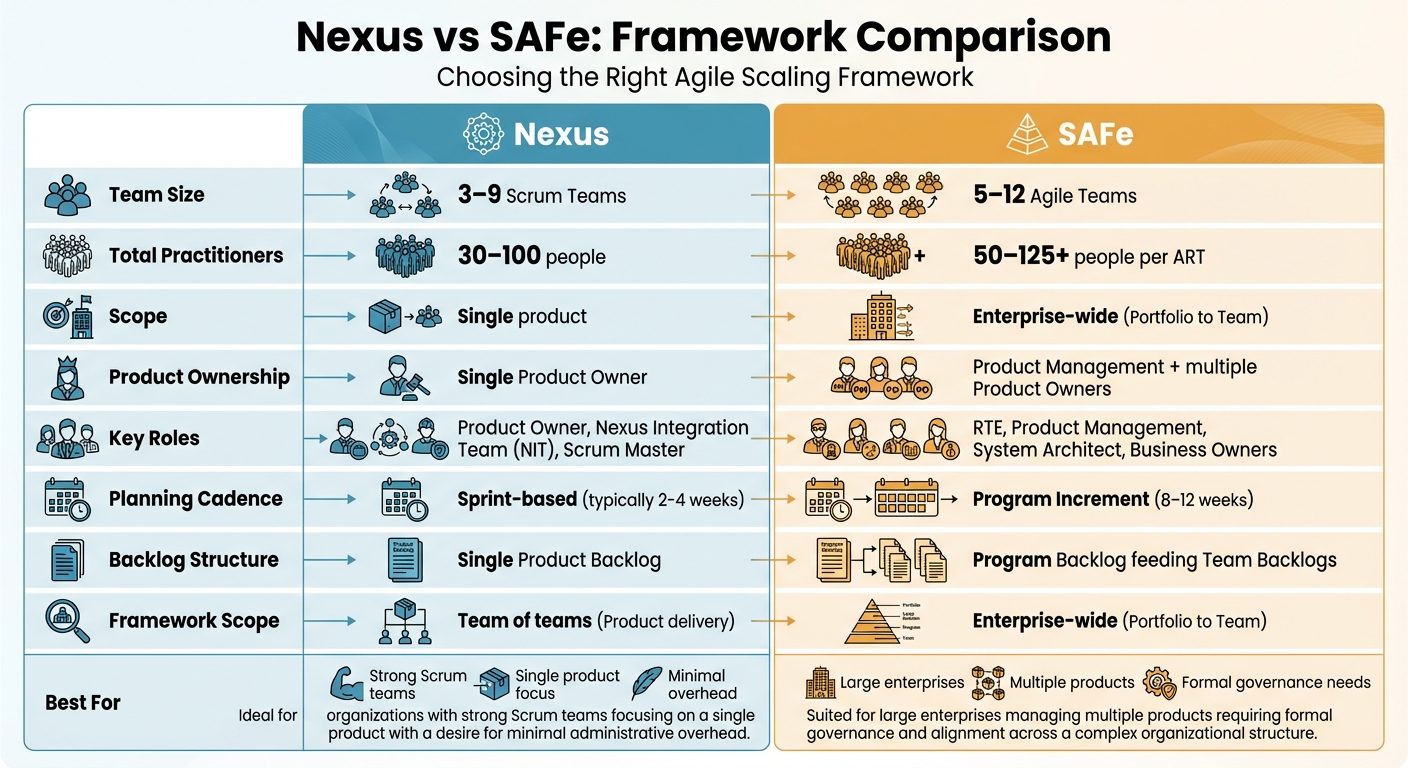
Nexus vs SAFe Framework Comparison: Key Differences in Team Size, Roles, and Scaling
LEARN How to SCALE with Nexus in 9 mins (SIMPLE STEP BY STEP GUIDE)
sbb-itb-97f6a47
What Nexus and SAFe Have in Common

Although they differ in scale, Nexus and SAFe share a foundation built on empiricism and self-managing teams to tackle the challenges of complex product development.
A focus on technical excellence is at the heart of both frameworks. Practices from Extreme Programming (XP) - like continuous integration, automated testing, and a well-defined Definition of Done - are enforced to minimize technical debt and maintain quality.
Both frameworks are designed around delivering value instead of working in silos. Teams are structured to produce complete increments within fixed-length cycles - Sprints in Nexus and Iterations in SAFe.
Leadership also plays a critical role in both approaches. Lean-Agile leadership emphasizes servant leadership, where leaders encourage a growth mindset, support ongoing improvement, and create an environment where teams can excel. This leadership style lays the groundwork for effective team coordination and backlog management.
Team Coordination and Roles
Both Nexus and SAFe rely on specific roles to align teams and handle integration challenges.
In Nexus, the Nexus Integration Team (NIT) takes on a coaching role, helping Scrum teams take responsibility for integration tasks. The NIT typically includes the Product Owner, a Scrum Master, and Nexus Integration Team Members who collaborate to manage dependencies and solve integration issues.
SAFe, on the other hand, uses a System Team that often takes a more hands-on approach. This team handles technical integration and maintains the development environment. To ensure smooth coordination across teams, both frameworks employ orchestration roles. In Nexus, the Scrum Master within the NIT facilitates Scrum practices across teams, while SAFe uses a Release Train Engineer (RTE) to guide the Agile Release Train and address cross-team obstacles.
Backlog Management
Centralized work management is another shared feature of these frameworks. Both Nexus and SAFe use a single, unified backlog to streamline work and support continuous delivery. Nexus operates with a Product Backlog for the entire product, ensuring all teams work from the same prioritized list. SAFe uses a Program Backlog at the Agile Release Train level to coordinate efforts across teams.
To maintain focus during iterations, both frameworks incorporate goal-setting practices. Nexus uses the Nexus Sprint Goal, while SAFe defines Program PI Objectives. As Yuval Yeret puts it:
"Program PI Objectives serve a similar purpose to the Nexus Sprint Goal – a steady North Star goal for the Sprint or set of Iterations to focus on while the details might shift around".
Both frameworks also emphasize regular inspection of integrated increments. Nexus conducts a Nexus Sprint Review, where stakeholders assess the combined work, while SAFe holds a System Demo at the end of each iteration to showcase progress. These practices ensure that integration happens continuously, with all teams contributing to a cohesive and evolving product.
How Nexus and SAFe Differ in Structure and Scale
While Nexus and SAFe share some similarities in coordinating teams, they differ significantly in their structure and scale. Nexus is designed for smaller setups, supporting 3–9 teams, whereas SAFe accommodates larger enterprises, typically managing 5–12 teams and scaling to thousands of practitioners if necessary. Nexus focuses on delivering a single product, while SAFe is tailored for enterprise-wide initiatives, offering configurations that extend across entire organizations. These differences shape how roles are defined and how coordination occurs.
One major distinction lies in product ownership. Nexus relies on a single Product Owner to guide the direction of a single product. As Yuval Yeret explains:
"A smaller Nexus can be easier to provide Product Ownership for, making the 'Single Product Owner' a more viable choice."
In contrast, SAFe separates responsibilities by introducing strategic Product Management alongside team-level Product Owners to handle broader, large-scale initiatives. This division naturally influences how teams align and plan their work.
Both frameworks use centralized backlogs, but their approaches to planning cycles and coordination differ. Nexus teams synchronize during shared Sprint events, maintaining a cadence that aligns with Scrum principles. SAFe, however, operates on a larger scale, coordinating teams through PI (Program Increment) Planning sessions every 8–12 weeks.
The scope of each framework is another defining factor. Adrian Lander, a Lean-Agile Transformation and Executive Business Coach, highlights this distinction:
"Nexus is the least prescriptive of scaled Agile frameworks... an enterprise organization may find it more difficult because the framework is not enterprise-ready on its own."
He also notes:
"SAFe is the only framework with four levels, Team, Program, and Portfolio - and since SAFe 4.0 the Value Stream level."
This layered structure equips SAFe to handle portfolio management, capital budgeting, and architectural oversight across the enterprise.
Comparison Table of Nexus and SAFe
| Factor | Nexus | SAFe (Essential Level) |
|---|---|---|
| Team Size | 3–9 Scrum Teams | 5–12 Agile Teams |
| Total Practitioners | Approximately 30–100 people | 50–125+ people per ART |
| Product Ownership | Single Product Owner | Product Management + multiple Product Owners |
| Primary Roles | Product Owner, Nexus Integration Team (NIT), Scrum Master | RTE, Product Management, System Architect, Business Owners |
| Key Events | Nexus Sprint Planning, Daily Scrum, Review, Retrospective (every Sprint) | PI Planning, System Demo, ART Sync, Inspect & Adapt (every 8–12 weeks) |
| Backlog Structure | Single Product Backlog | Program Backlog feeding Team Backlogs |
| Integration Approach | Nexus Integration Team (Coaching/Enablement focus) | System Team (Technical/Execution focus) |
| Framework Scope | Team of teams (Product delivery) | Enterprise-wide (Portfolio to Team) |
| Further Scaling | Nexus+ (multiple Nexuses) | Four configurations (Essential, Large Solution, Portfolio, Full) |
Pros and Cons of Nexus and SAFe
When comparing Nexus and SAFe, it’s clear that each framework has its own strengths and challenges, making them suitable for different organizational contexts.
Nexus is known for its straightforward approach and minimal overhead, making it a great option for organizations with established Scrum teams. It introduces only a few new roles and events, which helps teams scale without becoming bogged down in extra processes. The use of a single Product Owner ensures clear accountability and a strong focus on delivering value. However, Nexus does have its limitations. It’s designed for smaller scaling efforts (3–9 teams) and doesn’t provide guidance for enterprise-wide governance. Additionally, it lacks built-in portfolio management, meaning organizations may need to adopt additional practices to handle governance at a larger scale.
SAFe, on the other hand, shines when it comes to scaling at the enterprise level. It’s built to support hundreds or even thousands of practitioners through its structured layers. SAFe offers detailed guidance on areas like DevOps, Lean Portfolio Management, and budgeting, aligning well with traditional corporate structures. However, its prescriptive nature can make adoption challenging. The framework has a steep learning curve, requires significant training investment, and can sometimes lead to "Agile theater" - where teams adopt the appearance of agility without achieving its essence. Additionally, its Program Increment (PI) cadence, which typically spans 8–12 weeks, may limit the ability to pivot quickly compared to Nexus’s Sprint-by-Sprint flexibility.
Choosing between these frameworks ultimately depends on your organization’s size and maturity. Companies with strong Scrum foundations and a software-centric focus may find Nexus easier to integrate. In contrast, larger enterprises with traditional hierarchies and complex governance requirements often lean toward SAFe, even if it comes with added complexity.
Comparison Table of Pros and Cons
| Framework | Advantages | Disadvantages |
|---|---|---|
| Nexus | Straightforward: Minimal roles and events, easy for Scrum teams to scale Flexible: Low overhead allows quicker adaptation to change Clear Accountability: Single Product Owner maintains value focus |
Limited Reach: Not designed for enterprise-wide governance Supplementary Needs: Requires additional practices for portfolio management Scaling Cap: Best suited for up to 9 teams |
| SAFe | Enterprise-Ready: Scales to thousands of practitioners and large solutions Comprehensive Guidance: Covers DevOps, Lean Budgeting, and Portfolio Management Alignment: Works well with traditional corporate structures |
Complex Adoption: High training costs and risk of overburdening teams with process Less Agile: PI cadence can hinder rapid pivots Layered Approach: Can distance teams from customer needs |
This breakdown highlights how the choice between Nexus and SAFe should align with your organization’s specific needs, ensuring the framework supports both current workflows and long-term goals.
When to Use Nexus vs. SAFe
Choosing between Nexus and SAFe depends on the size of your organization, the complexity of your projects, and your technical maturity. Each framework has its strengths, making them suitable for different scenarios.
If your organization has 3–9 Scrum teams (30–100 people) working on a single product, Nexus might be the way to go. It keeps things straightforward by introducing only one additional role - the Nexus Integration Team - and a few extra events on top of standard Scrum. This simplicity works well for teams with advanced technical practices and a strong need for closely coordinated Sprints. These factors make Nexus a solid choice for organizations that can manage dependencies and integration effectively.
On the other hand, SAFe is designed for enterprises managing multiple products and portfolios. A single Agile Release Train (ART) in SAFe typically includes 5 to 12 teams, and the framework scales further with its hierarchical structure: Team, Program, Large Solution, and Portfolio levels. If your organization requires formal governance, strategic alignment between leadership and delivery teams, or well-defined budgeting processes, SAFe offers the structure to meet those needs. According to a 2015 Forrester survey, about 33% of enterprises were already using SAFe.
Technical maturity plays a big role in choosing the right framework. As Agile Coach Yuval Yeret explains:
"You cannot scale crap – Scaling requires technical excellence".
Nexus assumes your teams already excel at continuous integration and dependency management through strong engineering practices. If your teams aren't there yet, SAFe's structured approach - such as Program Increment (PI) Planning every 8 to 12 weeks - can help manage dependencies while improving your technical capabilities.
Another key difference lies in backlog management. Nexus works best when a single Product Owner can oversee the entire backlog. In contrast, SAFe divides responsibilities between Product Management and multiple Product Owners.
Before diving into either framework, consider whether your challenges might be addressed by "descaling" - reorganizing into fewer, more efficient teams rather than adding layers of coordination. Once you've assessed your needs, start small with a trial run, such as implementing a single Nexus or one Agile Release Train (ART). This cautious approach can help you minimize risks before committing to a full-scale rollout.
Conclusion
Deciding between Nexus and SAFe isn’t about finding a one-size-fits-all solution - it’s about choosing what aligns best with your organization’s size, technical expertise, and strategic goals. Nexus is ideal for 3–9 Scrum teams working on a single product with strong technical practices. On the other hand, SAFe is better suited for large enterprises managing multiple products and portfolios.
"There is no silver bullet. What works well in one context does not necessarily work in another."
The key is to align your choice with your actual needs. Start small - pilot a single Nexus implementation or an Agile Release Train - and focus on ensuring your teams achieve technical excellence. This foundation is essential for scaling effectively.
Once your internal processes are validated, external expertise can help refine your approach. Avoid isolated or superficial implementations. Professional consultants can tailor frameworks to your specific context - whether that involves simplifying SAFe’s detailed structure or supplementing Nexus with additional practices. This customization builds on the roles and challenges discussed earlier.
If you’re looking for expert guidance, explore the Top Consulting Firms Directory (https://allconsultingfirms.com). These professionals specialize in areas like digital transformation, agile practices, and organizational change, helping you scale effectively without unnecessary trial-and-error.
FAQs
How do I decide between Nexus and SAFe for my org?
Choosing between Nexus and SAFe comes down to your organization's size, Agile expertise, and specific goals.
SAFe provides a highly structured framework tailored for large enterprises. It includes detailed guidance, clearly defined roles, and governance mechanisms to ensure alignment across extensive teams and departments.
On the other hand, Nexus is a leaner, Scrum-based framework designed to help multiple Scrum teams work together by addressing dependencies. It’s a great choice for organizations that value simplicity and want to maintain a high degree of team autonomy.
The decision ultimately hinges on how much structure and governance your organization needs versus how much flexibility and simplicity you prefer.
What level of engineering maturity do we need to scale safely?
To grow securely and efficiently, organizations need to reach a level of engineering maturity that supports stability, predictability, and the ability to handle complexity effectively. This means having systems that operate reliably, well-established testing practices, and alignment with agile methodologies. Tools like the SAFe framework offer structured approaches for managing large-scale coordination, while models such as the CNCF Platform Engineering Maturity Model emphasize advancing in areas like automation, teamwork, and system stability. These elements are crucial for fostering dependable and scalable growth.
Can we start with Nexus and move to SAFe later?
Yes, moving from Nexus to SAFe can work, but it depends on what your organization needs and how ready it is for the change. Nexus is a simpler framework, great for scaling Scrum without adding much complexity. Once your teams have mastered scaled Scrum and require more formal coordination across the enterprise, SAFe might be the next logical step - as long as your organization is prepared for the governance structure and complexity that SAFe brings.