ISO 27001 and GDPR address two critical aspects of managing information: security and privacy. While ISO 27001 is a global standard focusing on securing all types of data through risk-based controls, GDPR is a legal framework aimed at protecting personal data of EU residents and ensuring their privacy rights.
Key Differences:
- Purpose: ISO 27001 secures data through technical and organizational measures. GDPR regulates how personal data is collected, processed, and protected.
- Scope: ISO 27001 covers all information assets (e.g., intellectual property, financial data). GDPR focuses solely on personal data.
- Enforcement: GDPR imposes fines up to €20 million or 4% of global revenue. ISO 27001 non-compliance results in loss of certification.
- Focus: ISO 27001 emphasizes confidentiality, integrity, and availability. GDPR prioritizes individual privacy rights like consent and data deletion.
Quick Comparison
| Criteria | ISO 27001 | GDPR |
|---|---|---|
| Focus | Data security (all assets) | Personal data privacy |
| Scope | All data types | EU residents' personal data |
| Enforcement | Certification audits | Legal penalties (fines) |
| Risk Management | Broad risk-based approach | Privacy-specific risk management |
| Data Subject Rights | Not addressed | Required (e.g., access, erasure, portability) |
| Legal Basis for Processing | Not required | Mandatory |
| Breach Notification | No specific deadlines | 72-hour mandate |
Key Takeaway:
ISO 27001 and GDPR complement each other but serve different purposes. To comply with both, organizations must integrate security controls with privacy practices, ensuring robust protection for all data while respecting individual rights.
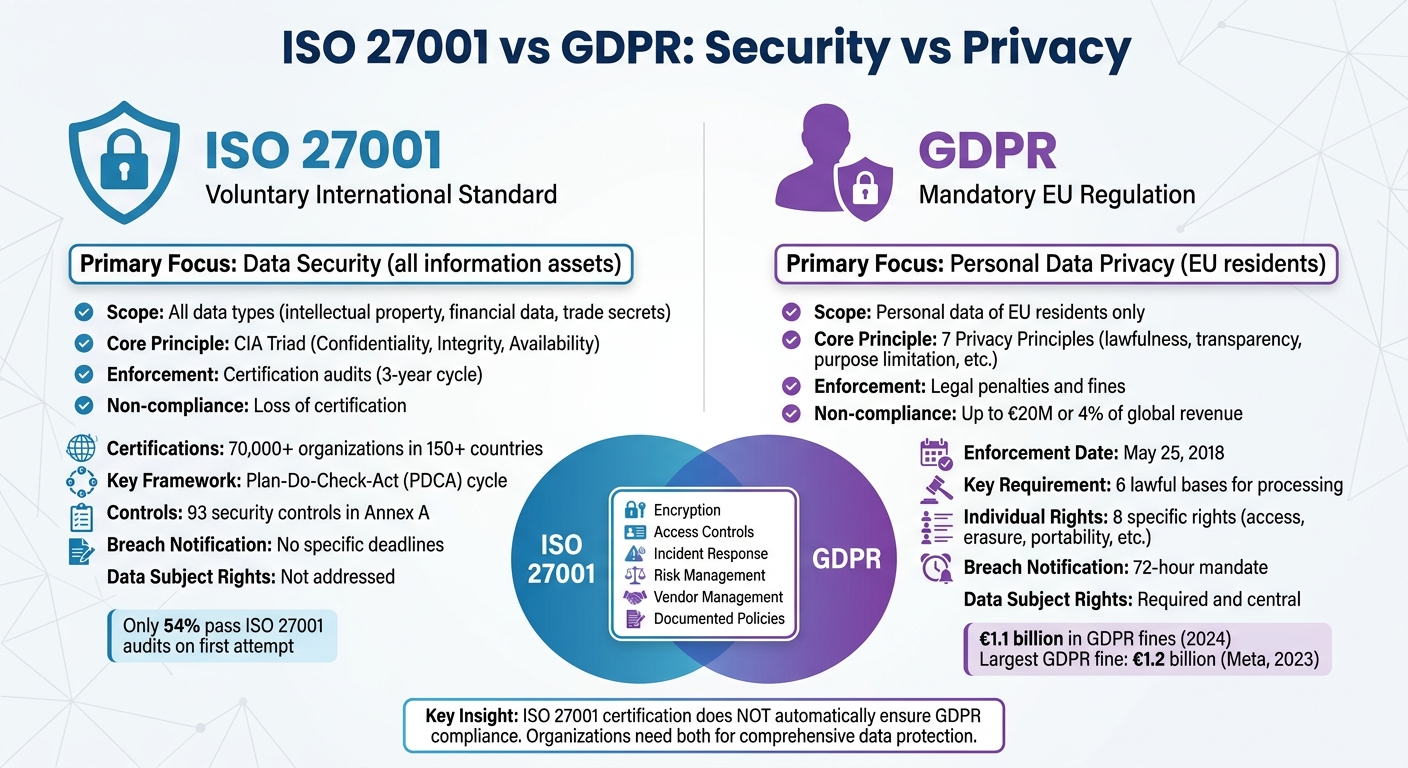
ISO 27001 vs GDPR: Key Differences in Data Security and Privacy Compliance
What is ISO 27001?
ISO 27001 Framework Explained
ISO/IEC 27001:2022 is the global standard for creating and managing an Information Security Management System (ISMS). An ISMS combines people, processes, and technology to safeguard your organization’s sensitive data. Unlike a simple checklist of security tools, ISO 27001 uses a risk-based approach, tailored to your company’s specific needs and scale.
At the heart of ISO 27001 is the CIA triad: Confidentiality (ensuring only authorized users access information), Integrity (maintaining data accuracy and preventing unauthorized changes), and Availability (ensuring information is accessible to authorized users when needed). According to the 2022 ISO Survey, over 70,000 organizations across 150 countries hold ISO 27001 certifications, with the Information Technology sector making up nearly 20% of these certifications.
"ISO/IEC 27001 helps organizations become risk-aware and proactively identify and address weaknesses." - ISO
The framework follows the Plan-Do-Check-Act (PDCA) cycle, which emphasizes continuous improvement. This cycle ensures organizations consistently identify risks, implement safeguards, monitor performance, and refine their strategies over time. Let’s break down the key components that form this framework.
Main Components of ISO 27001
ISO 27001’s structure is built around Clauses 4 through 10, which outline the mandatory requirements for an ISMS. These clauses cover leadership involvement, risk assessment, internal audits, and performance evaluations. Additionally, Annex A lists 93 security controls, grouped into four categories:
- Organizational (37 controls)
- People (8 controls)
- Physical (14 controls)
- Technological (34 controls)
The most recent update in 2022 streamlined the framework by reducing the number of controls from 114 to 93 while introducing 11 new controls. These additions address modern security challenges like threat intelligence (A.5.7), cloud security (A.5.23), and data masking (A.8.11). A key document in this process is the Statement of Applicability (SoA), which outlines which of the 93 controls are relevant to your organization and explains any exclusions based on your risk assessment.
ISO 27001 certification is valid for three years. During this period, organizations must undergo annual surveillance audits in the first two years, followed by a full recertification audit in the third year.
sbb-itb-97f6a47
What is GDPR?
GDPR Objectives and Scope
The General Data Protection Regulation (GDPR) sets the standard for how organizations manage personal data, updating privacy rules that were originally established in 1995. Enforced since May 25, 2018, GDPR's goal is to enhance individuals' rights, unify data privacy laws across the European Union, and give people greater control over their personal information.
"The General Data Protection Regulation (GDPR) is the toughest privacy and security law in the world." - Ben Wolford, Editor in Chief, GDPR.eu
One of GDPR's defining features is its global reach. It applies to any organization worldwide that processes data belonging to EU residents or offers them goods and services. Unlike a directive, GDPR is a regulation, meaning it automatically applies across all EU countries without requiring separate national legislation. Non-compliance can result in severe penalties - up to €20 million or 4% of a company's total global annual revenue, whichever is larger.
These goals are supported by a set of principles that outline how personal data should be handled.
Core Principles of GDPR
GDPR is guided by seven core principles that shape how organizations manage personal data. The first, lawfulness, fairness, and transparency, requires a valid legal reason for data processing and ensures clarity about how the data will be used. Under purpose limitation, data must only be collected for clearly defined purposes and cannot be used for unrelated activities. Data minimization ensures that only the information necessary for a specific purpose is collected, while accuracy mandates that personal data be kept up to date.
Other principles include storage limitation, which restricts how long data can be kept, and integrity and confidentiality, which demand that data is stored securely to prevent unauthorized access. The principle of accountability requires organizations to demonstrate compliance with GDPR standards.
Organizations must also establish one of six lawful bases for processing personal data: consent, contract, legal obligation, vital interests, public task, or legitimate interests. GDPR further empowers individuals with eight specific rights, such as the right to access their data, request corrections, have their data erased (the "right to be forgotten"), and transfer their data to another provider (data portability). Additionally, if a data breach occurs, organizations are required to notify supervisory authorities within 72 hours of discovery.
Main Differences Between ISO 27001 and GDPR
Scope and When Each Applies
ISO 27001 and GDPR serve different purposes and apply to distinct areas of compliance. GDPR specifically regulates the handling of personal data belonging to EU residents, while ISO 27001 takes a broader approach, covering various types of information assets such as intellectual property, financial data, and third-party information. Knowing these differences is essential for aligning your organization’s practices with both security and privacy requirements.
Enforcement mechanisms also vary significantly. GDPR violations can result in heavy fines - up to €20 million or 4% of global annual revenue, whichever is higher. A notable example is the €1.2 billion fine imposed on Meta Platforms Ireland Ltd in May 2023 by the Irish Data Protection Commission for improper data transfers between the EU and the US. On the other hand, ISO 27001 compliance is assessed through third-party audits, and failure typically results in the loss of certification rather than monetary penalties. Interestingly, only 54% of organizations pass ISO 27001 audits on their first attempt.
These differences in scope and enforcement highlight the distinct focuses of each framework, setting the stage for a closer look at their respective priorities.
Security vs Privacy Focus
The core distinction between ISO 27001 and GDPR lies in their primary objectives. ISO 27001 emphasizes protecting an organization’s overall information systems through technical measures like firewalls, encryption, and access controls to maintain the confidentiality, integrity, and availability of all data assets. GDPR, in contrast, prioritizes individual privacy through principles like transparency, lawful data processing, and obtaining user consent. As Elliott Harnagel, Product & Compliance Experience Strategist at Strike Graph, points out, GDPR’s security requirements are narrower in scope compared to ISO 27001 because it is a privacy regulation, not a cybersecurity standard.
This difference means that achieving ISO 27001 certification does not automatically ensure GDPR compliance, as ISO 27001 does not address specific privacy rights like the right to be forgotten, data portability, or explicit consent. Conversely, being GDPR-compliant doesn’t guarantee robust overall data security. For example, an organization could process personal data lawfully under GDPR but still leave other critical assets - such as intellectual property - exposed to risks. GDPR also has strict breach reporting requirements, mandating notification to supervisory authorities within 72 hours, and informing affected individuals if the risk is significant. ISO 27001, while requiring an incident management process, does not impose specific legal deadlines.
In 2024 alone, GDPR fines totaled approximately €1.1 billion, underscoring the high stakes of failing to meet its privacy obligations. This sharp contrast in focus between the two frameworks reinforces the need for organizations to address both security and privacy comprehensively.
Comparison Table: ISO 27001 Controls vs GDPR Articles
Control and Article Mapping
Mapping ISO 27001 controls to GDPR articles shows how the two frameworks align and where gaps remain. While some controls strongly support GDPR requirements, others fall short, especially in areas related to individual privacy rights. The table below highlights how ISO 27001 controls correspond to GDPR articles, offering a clear picture of their alignment and limitations.
For instance, GDPR Article 32 (Security of Processing) aligns well with ISO 27001 controls related to technology (A.8.1–8.34) and physical security (A.7.1–7.14). These controls address encryption, access management, and secure system configurations. Similarly, ISO 27001's logical access controls (A.5.15, A.5.18, A.8.2, A.8.3, A.8.5) support GDPR Article 25's Privacy by Design principles by focusing on secure authentication, authorization, and the principle of least privilege.
However, areas like data subject rights (GDPR Articles 15–22) are not covered well by ISO 27001. The standard lacks provisions for handling user requests such as data access, rectification, or erasure. Additionally, GDPR's requirement for a Data Protection Officer (Articles 37–39) only loosely corresponds to ISO 27001's role assignment controls (A.5.2, A.5.4), which emphasize security responsibilities rather than privacy oversight.
| GDPR Requirement | ISO 27001:2022 Controls | Coverage Level | Key Focus |
|---|---|---|---|
| Art. 32: Security of Processing | A.8.1–8.34 (Technology); A.7.1–7.14 (Physical) | High | Encryption, access controls, system security |
| Art. 25: Privacy by Design | A.8.25–8.27 (Secure Development); A.8.11 (Anonymization) | Medium | Secure coding, data de-identification |
| Art. 30: Records of Processing | A.5.9 (Inventory); A.5.12–5.13 (Classification) | Medium | Asset tracking, data labeling |
| Art. 33–34: Breach Notification | A.5.24–5.28 (Incident Management); A.6.8 (Reporting) | Medium | Incident response (lacks 72-hour mandate) |
| Art. 35: DPIA | Clause 6.1 (Risk Assessment); A.5.8 (InfoSec in PM) | Medium | Risk evaluation framework |
| Art. 15–22: Data Subject Rights | No direct equivalent | Low | User access, deletion, portability requests |
This comparison highlights the strengths and weaknesses of ISO 27001 when it comes to GDPR compliance. While ISO 27001's data retention and deletion controls (A.5.14, A.8.10) support GDPR Article 5's storage limitation principle by enforcing removal schedules, they do not address data minimization. Organizations must implement additional measures to limit data collection independently.
Where ISO 27001 and GDPR Overlap and Differ
Shared Risk Management Approach
ISO 27001 and GDPR both emphasize a risk-based strategy for safeguarding data. They share common ground in implementing key security measures like access controls, encryption, documented policies, incident response planning, and vendor management. These overlapping requirements highlight a shared commitment to strong security practices, though their focus and scope differ significantly.
The distinction lies in the type of risks each framework prioritizes. ISO 27001 is designed to protect an organization's overall information assets - this includes intellectual property, financial records, and trade secrets - through an Information Security Management System (ISMS). In contrast, GDPR is centered on protecting individuals' rights and freedoms, specifically concerning their personal data.
Their methodologies also diverge. GDPR requires a Data Protection Impact Assessment (DPIA) for high-risk data processing activities, ensuring that individual privacy risks are addressed. ISO 27001, on the other hand, employs a broader risk assessment approach, selecting controls from its Annex A to safeguard information assets. Despite these differences, organizations can align both frameworks effectively. For example, ISO 27001’s technical controls can help meet GDPR Article 32’s demand for "appropriate technical and organizational measures". However, while both frameworks share a focus on risk management, GDPR’s emphasis on individual privacy introduces unique obligations.
GDPR Requirements Not Covered by ISO 27001
ISO 27001 does not address some critical privacy requirements mandated by GDPR. For instance, ISO 27001 overlooks the rights of data subjects, such as access, rectification, erasure, portability, and objection. These rights are fundamental to GDPR but fall outside ISO 27001's scope, which focuses on securing data rather than addressing privacy rights.
Another notable gap is the absence of a requirement to establish a legal basis for data processing. GDPR obligates organizations to justify data collection based on criteria such as informed consent, contractual necessity, or legitimate interest. ISO 27001, by contrast, is solely concerned with protecting data after it has been collected. Additionally, GDPR’s principle of data minimization - collecting only what is strictly necessary - is not covered by ISO 27001.
To address these privacy-specific gaps, many organizations turn to ISO 27701, an extension to ISO 27001 that integrates privacy management requirements. This addition helps bridge the divide, ensuring compliance with GDPR’s more privacy-focused mandates while maintaining robust data security practices.
How to Comply with Both ISO 27001 and GDPR
Steps to Meet Both Requirements
To align with both ISO 27001 and GDPR, extend your Information Security Management System (ISMS) to include all personal data processing activities. This ensures your security measures address GDPR requirements without duplicating efforts. Start by conducting a gap analysis to compare your current practices with the requirements of both frameworks. Pay special attention to areas like data subject rights, legal bases for processing, and consent management - topics that ISO 27001 doesn’t explicitly cover.
Incorporate GDPR's Records of Processing Activities (ROPA) into your ISO 27001 asset inventory. Additionally, update your Statement of Applicability (SoA) to reflect GDPR requirements and consolidate your compliance documentation. Revise your incident response procedures to align with ISO 27001 standards while meeting GDPR’s 72-hour breach notification rule. A unified incident response process not only reduces audit fatigue but also helps you identify and address gaps before external audits. These integrated steps create a stronger, more cohesive compliance framework.
By combining these efforts, you’ll improve your security measures while ensuring robust privacy protection.
"The combination creates defense in depth. ISO 27001's systematic approach prevents security gaps. GDPR's user-focused requirements protect you from privacy violations." – ComplyDog
Working with Consulting Firms
Consulting firms with expertise in both ISO 27001 and GDPR can simplify the process of integrating compliance controls. These specialists help identify gaps and create plans that address both the technical security needs of ISO 27001 and the legal privacy obligations of GDPR.
"External support can fill capability gaps. Consultants who understand both GDPR and ISO 27001 can guide your implementation more efficiently than separate specialists in each area." – ComplyDog
Many consulting firms also assist with transitioning to ISO 27001:2022, which introduces updated controls for third-party management and cyber risks that align more closely with GDPR. This dual-focused approach ensures that your security controls and privacy measures work seamlessly together.
For businesses looking to find the right expertise, the Top Consulting Firms Directory provides a resource to connect with leading firms specializing in IT, digital transformation, and strategic management - key areas for achieving dual compliance.
The difference between GDPR and ISO 27001 compliance
Conclusion
ISO 27001 and GDPR work hand in hand to strengthen both data security and privacy. While ISO 27001 delivers a structured framework for safeguarding all types of information assets, GDPR focuses on protecting the personal data of EU residents, backed by strict legal requirements. Together, they create a layered defense strategy that addresses technical safeguards and legal responsibilities.
The key distinction lies in their purpose and enforcement. ISO 27001 is a voluntary international standard emphasizing confidentiality, integrity, and availability of information systems. GDPR, on the other hand, is a mandatory regulation with steep penalties - up to €20 million or 4% of global annual revenue, whichever is higher. High-profile fines in the past highlight the importance of adhering to GDPR's requirements.
Since both frameworks overlap in areas like encryption, access control, and incident response, managing them through a unified program makes practical sense. Organizations that achieve compliance with both often find themselves better positioned for enterprise contracts and government projects, as dual compliance is increasingly seen as a mark of reliability.
For businesses navigating these requirements, expert guidance is invaluable. Professionals skilled in both ISO 27001 and GDPR can identify compliance gaps, streamline processes, and consolidate documentation. The Top Consulting Firms Directory is a helpful resource for finding experts in IT, digital transformation, and strategic management - key areas for aligning security and privacy efforts.
FAQs
Do I need ISO 27001 if I already comply with GDPR?
If you already comply with GDPR, pursuing ISO 27001 isn’t a requirement, but it can provide extra advantages. GDPR emphasizes legal standards for data privacy and protecting individual rights. On the other hand, ISO 27001 offers a structured approach to managing overall information security. Implementing ISO 27001 can enhance your security measures and minimize risks, working alongside GDPR compliance to cover a wider range of organizational and technical safeguards for data protection.
Does ISO 27001 certification reduce GDPR fine risk?
Absolutely. ISO 27001 certification can play a key role in lowering the risk of GDPR fines. By adopting a structured Information Security Management System (ISMS), ISO 27001 aligns closely with GDPR’s requirements for data security and risk management.
Achieving this certification shows that your organization has implemented strong security measures. This not only supports compliance with GDPR’s mandates to safeguard personal data but also reduces the chances of violations - and the hefty fines that come with them.
Should I add ISO 27701 for GDPR privacy requirements?
ISO 27701 builds on ISO 27001 by adding a structured approach to managing privacy information, making it a strong ally for GDPR compliance. It emphasizes safeguarding Personally Identifiable Information (PII) and aligns closely with GDPR's focus on privacy, data protection, and accountability. By adopting ISO 27701, organizations can establish clear privacy controls, document data processing activities, and showcase their commitment to meeting GDPR standards. It's a practical way to bolster your privacy management system and ensure compliance.