Hybrid work is now the norm, with 83% of employees preferring flexible arrangements. Companies that adapt see benefits like 25% lower turnover and 4–8% higher productivity, while those that don't risk losing talent - 50% of knowledge workers would quit if flexibility were removed. Here's a quick guide to thriving in a hybrid setup:
- Assess Your Workplace: Use surveys and pulse checks to understand employee needs. Address concerns like proximity bias, which worries 66% of hybrid workers.
- Set Clear Policies: Define eligibility for hybrid work, establish communication norms (e.g., 30-minute response for instant messages), and focus on outcomes, not visibility.
- Upgrade Technology: Provide modern hardware, secure software, and tools like digital whiteboards to streamline collaboration.
- Support Well-Being: Offer mental health resources, ergonomic stipends, and enforce work-life boundaries to reduce burnout.
- Monitor and Improve: Regularly gather feedback, track metrics like focus time and after-hours communication, and adjust as needed.
Hybrid work isn't just a trend - it's a smart way to boost retention, attract top talent, and improve performance. By focusing on these steps, businesses can create a flexible, productive, and connected workforce.
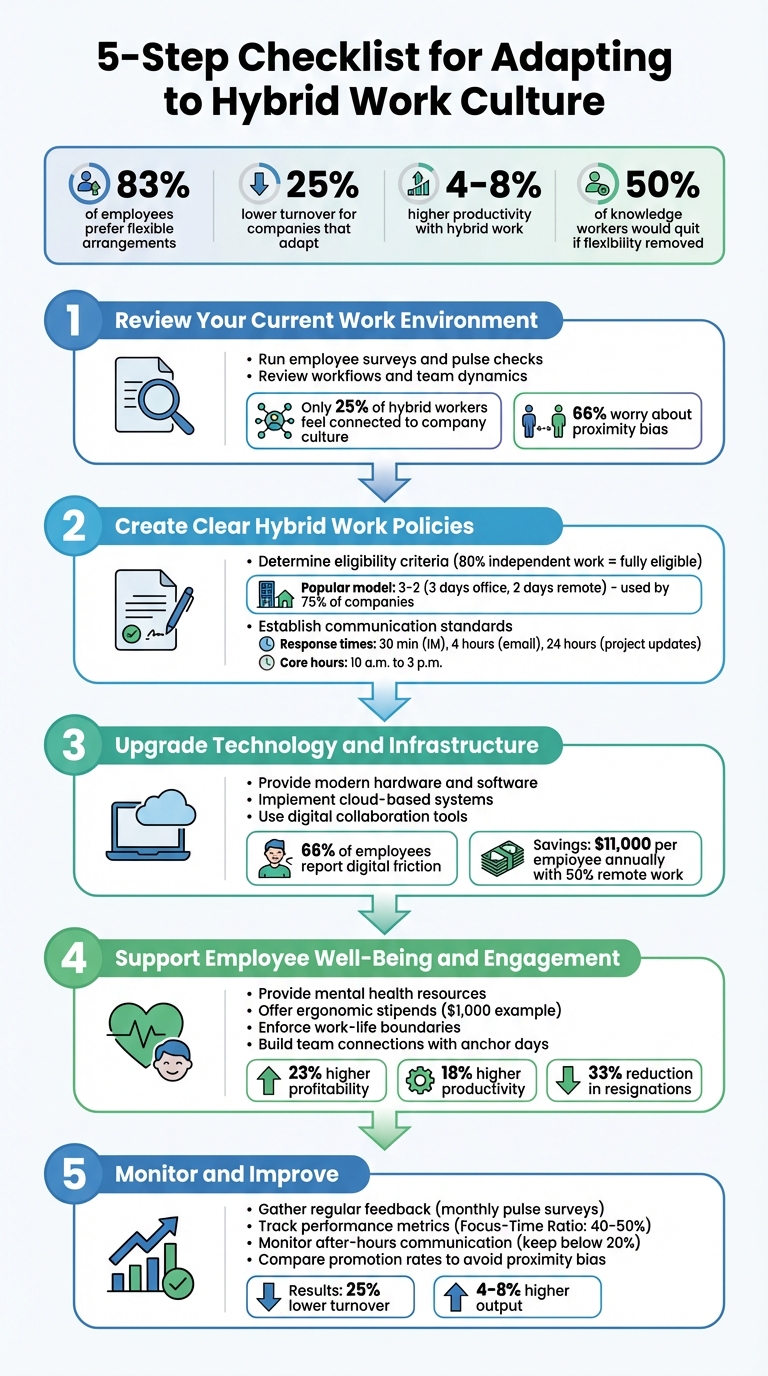
5-Step Checklist for Implementing Hybrid Work Culture
Step 1: Review Your Current Work Environment
Take a close look at your work environment by diving into real data about team operations and employee needs. Here's a striking fact: only 25% of hybrid workers feel genuinely connected to their company culture. Why does this matter? Because workers who feel highly connected perform 37% better than those who don't.
Run Employee Surveys and Focus Groups
Start by asking employees about their expectations and concerns. One common worry among hybrid workers is proximity bias - the belief that remote work could hurt their career growth. In fact, 66% of hybrid professionals are concerned that working remotely might slow their advancement.
When conducting surveys, make sure to distinguish between different types of flexibility. For example, employees who enjoy "radical flexibility" - control over where, when, and how much they work - report feeling 53% more connected. Compare that to just 18% connectedness for those with limited flexibility.
Don’t rely solely on annual surveys. Hybrid work environments are dynamic, and sentiments can shift quickly. Instead, use regular pulse checks that provide quick insights. Managers in hybrid setups can’t rely on in-person cues to spot burnout or disengagement. As Gartner puts it:
"Physical proximity is being in the same space as another individual - being seen. Emotional proximity is being of importance to others - feeling seen".
This feedback is crucial for identifying areas where workflows and team dynamics need improvement.
Review Current Workflows and Team Dynamics
Take a hard look at your organization’s processes to pinpoint what’s slowing remote work down. Are there outdated bureaucratic steps, like paper approvals? Or maybe your team relies on location-specific software that limits flexibility.
Next, evaluate how your team collaborates. Do all decisions require meetings, or could asynchronous tools do the job just as well? Research from Stanford shows that when hybrid roles are structured thoughtfully, productivity can rise by 4–8%.
If your organization’s performance management is more focused on visibility than results, it’s time to rethink that approach. Shift to output-based metrics before fully embracing hybrid work. This step will help you gauge whether your company is ready to give employees the autonomy they need - or if deeper cultural adjustments are required first.
sbb-itb-97f6a47
Step 2: Create Clear Hybrid Work Policies
After reviewing your current work environment, it's time to formalize policies that outline who qualifies for hybrid work and how accountability will be maintained. Without clear guidelines, you risk inconsistency and potential legal issues. Start by defining eligibility criteria before setting communication and accountability norms.
Determine Eligibility Criteria for Hybrid Work
Eligibility should be based on job functions to ensure fairness and consistency. Some roles may require physical presence due to machinery, secure file access, or in-person customer interactions. To simplify, you can divide roles into three categories:
- Fully eligible: Roles with at least 80% independent work.
- Partially eligible: Roles that occasionally require on-site presence for tasks like lab work or client meetings.
- Not eligible: Roles requiring constant on-site presence.
A popular approach is the 3-2 model, where employees spend three days in the office and two working remotely. About 75% of companies now use this model. Another common practice is setting "anchor days" - typically Tuesday and Wednesday - when entire teams are required to be on-site. This structure makes scheduling easier and ensures face-to-face collaboration.
Once roles are categorized, clearly communicate expectations and establish performance metrics for all employees.
Establish Communication and Accountability Standards
Define response times for different communication channels to set clear expectations. For example:
- 30 minutes for instant messages during core hours.
- 4 hours for emails.
- 24 hours for project management updates.
Most companies designate 10 a.m. to 3 p.m. in the primary time zone as the core availability window. This ensures overlap for collaboration while accommodating flexibility.
To evaluate performance fairly, focus on measurable outcomes rather than visibility. Frameworks like Objectives and Key Results (OKRs) can help track results. This is especially important because 67% of managers admit they view in-office employees as more committed than remote ones. To counteract this proximity bias, consider blind performance reviews and regular audits of promotions to ensure remote workers aren't overlooked.
Encourage asynchronous communication as the default. The SmartKeys Podcast emphasizes this approach:
"Make async the default; use live meetings for problem-solving and decisions, and always summarize next steps in writing".
Document all meeting notes and decisions in a shared space within 24 hours. For non-exempt employees, ensure written pre-approval for overtime to avoid compliance issues with the Fair Labor Standards Act (FLSA).
Here's a quick guide to communication expectations:
| Communication Channel | Expected Response Time | Best Use Case |
|---|---|---|
| Instant Messaging (Slack/Teams) | 30 Minutes (during core hours) | Urgent queries, quick updates, social bonding |
| 4 Hours | Formal communication, external clients, non-urgent info | |
| Project Management (Asana/Jira) | 24 Hours | Task status, technical blockers, long-term planning |
| Async Video (Loom) | N/A (Review within 24h) | Demos, walkthroughs, replacing long meetings |
Step 3: Upgrade Technology and Infrastructure
Once you've laid down clear policies, the next step is to enhance your technology to support hybrid work. Did you know that 66% of employees report moderate to high digital friction? On top of that, companies can save up to $11,000 per employee annually when staff work remotely half the time. A solid technical foundation is essential to unlock these benefits.
Improve IT Infrastructure for Hybrid Work
With hybrid work policies in place, it's time to upgrade your IT tools for smooth operations. Start by providing remote employees with reliable hardware, such as modern laptops from brands like Dell, HP, or Lenovo. These devices should support stable video processing and USB-C docking. Pair them with AI-enabled headsets like the Jabra Evolve2, which can reduce background noise and improve call clarity.
For office spaces, enhance meeting rooms with advanced tools like all-in-one video bars (e.g., Logitech Rally) and touch-panel controllers (e.g., Crestron Flex). These devices offer one-touch join functionality, ensuring that remote participants can engage just as effectively as those physically present - a principle called meeting equity.
"Even the most advanced collaboration platforms underperform when the underlying hardware is outdated, inconsistent, or poorly integrated." - Sophie Wilson, UC Today
Beyond hardware, focus on software solutions. Implement cloud-based endpoint management systems to securely monitor, patch, and manage devices - whether employees are at home or in the office. Hot-desk and meeting room booking software that integrates with tools like Slack or Microsoft Teams can help avoid scheduling conflicts and make office visits more efficient. For brainstorming sessions, digital whiteboarding tools like Miro or Mural can bridge the gap between in-office and remote team members.
To ensure security, require VPNs for public Wi-Fi use and automate endpoint patching. Store critical documents in secure cloud platforms such as Google Drive, OneDrive, or Dropbox, so everyone - remote or in-office - has equal access to information.
Work with Expert Consultants
If upgrading hardware and software feels overwhelming, consider bringing in the pros. Digital transformation can be complex, and expert consultants can help you navigate the process. Firms specializing in IT infrastructure and cloud solutions can guide you in selecting the right technology stack, avoiding costly errors, and speeding up your hybrid work transition. The Top Consulting Firms Directory is a great resource for finding experienced consultants in areas like cybersecurity, cloud services, and IT modernization.
Step 4: Support Employee Well-Being and Engagement
Put your people first. Companies with robust well-being programs see 23% higher profitability and 18% higher productivity. Even more striking, moving from fully in-person work to a hybrid model has led to a 33% reduction in resignations. The goal? Create an environment where employees feel supported, connected, and valued.
Provide Wellness Resources and Support
Hybrid work introduces unique challenges to employee well-being. Over 70% of employees report feeling drained by the constant back-and-forth between home and office. To address this, offer mental health resources like virtual counseling and online therapy platforms that employees can access on their own terms. Mindfulness training and stress management workshops can also help ease the mental strain caused by endless digital interactions.
Physical wellness matters too. Providing ergonomic stipends is one way to help - Shopify, for instance, gave employees a $1,000 stipend for their home office setup in 2025. Investments like these pay off, as companies can cut healthcare costs by up to 35% when employees actively participate in wellness programs. Other ideas include virtual fitness classes, ergonomic consultations, and reminders to take breaks and move during the workday.
Burnout prevention is key, so establish clear work-life boundaries. Enforce "no-contact" policies after work hours and encourage leaders to model these expectations by scheduling emails to go out only during working hours. Flexible schedules also allow employees to balance personal and professional responsibilities, which boosts motivation and well-being. In fact, 59% of knowledge workers say hybrid arrangements improve their mental health, and 54% note better physical health as well.
Once well-being is addressed, focus on fostering stronger team connections.
Build Team Connection and Collaboration
Even with better policies and tools, only about 25% of hybrid workers feel a real sense of connection. This highlights the importance of intentional team-building efforts. The answer isn’t forcing everyone back to the office - it’s fostering emotional proximity, or making employees feel valued and connected to their colleagues. This approach can improve workplace culture connectedness by 27%.
One way to do this is by implementing anchor days - commonly Tuesdays and Wednesdays - when teams are encouraged to work in the office together. Additionally, tools like Donut or RandomCoffee can be used to arrange 15-minute virtual coffee chats, helping employees build casual social bonds. Slack or Microsoft Teams channels dedicated to "show-and-tell" moments, where employees can share hobbies, pets, or other personal interests, can recreate those informal water cooler conversations.
Focus on creating team-specific experiences rather than broad, company-wide initiatives. These smaller "microcultures" are often more effective in fostering connection. For instance, Virgin Money developed an app for its call center staff, allowing them to align daily tasks with personal values, which strengthened their connection to the company mission. Regular check-ins, along with virtual or in-person social events, can also help maintain engagement and reduce feelings of isolation in a hybrid setup.
Step 5: Monitor and Improve the Hybrid Model
Creating a successful hybrid work environment means treating it as an evolving process. It's not enough to set it and forget it. Regularly assess how well it's working by focusing on what truly matters - collaboration, productivity, and retention - rather than outdated metrics like hours worked or desk usage.
Gather and Review Feedback Regularly
Feedback is your guiding star for refining the hybrid model. Set up multiple ways to collect it, like monthly pulse surveys, to gauge how tools are performing, whether employees feel connected, and if work-life balance is being maintained.
Take a page from Adobe's playbook. Back in 2014, they replaced annual reviews with their "Check-In" system, transforming feedback into an ongoing dialogue. The result? A 30% boost in employee engagement. Siemens followed suit with their "My Voice" initiative, which improved employee satisfaction scores by 15% in just a year.
The key is to act on the feedback you gather. Communicate changes clearly using a "You said, we did" approach. This builds trust and shows employees their input matters. IBM took this a step further with their massive virtual "Think Forward Jam", involving over 34,000 employees to co-create their hybrid strategy. When employees help shape the system, they’re more likely to embrace and support it.
Once feedback is in hand, shift your focus to tracking meaningful performance metrics that align with hybrid work goals.
Track Performance Metrics
After gathering insights, use outcome-based metrics to measure how well your hybrid model supports productivity and engagement. For example, high-performing hybrid teams often spend 40–50% of their workday in uninterrupted focus blocks of two or more hours - known as the Focus-Time Ratio.
Keep an eye on after-hours communication. If it exceeds 20%, it’s linked to a 35% increase in turnover and 28% lower engagement. Weekly one-on-one meetings between managers and employees are another important metric; cancellation rates should stay below 10%, as higher rates can negatively impact engagement and performance.
Also, watch for proximity bias by comparing promotion rates of remote versus in-office employees on a quarterly basis. Segment metrics like Employee Net Promoter Scores (eNPS) and voluntary turnover rates by work arrangement to identify and address any disparities early.
Companies that get this right see real benefits: structured hybrid teams experience 25% lower voluntary turnover and deliver 4–8% higher output compared to fully in-office setups. Tracking these metrics ensures your hybrid model remains effective and adaptable over time.
Conclusion
Shifting to hybrid work is about more than just logistics - it's about creating a workplace that prioritizes people. By focusing on five key areas - evaluating your environment, defining clear policies, upgrading tools, supporting employee well-being, and tracking performance - you can build a hybrid work culture that lasts.
Companies that embrace effective hybrid policies see tangible benefits, including lower turnover, increased productivity, and greater employee loyalty. In fact, as of early 2026, 83% of employees across various industries prefer hybrid work setups, and job postings offering this flexibility attract 35% more qualified applicants.
"I don't think of the hybrid future as one of physical place. I think of it as really caring for people and giving them the flexibility that's needed to have a high sense of well-being." - Michael C. Bush, CEO, Great Place To Work
This shift isn't just about adapting - it's a chance to rethink how culture is built. Instead of relying on "culture by osmosis", organizations can foster intentional connections and values through everyday work. This approach strengthens teams, making them more adaptable and engaged, no matter where they work.
If you're looking for guidance to make this transition smoother, expert resources can help. The Top Consulting Firms Directory (https://allconsultingfirms.com) is a great starting point to find professionals specializing in digital transformation, strategic planning, and organizational change. With the right approach, your hybrid model can become a powerful tool to attract top talent, improve performance, and create a workplace where employees genuinely feel appreciated.
FAQs
How do we pick which roles are hybrid-eligible?
Figuring out which roles can thrive in a hybrid work setup starts with evaluating whether the job can be done effectively from a remote location. Here are some key factors to consider:
- On-Site Interactions: Does the role require frequent in-person collaboration or hands-on tasks that can’t be replicated online?
- Access to Tools and Equipment: Are there specific systems, equipment, or resources that employees must physically access to perform their duties?
- Monitoring Productivity: Can the employee’s performance and output be tracked and managed without being on-site?
Jobs that rely heavily on in-person activities or specialized equipment may not be a good fit for hybrid work. Additionally, it’s important to weigh operational needs, ensure compliance with legal requirements, and confirm that responsibilities can be effectively handled in a flexible environment.
How can we prevent proximity bias in promotions?
To tackle proximity bias in promotions, it's crucial to create clear, outcome-focused criteria for recognizing and advancing employees. This approach ensures that promotions are based on measurable results rather than who happens to be in the office more often.
Additionally, maintaining transparent processes is key. Regular check-ins can help ensure that remote employees are given the same opportunities for recognition and growth as their in-office counterparts. These steps not only promote fairness but also build trust within hybrid teams.
What metrics should we track to see if hybrid work is working?
Key metrics to watch include the focus-time ratio, which measures the balance between uninterrupted work and other tasks, and cross-team network strength, which evaluates how well teams collaborate across departments. Pay attention to the after-hours communication rate to understand work-life balance and the meeting-to-outcome ratio to assess the efficiency of meetings.
Other important indicators are the onboarding ramp rate, which tracks how quickly new hires adapt, and the balance between collaboration and focus time, highlighting how employees split their time between teamwork and individual tasks. Lastly, keep an eye on employee engagement indicators to gauge overall satisfaction and productivity. Together, these metrics provide insight into the effectiveness of hybrid work models.