Engaging stakeholders effectively requires understanding their unique roles and needs. Here's the key takeaway: Tailored communication and participation strategies are essential for success. Why? Different groups - executives, middle managers, and frontline employees - have diverse priorities and perspectives.
- Executives need concise, high-level updates focused on outcomes like revenue or risk.
- Middle managers require actionable tools and clear guidance to bridge strategy and execution.
- Frontline employees value hands-on involvement and practical insights for day-to-day tasks.
A one-size-fits-all approach leads to disengagement and possible project failure. Instead, organizations should map stakeholders, prioritize based on influence, and customize engagement. For example, use tools like power-interest grids and RACI matrices to define roles and communication frequency.
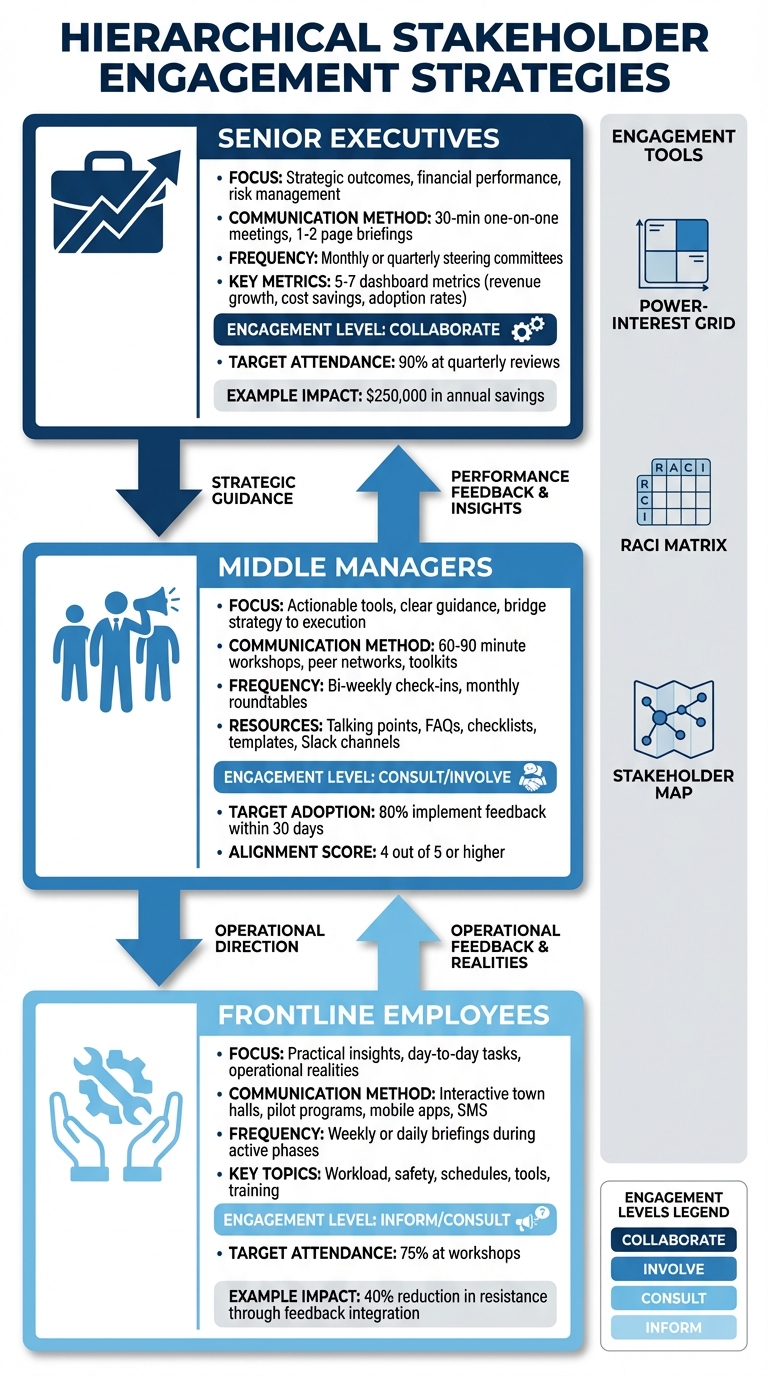
Stakeholder Engagement Framework: Communication Strategies Across Organizational Hierarchies
How to Map Stakeholders Across Hierarchies
Identifying Key Stakeholder Groups
Start by reviewing your organizational chart to pinpoint all stakeholders who are either impacted by or have influence over your project. Senior executives like CEOs and CFOs play a critical role by setting the strategic direction and controlling resources. Middle managers, such as department heads and team leaders, are responsible for translating strategy into actionable steps and managing daily operations. Meanwhile, frontline employees handle the actual execution of tasks and possess a deep understanding of operational realities. Don’t forget to include support functions - like HR, IT, and finance - as well as external stakeholders such as clients, suppliers, and regulators.
While organizational charts provide a good starting point, complement them with direct outreach. Use tools like surveys or interviews to confirm who is actively involved. Segmenting stakeholders into groups can help capture operational insights, evaluate project feasibility, and secure necessary approvals. This dual approach ensures that informal influencers - those who may not hold official titles but carry significant sway - are not left out. A clear categorization of stakeholders allows you to tailor strategies to the unique needs of each group.
Prioritizing Stakeholders by Influence and Needs
Once you’ve identified your stakeholder groups, the next step is to assess their influence and needs. A power-interest grid is a handy tool for this. This 2x2 matrix helps you categorize stakeholders based on their level of power (decision-making authority) and interest (how much the project impacts them). For example, senior executives often land in the "manage closely" quadrant due to their high power and high interest, while groups with low power and low interest may only need occasional updates.
To further clarify roles, consider using a RACI matrix. This framework assigns stakeholders specific roles: Responsible (task execution), Accountable (final decision-making), Consulted (providing input), and Informed (kept in the loop). Focus on "Accountable" stakeholders first, as they hold the authority to approve major decisions. For instance, a CFO responsible for budget approvals will require early and detailed engagement, while team members who are simply informed can be updated less frequently. Keep in mind that priorities may shift as the project progresses; while executives are crucial during the planning phase, middle managers often take center stage during implementation.
Documenting Engagement Touchpoints
With your stakeholder priorities in place, it’s important to establish clear engagement touchpoints to maintain effective communication. Create a centralized map that outlines each stakeholder's preferred communication methods, frequency of updates, and ownership of specific content. Examples of touchpoints include executive briefings, email updates, workshops, digital platforms like Slack, and one-on-one conversations. This documentation is crucial for avoiding missteps, such as bombarding low-interest stakeholders with unnecessary details or duplicating information across groups.
Regularly review and update the touchpoint map to keep communication streamlined. For instance, if multiple team members are reaching out to the same department head about similar issues, consolidate those interactions to avoid redundancy. Similarly, if a high-influence external partner hasn’t been engaged recently, schedule a timely follow-up. By tailoring communication to each stakeholder’s preferences and needs, you can ensure that everyone stays informed without feeling overwhelmed. These touchpoints serve as the foundation for a well-structured, hierarchy-aware communication plan.
Customizing Engagement Strategies for Each Level
Engaging Senior Executives
Senior executives focus on the big picture - strategic outcomes, financial performance, risk management, and reputation. To get their attention, frame outcomes in terms of measurable results like revenue growth, cost savings, risk mitigation, or added value. Use straightforward visuals, such as dashboards, to present key data at a glance. For example, highlight a result like "$250,000 in annual savings" to make the impact clear.
When meeting with executives, keep it concise. A 30-minute one-on-one discussion paired with a 1–2 page briefing is ideal. For steering committees, schedule monthly or quarterly meetings with structured agendas that zero in on 2–3 key decisions, risk updates, and brief status summaries. Avoid diving into operational details that don't require their input. Between meetings, quick email updates or dashboard snapshots can keep them informed without overwhelming their schedules.
Dashboards should focus on 5–7 metrics that matter most to executives. These might include business value delivered, adoption rates across functions, risk heat maps, or customer impact metrics. Share dashboards digitally and review them at major milestones or monthly check-ins. Use quarter-by-quarter breakdowns and time-bound milestones that align with board-level priorities or address market and regulatory risks.
Empowering Middle Managers
After engaging executives, shift your focus to middle managers, who need clear guidance and practical tools to execute strategies. Keep in mind their packed schedules, and provide resources that are both concise and actionable. Offer manager-specific briefing materials, such as talking points, FAQs, and customizable slide decks. Support these with change toolkits that include checklists, meeting templates, and sample emails, making it easier for managers to communicate effectively with their teams.
Workshops of 60–90 minutes work well for this group, especially when scheduled to avoid busy periods like month-end or quarter-end. Combine brief presentations with hands-on activities, such as role-playing or scenario planning, to make the sessions practical and engaging. Create peer networks or communities of practice - monthly virtual roundtables or forums, for instance - where managers can share successes, compare metrics, and solve problems collaboratively.
Clearly define managers' roles in engagement efforts. Whether they’re leading pilot teams, tracking department-level metrics, or acting as change advocates, they need to understand their responsibilities. Provide access to collaboration tools, such as Slack channels or project workspaces, stocked with ready-to-use resources. On-demand materials like short videos and playbooks can also be helpful. To respect their time, integrate engagement topics into existing team meetings for maximum efficiency.
Involving Frontline Employees
Once leadership and management are aligned, focus on frontline employees with practical, hands-on engagement. For this group, strategies should be interactive, localized, and action-oriented. Replace one-way presentations with interactive town halls that include Q&A sessions, live polls, and small-group discussions. Address their immediate concerns - things like workload, safety, schedules, and tools - and show them how their feedback has shaped decisions. Using a "you told us X, we changed Y" approach can build trust and encourage continued participation.
Pilot programs are a great way to involve frontline staff. Select a few employees to test new tools or processes, gather their feedback, and make adjustments before rolling changes out more broadly. Communicate these updates clearly to the rest of the workforce. Use digital platforms like mobile apps, SMS updates, or intranet forums to share quick, visual updates, recognize contributions, and provide a simple way for employees to submit ideas or concerns.
Keep messaging focused on tangible benefits to their work - like improved safety, better tools, lighter workloads, or new training opportunities. Use plain language, relatable examples, and visuals to make the information accessible. Offer dedicated time for participation during shifts, and recognize contributions with shout-outs or small rewards. Be mindful of operational realities like shift patterns and break times to ensure everyone has the chance to engage.
Engaging Stakeholders: Strategies for Success
sbb-itb-97f6a47
Setting Up Engagement Levels and Communication Frequency
Once you’ve mapped out your stakeholders and customized your strategies, the next step is putting your engagement plan into action. This means assigning engagement levels to each group, choosing the right communication channels, and establishing a consistent rhythm for updates.
Engagement Levels: Start by matching stakeholder groups to specific engagement levels based on their influence and role. For instance:
- Use "inform" for low-priority groups where one-way updates suffice, like sending monthly email newsletters to frontline employees who only need basic awareness.
- Apply "consult" for stakeholders who provide feedback, such as middle managers, through surveys or interactive workshops.
- Opt for "involve" for stakeholders with high interest, like team members who actively contribute via weekly stand-ups or real-time Slack discussions.
- Reserve "collaborate" for top-priority leaders, such as senior executives, who participate in joint planning sessions and milestone reviews to shape the strategy.
These actions naturally build on the stakeholder mapping and tailored strategies you’ve already developed.
Communication Channels: The method of communication should reflect each group's preferences and availability. For example:
- Senior executives often prefer executive briefings or one-on-one meetings, which accommodate their busy schedules.
- Middle managers thrive in interactive workshops or through internal platforms where they can ask questions and share resources in real time.
- Frontline employees are best reached through team stand-ups, messaging apps, or email updates that fit around their shift schedules.
Using multiple channels ensures you’re meeting stakeholders where they are, both literally and figuratively.
Frequency of Updates: Timing matters just as much as the message. During active project phases, high-priority stakeholders might need daily or weekly updates, while middle managers could benefit from bi-weekly check-ins. Frontline employees may require weekly or even daily briefings depending on their involvement. As the project moves into monitoring or closure, you can scale back to monthly summaries. Be sure to adjust the frequency based on feedback to keep communication relevant.
Lastly, track how well your engagement plan is working. Monitor response rates, attendance at meetings, and feedback from sessions to gauge overall sentiment. These metrics will help you refine your approach, keeping it adaptable and effective throughout the project lifecycle.
Measuring Stakeholder Engagement Results
Once your engagement plan is in motion and communication routines are established, the next step is figuring out how well it's working. Measuring engagement is crucial to confirm that stakeholders are genuinely involved and aligned at all levels.
Key Metrics for Evaluating Engagement
Each level of engagement requires specific metrics to track progress. For executive sponsorship, start by monitoring meeting attendance - aim for a 90% attendance rate at quarterly reviews. Also, keep an eye on public endorsements, such as mentions in internal communications. If executives are actively promoting your initiatives during town halls or in company-wide emails, it’s a clear sign they’re on board.
For manager alignment, focus on adoption rates and survey results. A good benchmark is having at least 80% of managers implement feedback within 30 days. Additionally, aim for alignment survey scores of 4 out of 5 or higher. These metrics reveal whether middle managers are effectively translating strategy into action or if there are gaps that need to be addressed.
When it comes to frontline participation, track workshop attendance (target 75%) and analyze feedback contributions. For instance, during one reorganization, feedback from frontline employees led to process changes that reduced resistance by 40%. Sharing these updates in town halls showed employees how their input directly shaped outcomes, reinforcing their engagement.
Feedback Loops and Continuous Improvement
To keep the engagement process dynamic, use multiple feedback channels. Start with quarterly pulse surveys through tools like Google Forms or SurveyMonkey. Include both Likert-scale questions (e.g., "Rate your involvement in decisions: 1-5") and open-ended prompts for suggestions. A 70% response rate is a solid goal to ensure you’re capturing diverse perspectives across the organization.
Pair surveys with cross-level focus groups of 6-8 participants, mixing executives, managers, and frontline staff. Hold these sessions every two months to discuss challenges and create action logs with clear owners and deadlines for follow-ups. For example, when executives received low clarity scores (3.2 out of 5) on briefings, the team introduced visual dashboards. This change boosted satisfaction to 4.5 in subsequent surveys. Iterating based on feedback ensures your strategies stay effective and relevant.
Demonstrating Results and Adjusting Strategies
Use the feedback you gather to fine-tune your approach in real time. Tailor how you present results to different audiences. For executives, create high-level dashboards showcasing metrics like "Engagement boosted project success by 30%" with clear visuals. Managers should receive reports focused on their team’s specific metrics, while frontline staff benefit from stories showing how their contributions made a difference, like "Your feedback cut delays by 2 weeks."
When gaps emerge, act quickly to adjust. For instance, in one project, low executive availability (60% participation) led the team to reprioritize tasks and introduce templatized milestone updates. These changes increased engagement to 95%, bringing project timelines back on track - a 35% improvement. These measurable results not only validate your approach but also highlight where shifts are needed as priorities evolve over the course of the project.
Conclusion
Engaging stakeholders effectively means tailoring your communication to fit their specific roles and responsibilities. This involves identifying key players, customizing your messaging for executives, middle managers, and frontline employees, and tracking what resonates so you can adjust in real time. By aligning your approach - whether it’s informing, consulting, or collaborating - you turn one-way announcements into meaningful two-way conversations that build accountability.
Each stakeholder group benefits from focused updates. Executives need insights into strategic outcomes, managers require clarity on decision-making and coordinated operations, and frontline employees need actionable, practical information. Prioritizing open dialogue ensures smoother transitions and leads to better results across the board.
To measure your success, use metrics like feedback response rates and adoption timelines. These insights allow you to refine your approach based on what stakeholders are saying. For more complex initiatives, seeking expert support - like the resources available through the Top Consulting Firms Directory - can help you navigate intricate organizational structures and implement proven strategies for stakeholder engagement.
The key to success lies in treating stakeholder engagement as an ongoing relationship, not a one-off task. By maintaining open communication and adapting to changing needs, organizations can deliver real, measurable value at every level while staying aligned with evolving priorities.
FAQs
How can organizations adapt their communication to engage stakeholders at different levels?
To connect with stakeholders effectively across various levels, organizations need to tailor their communication to match the audience’s specific interests, responsibilities, and concerns. This means speaking their language, using examples that resonate with their roles, and selecting the communication channels they prefer.
It’s also crucial to prioritize clear and focused messaging that directly addresses what matters most to them. By personalizing communication in this way, you can build trust, encourage better understanding, and create meaningful interactions that resonate throughout the organization.
What are the best tools for identifying and prioritizing stakeholders?
To identify and prioritize stakeholders effectively, tools such as stakeholder analysis matrices can be incredibly useful. Two widely used methods are the Power-Interest Grid and the Salience Model.
The Power-Interest Grid helps classify stakeholders by assessing their level of influence and interest, making it easier to determine how much attention they require. On the other hand, the Salience Model evaluates stakeholders based on three key factors: power, urgency, and legitimacy, offering a more nuanced understanding of their importance.
These tools provide a structured way to grasp stakeholder dynamics, enabling you to craft engagement strategies that fit their unique roles and priorities.
How should stakeholder engagement adapt throughout a project?
As a project moves forward, the way you engage with stakeholders should evolve into a more interactive and collaborative process. At the start, prioritize delivering clear and straightforward updates to ensure everyone is on the same page and aligned with the project's goals. As things progress, transition to more engaging communication methods, like seeking feedback and involving stakeholders in important decisions.
This progression keeps stakeholders informed, actively involved, and invested in the project's success as it develops.