Hook: Did you know that 95% of purchase decisions are driven by subconscious emotions, yet 89% of consumers feel no personal connection to the brands they buy from?
Value Summary: Emotional branding focuses on building deep, personal connections with customers by appealing to their feelings and aspirations, rather than just promoting product features. Brands that successfully connect emotionally see customers who are 52% more valuable and three times more likely to stay loyal and recommend them.
Quick Overview:
- Emotional branding prioritizes how customers feel over what a product does.
- It leverages psychology, like subconscious decision-making and emotional triggers, to build loyalty.
- Tools like storytelling, color psychology, and empathy mapping help brands align with customer emotions.
- Authenticity and consistency are critical to maintaining trust and emotional bonds.
Bridge: Let’s explore how emotional branding works, why it’s effective, and how you can use it to create lasting customer loyalty.
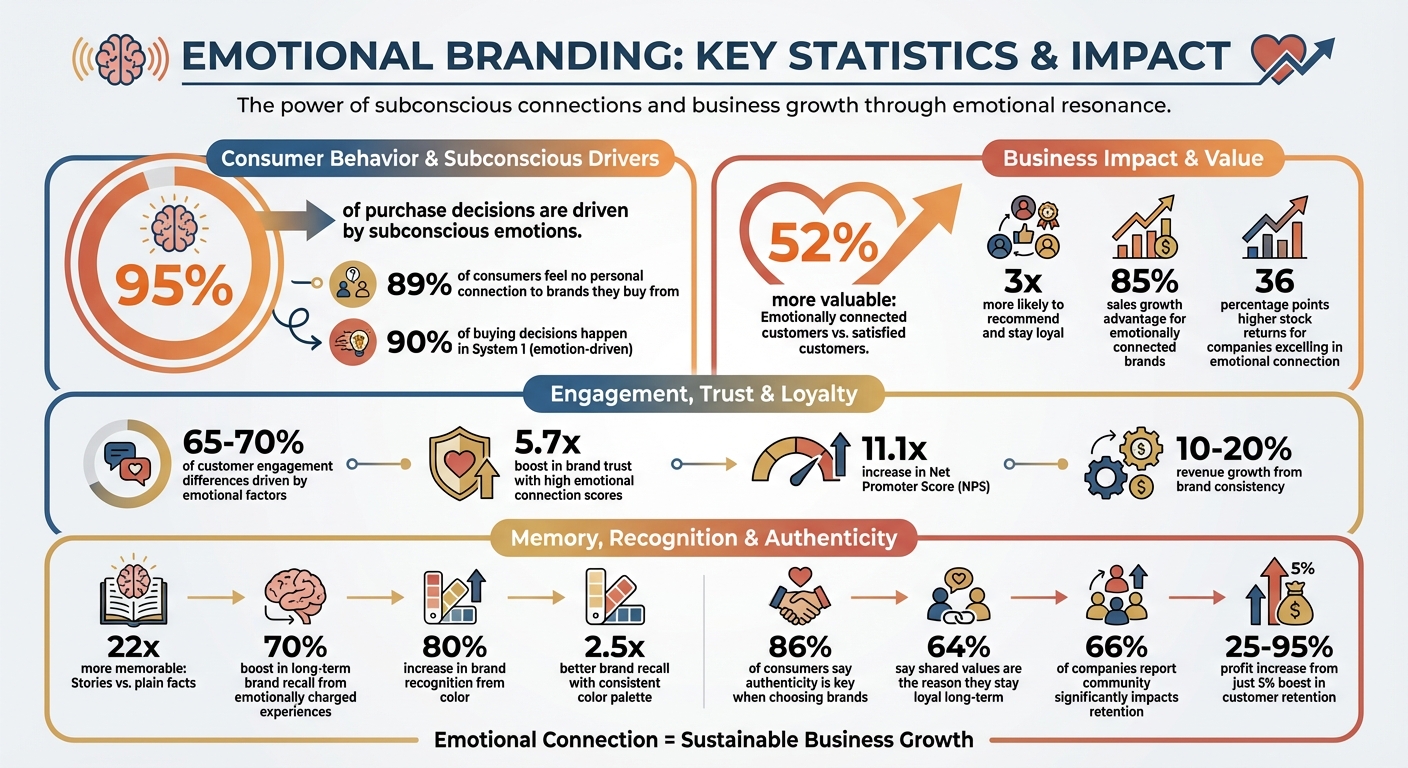
Emotional Branding Statistics: Impact on Customer Value and Brand Performance
What Is Emotional Branding and How Does It Work?
Defining Emotional Branding
Emotional branding is all about building a deeper connection between your brand and your customers by appealing to their feelings, aspirations, and subconscious needs - not just highlighting product features or benefits. While traditional branding focuses on what a product does, emotional branding focuses on how it makes people feel.
Marc Gobé, a leading voice in this area, introduced "The Ten Commandments of Emotional Branding", which emphasize a shift from thinking of "Consumers to People", "Product to Experience", and "Function to Feel". The ultimate aim? To make your brand a fundamental part of your customers' identity. Fascinatingly, brain imaging studies reveal that strong brands activate the same reward centers in the brain that light up when people think about loved ones like friends or family.
"Emotional branding is the process of building lasting relationships by appealing to consumers' emotional state, ego, needs, and aspirations." - Marc Gobé, Author/Pioneer of Emotional Branding
Unlike traditional branding, which focuses on awareness and driving purchases, emotional branding fosters loyalty and advocacy. Here's a powerful stat: emotionally connected customers are 52% more valuable than customers who are simply satisfied. This connection is deeply rooted in how our brains process emotions, as we’ll explore next.
The Psychology Behind Emotional Branding
Our brains make decisions using two systems: the quick, emotion-driven System 1, and the slower, logic-based System 2. Emotional branding directly targets System 1, where a whopping 90% of buying decisions happen.
Neuroscientist Antonio Damasio's Somatic Marker Hypothesis sheds light on this. It suggests that emotions create "somatic markers" - essentially gut feelings - by linking certain outcomes to specific emotions. Brands take advantage of this through classical conditioning, repeatedly pairing their products with positive triggers like heartwarming ads or uplifting music. Over time, these associations become automatic.
Emotional branding also ties into Maslow's Hierarchy of Needs, addressing higher-level desires like belonging, esteem, and self-actualization. When a brand aligns with these needs, it becomes part of a customer's identity, engaging the brain's default mode network - the part responsible for self-reflection.
"Emotions are processed faster than rational information." - SpotLight
The payoff for brands that connect emotionally is massive. They outperform competitors by 85% in sales growth, and emotional factors drive 65% to 70% of the differences in customer engagement.
sbb-itb-97f6a47
How to Identify and Use Your Audience's Emotions
Researching Your Audience's Emotional Drivers
Understanding your audience goes beyond basic demographics. Dive deeper by conducting direct interviews with your customers to uncover their emotional motivations. Ask questions like, "How can this business improve my life?" or "What personal goal can I achieve with this service?" These conversations help bridge gaps between your brand and your audience's emotional needs.
Pay close attention to behavioral signals, which reveal emotions in real time. Digital tools can track actions like rage-clicking, typing in all caps, or frequent backtracking - signals of frustration, anger, or confusion. Similarly, during calls, a rising pitch or frequent interruptions can indicate distress. These involuntary reactions often provide more honest insights into emotions than words alone.
Customer journey mapping is another powerful tool. It helps you identify emotional high points and endings, which, according to the Peak-End Rule, shape how customers remember their experiences. Advanced tools like facial recognition, biometric sensors, and targeted surveys can even quantify these emotional responses.
This effort pays off. Companies that excel in emotional connection outperform their competitors by 36 percentage points in stock returns. Additionally, high emotional connection scores are linked to a 5.7x boost in brand trust and an 11.1x increase in Net Promoter Score (NPS).
By understanding these emotional cues, you can craft a brand position that resonates deeply with your audience.
Connecting Emotions to Your Brand Position
Once you've identified your audience's emotional drivers, focus on aligning your brand's emotional value with their expectations. Start by choosing one "anchor emotion" that reflects your product's core truth. Instead of trying to evoke every emotion, zero in on one - like Apple's focus on inspiration or Nike's emphasis on determination - and let it guide everything from your tone to your product design.
To better understand your audience's emotional reality, try empathy mapping. This tool categorizes what customers "Say", "Think", "Feel", and "Do", revealing hidden fears or aspirations your brand can address. Overlay these insights onto the customer journey to identify key emotional moments, such as curiosity or anxiety.
Another helpful framework is Plutchik's Wheel of Emotions, which outlines eight primary emotions: Joy, Trust, Fear, Surprise, Sadness, Disgust, Anger, and Anticipation. Choose your primary emotion, then layer in complementary ones for depth. For instance, if Trust is your anchor, you could add shades of Joy and Anticipation to create a sense of confident optimism.
Finally, audit every customer touchpoint - whether it's your website, packaging, or ads - to ensure the tone, colors, and design consistently reflect your target emotion.
But keep this in mind: authenticity matters more than anything else. A staggering 86% of consumers say authenticity is key when deciding which brands to support. On the flip side, brands that come across as emotionally manipulative can see long-term NPS scores drop by 38% within a year. Your emotional positioning needs to stem from genuine values and truths, not hollow attempts to manufacture feelings.
How To Use Emotional Branding (In 7 Steps)
Creating Your Emotional Branding Strategy
Once you've identified your audience's emotional triggers, the next step is to develop a strategy that consistently communicates this emotion across every interaction with your brand. This means weaving these emotional insights into your brand’s core elements - like the stories you tell and the colors you use. The goal? To create an experience that feels real and resonates every time someone connects with your brand.
Writing Stories That Connect With Your Audience
Stories are at the heart of emotional branding. They transform your brand from just another name into something memorable and relatable. In fact, stories are up to 22 times more memorable than plain facts, and emotionally charged experiences can boost long-term brand recall by 70%.
The secret to a great story? Make your customer the hero. Your brand should act as the guide, helping them overcome obstacles or achieve their goals. This taps into the brain's limbic system, making your brand not just memorable but unforgettable.
Start by identifying a real, unspoken tension your audience feels. For instance, Dove's "Real Beauty" campaign highlighted real women with diverse body types, shifting the focus from selling soap to promoting self-esteem. This sparked a global conversation and deepened brand loyalty. Similarly, Nike’s "Find Your Greatness" campaign showcased everyday people, reinforcing the idea that greatness is for everyone - not just elite athletes.
To create your own story, tie specific emotions to a central theme. If your target emotion is confidence, your message might be, "We’ve got your back." Then, reflect this across every touchpoint. For example, instead of a generic error message, use something more reassuring like, "Oops - looks like you missed one. Let’s fix it together." Even small tweaks like these can have a big impact. For example, Storm Brain revamped a wellness brand’s onboarding process to feel more supportive, leading to a 31% jump in trial-to-paid conversions over six weeks.
Sharing vulnerability can also make your brand feel more authentic. Talk about your humble beginnings, struggles, or near-misses. As Topload Brands puts it:
"A brand without a story is a product. A brand with a story is a companion."
But a great story is only part of the equation. Visual design is just as crucial in reinforcing your brand’s emotional identity.
Using Colors and Design to Trigger Emotions
Color has a direct line to our emotions. It can boost brand recognition by up to 80% and influence how people feel about your brand before they even think about it. That’s because colors activate the amygdala - the brain’s emotional hub - bypassing logic entirely.
Studies show that color shapes 62% to 90% of first impressions in branding, and using a consistent color palette can increase brand recall by 2.5 times compared to inconsistent ones. For example, 74% of people associate blue with trust, while 68% link it to competence.
Here’s a quick guide to how colors can evoke emotions and align with brand positioning:
| Color | Emotional Trigger | Brand Positioning | Best For |
|---|---|---|---|
| Navy Blue | Authority, Security, Reliability | Trust, Stability | Finance, Cybersecurity, SaaS |
| Sage Green | Balance, Calm, Sustainability | Eco-conscious, Organic | Wellness, Skincare, Bio-tech |
| Rose Gold | Warmth, Refined Optimism | Premium, Modern Luxury | Beauty Tech, E-commerce |
| Charcoal | Depth, Minimalism | Professional Stability | AI Tools, Architecture |
| Red | Energy, Passion, Urgency | Action-oriented, Bold | Retail, Food, Entertainment |
| Yellow | Friendliness, Optimism | Approachable, Affordable | Youth Brands, Logistics |
(Data source:)
Typography also plays a big role. Fonts send a message before anyone even reads the words. Serif fonts (like Georgia) convey tradition and authority, while sans-serif fonts (like Inter) feel modern and approachable.
Beyond color and typography, design elements like whitespace, animations, and visual hierarchy can also evoke emotions. Generous whitespace paired with bold fonts can exude confidence, while subtle animations (under 300ms) add instant appeal. For instance, Storm Brain enhanced Brontide’s call-to-action experience by adding supportive microcopy and trust-building animations, resulting in a 22% increase in demo completions within 30 days.
One thing to keep in mind: color meanings can vary by culture. For example, red might signal urgency in the U.S., but it symbolizes prosperity in many Asian countries. Always consider your audience’s cultural context when crafting your brand’s visual identity.
While design draws people in, authenticity keeps them coming back.
Staying Authentic in Your Emotional Branding
Authenticity is the glue that holds emotional branding together. It’s not about pretending to be real - it’s about consistently being true to who you are and delivering on your promises. As Stuart L. Crawford from Inkbot Design puts it:
"Authenticity isn't a tactic. It's the absence of deceit. Just be who you say you are, and do what you say you'll do, over and over again."
For example, if you claim to be customer-focused but hide your contact information, people will notice. Even small inconsistencies, like a confusing checkout process, can overshadow any emotional connection you’re trying to build.
To stay authentic, align your efforts with the "Four Pillars of Emotional Reality": Product (what you offer), People (how you interact), Process (the experience), and Visuals (the signals you send). Ask yourself if every decision supports the primary emotion you want customers to feel.
Here’s a simple tip: record yourself explaining your product or service out loud, then transcribe it. This often captures a more natural, human tone than formal writing. Small businesses have a real edge here - they can build personal, genuine relationships that larger brands might struggle to replicate.
Implementing and Maintaining Your Emotional Brand Position
Defining an emotional brand strategy is just the beginning. The challenge lies in keeping it consistent and alive across every interaction customers have with your brand. Emotional continuity means ensuring that every touchpoint - whether it’s an Instagram post, your website, or a customer service email - delivers the same core feeling.
Keeping Your Message Consistent Everywhere
Consistency is the glue that turns scattered interactions into a unified experience. And the payoff? Brands that maintain consistency see revenue growth between 10% and 20%. Yet, despite 85% of organizations having brand guidelines, only 30% enforce them consistently.
The solution? Make emotional branding a company-wide priority, not just a marketing initiative. Take D1 Training as an example. In January 2026, the boutique fitness franchise tackled this issue by using a digital asset management platform. President Mike Abramson introduced pre-designed templates that protected key brand elements like logos and colors while allowing franchisees to customize local marketing. As he explained:
"I love that you can lock a form or an image - whether you lock content, location, font size, etc. - so that franchisees still have the freedom to play without straying outside the brand guidelines."
Reinhart Realtors also streamlined their branding efforts with a centralized platform, saving 320 hours weekly while ensuring consistency across the board.
Here’s how you can achieve the same level of consistency:
- Audit your brand assets. Identify outdated or unauthorized materials that could dilute your brand.
- Centralize everything. Use a Digital Asset Management (DAM) platform to store approved assets, ensuring teams always work with the latest versions.
- Lock down key elements. Create templates that secure vital components like logos, fonts, and messaging while allowing flexibility for local adaptations.
Don’t stop at the visuals. Educate your team with internal "brand masterclasses" to ensure everyone - from sales to customer service - understands your brand’s history, tone, and values. Consider appointing "brand stewards" within departments or regions to maintain emotional alignment globally while addressing local nuances.
Lastly, consistency isn’t just about what customers see. Sensory elements like sound, scent, and texture can evoke emotional responses, too. If your brand feels warm and inviting online but cold and impersonal in person, that disconnect will erode trust.
Creating a Community Around Your Brand
Consistency sets the stage, but emotional branding thrives when customers feel like part of a community. It’s not just about transactions - it’s about creating spaces where people can connect with your brand and each other. This shift from broadcasting to conversation is where emotional branding really takes root.
And the benefits are undeniable: 66% of companies report that their community significantly impacts customer retention, and emotionally connected customers are 52% more valuable than those who are only rationally engaged. Even a modest 5% boost in customer retention can increase profits by 25% to 95%.
A great example is Glossier. In March 2025, CEO Kyle Leahy demonstrated how the cosmetics brand used its "Into The Gloss" blog to turn readers into "design partners." By gathering feedback on social media, Glossier shaped its bestselling products. They also launched "Glossier Labs", inviting customers to preview campaigns and test products before release. As Leahy noted:
"Brands that don't matter, people don't talk about, talk to, or talk with. For us, the community conversation is incredibly important."
GoPro also excels at this by leveraging user-generated content to unite a global adventurer community.
To build your own brand community, start by identifying the type that fits your audience. Communities generally fall into three categories:
- Fans: Driven by passion for your brand.
- Design Partners: Focused on collaboration and co-creation.
- Interest Groups: Built around shared habits or needs.
Create spaces - whether digital forums, Discord channels, or even physical venues - where people can connect. Foster participation by inviting contributions, not just attention. Use hashtags, rituals, and traditions to create a sense of belonging. Share behind-the-scenes content and employee stories to humanize your brand. And when possible, prioritize video testimonials over text - they capture emotions like tone and facial expressions far better.
Tracking and Improving Your Emotional Branding
To refine your emotional branding, you need to measure its impact. Tools and methods like Brand Lift Studies, Emotional Connection Scores, and sentiment analysis can provide valuable insights.
- Brand Lift Studies: Compare audience segments that have and haven’t been exposed to your messaging. Even a 5% increase in affinity among the exposed group signals success.
- Emotional Connection Score (ECS): Measure how many customers feel a strong emotional bond with your brand using surveys and social media engagement.
- Sentiment Analysis: Use tools powered by Natural Language Processing (NLP) to analyze social media, reviews, and customer service interactions for mood and tone shifts.
Behavioral indicators like repeat purchases, user-generated content, and organic referrals are also strong signs of emotional engagement.
| Metric | Sample Question/Data Source |
|---|---|
| Brand Awareness | "Are you familiar with this brand?" |
| Brand Loyalty | "How likely are you to purchase from this brand again?" |
| Brand Experience | "Do you find the products from this brand to be helpful/joyful?" |
| Net Promoter Score | "How likely are you to recommend this brand to a friend?" |
| Sentiment Value | Tone analysis of social media mentions (Positive/Negative/Neutral) |
Tools like Hootsuite and Brandwatch can monitor social media, while Sentiment Analyzer detects tone. Platforms like Trustpilot and Yelp are useful for tracking reviews. Google Analytics can measure engagement levels, and Collabstr helps source authentic video testimonials.
Finally, set up feedback loops. Use customer service data and social listening to stay in tune with your audience’s emotions in real time. Regularly audit every touchpoint - whether it’s your website, packaging, or customer support - to ensure they align with your brand’s emotional essence. Because if your tone is playful on social media but cold in customer service, that inconsistency can fracture trust.
Conclusion
Emotional branding is the backbone of building lasting connections with customers. While functionality grabs attention, it's emotion that cements memories. Studies reveal that creating an emotional bond can increase customer value by over 50%, and 64% of consumers say shared values are the key reason they stick with a brand long-term.
The most successful brands strike a balance between performance and perception. Functionality may be the starting point, but emotion is what fosters loyalty. Take Lacoste's 2018 "Save Our Species" campaign, for example. During Paris Fashion Week, Lacoste replaced its iconic crocodile logo with images of endangered species and limited shirt production to match the remaining population of each species. The result? The collection sold out in just 24 hours, earned 10 Cannes Lions awards, and helped fund IUCN conservation projects. This campaign is a perfect example of how aligning meaningful actions with emotional storytelling can strengthen a brand's connection with its audience.
Authenticity remains non-negotiable. A compelling 86% of consumers say they value brands that genuinely reflect their core beliefs. Any gap between what a brand promises and what it delivers can quickly erode trust. As FasterCapital aptly puts it:
"Authenticity cannot be faked. Consumers are adept at detecting insincerity, so it's crucial that the brand's emotional messaging is genuine." – FasterCapital
To succeed, emotional branding needs to be backed by consistent actions, a unified message across all platforms, and a willingness to embrace and show a brand's human side - flaws included.
FAQs
How do I choose the right “anchor emotion” for my brand?
To choose the right anchor emotion, think about the emotional benefit that makes your brand special and connects deeply with your audience. Consider emotions like trust, joy, or a sense of belonging - feelings that align with what your brand stands for. The key is to pick an emotion that highlights your unique value and forges a genuine bond with your audience, making your brand memorable in a crowded marketplace.
How can I measure whether emotional branding is working?
To gauge the success of emotional branding, focus on tracking a few key metrics:
- Customer Sentiment Analysis: Monitor social media mentions, online reviews, and survey feedback to understand how people feel about your brand.
- Net Promoter Score (NPS): Measure customer loyalty by identifying how likely customers are to recommend your brand to others.
- Customer Retention and Lifetime Value (CLV): Assess the strength of long-term relationships by analyzing how well you retain customers and their overall value over time.
- Engagement Metrics: Keep an eye on indicators like time spent on your site and the number of social shares to see how well your brand is resonating.
Using tools such as social listening platforms, customer surveys, and behavioral analytics can provide even more detailed insights to fine-tune your emotional branding efforts.
How do I stay authentic without sounding manipulative?
To connect meaningfully, prioritize creating real, consistent positive experiences instead of leaning on flashy storytelling or empty promises. Emotional branding thrives when it's grounded in honesty, empathy, and openness.
Align your brand’s values and mission with what your audience truly cares about. Build trust by fostering relatable connections and backing them up with meaningful actions. Focus on delivering value and being genuine, rather than resorting to manipulative strategies.