If I had to boil it down to one point, it’s this: cost-plus protects margin, while value-based can grow revenue if I can prove ROI.
Here’s the short version:
- Cost-plus pricing starts with my costs, then adds a markup.
- Value-based pricing starts with what the buyer gets, like time saved, risk reduced, or revenue added.
- Cost-plus is simpler and faster to put in place, but it can leave money on the table.
- Value-based can lead to 50% to 80% margins and 30% higher revenue growth, but only if I have proof.
- A hybrid model can work when I need a price floor and still want upside.
A few numbers stand out:
- About 65% of SaaS companies still lean on cost-plus pricing.
- Product cost allocation can be off by 20% to 60% if overhead is spread the wrong way.
- Willingness-to-pay research often costs $15,000 to $50,000.
- Usage-based billing systems can cost $50,000 to $200,000 to set up.
If I sell into public procurement, low-difference markets, or early-stage product categories, cost-plus may fit better. If I sell a product with clear ROI and a sales team that can talk in dollars, value-based pricing usually gives me more room.
Quick Comparison
| Factor | Cost-Plus Pricing | Value-Based Pricing |
|---|---|---|
| Price starts from | Internal cost | Buyer outcome |
| Margin range | 20% to 40% | 50% to 80% |
| Best fit | Commodities, tenders, early-stage offers | SaaS, cybersecurity, analytics, AI, B2B services |
| Buyer focus | Price build-up | ROI and business results |
| Setup time | 1–2 weeks | 6–10 weeks |
| Main risk | Underpricing | Weak proof of value |
So when I choose between the two, I’m not just picking a formula. I’m choosing how I sell, how I defend price, and how much of the upside I keep.
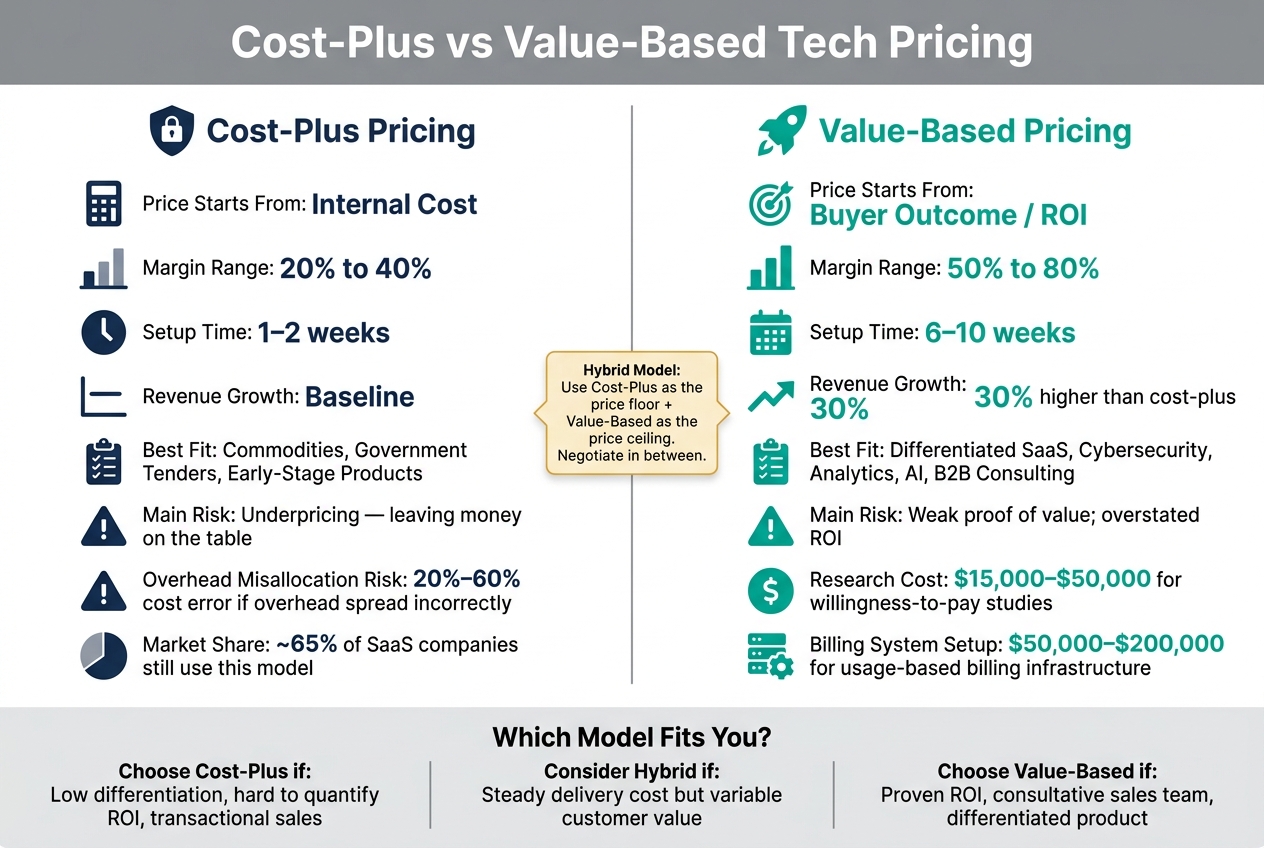
Cost-Plus vs Value-Based Tech Pricing: Key Metrics Compared
Cost-Plus Pricing: Predictable Margins, Limited Upside
How Cost-Plus Pricing Is Built
The formula is simple: Selling Price = Unit Cost + (Unit Cost × Markup Percentage).
Where things get messy is the phrase unit cost. In tech, that number can pull in engineering labor, cloud spend, support, sales overhead, and allocated G&A. And because many of those costs are fixed or semi-fixed, companies have to pick a way to spread them across products. If that allocation is off, product costs can be misstated by 20% to 60%.
That’s the logic behind cost-plus: start with your costs, then add a markup. Value-based pricing moves the other way. It starts with the result the buyer gets.
Where Cost-Plus Pricing Fits Best
Cost-plus tends to work best in government contracts, regulated utilities, and commoditized tech markets where buyers can directly audit costs. In those settings, the model lines up with how purchasing already works.
It can also make sense as a temporary approach when value data is still too thin to support outcome-based pricing. So if you're selling into a compliance-heavy market or one with little product separation, cost-plus can be a practical starting point.
Buyer Response and Margin Tradeoffs
In government and audited procurement, buyers often like the transparency. They can see how the price was built, line by line. That kind of visibility matters in those deals.
But most modern tech buyers don’t care much about a seller’s internal cost structure. They care about outcomes and ROI.
That’s the core tradeoff: cost-plus gives you pricing that is predictable and easy to defend, but it puts a cap on your upside. Say your product saves a client $2 million per year, and your fully loaded delivery cost is $200,000. With a 30% markup, your price lands at $260,000. The buyer keeps most of the value.
For differentiated tech, cost-plus is better used as the floor, not the ceiling. The next step is figuring out how much of the customer value the seller can keep.
sbb-itb-97f6a47
Cost-Plus or Value-Based Pricing? - Pricing Expert & Author, Harry Macdivitt
Value-Based Pricing: Higher Margin Potential, More Proof Required
Value-based pricing starts with the buyer’s outcome, not the seller’s cost base. That’s why it can support higher margins. It’s also why it takes more work.
What Creates Value in Technology Products and Services
In tech, value usually comes down to dollars tied to a clear business result. The main levers in B2B are often:
- Cost savings
- Risk reduction
- Revenue growth
That can look like cutting manual work, avoiding a security breach or outage, or lowering churn. Each of those outcomes has a dollar figure behind it. And that figure helps set the ceiling for pricing.
The catch? Buyers rarely pay for claimed value on its own. They want proof.
Where Value-Based Pricing Fits Best
This model tends to work best when two things are true: the product stands apart, and the outcome can be measured.
That’s why it often fits:
- Differentiated SaaS platforms
- Cybersecurity tools
- Analytics or AI solutions
- Consultative B2B services tied to a specific business result
When pricing is tied to outcomes instead of feature bundles, average contract value can move up in a big way. Companies that implement value-based pricing show 30% higher revenue growth compared with those using cost-plus models.
Buyer Response and Execution Risks
Buyers will often accept higher prices when the ROI story is clear and believable. Problems start when value claims feel fuzzy, hard to check, or too generic for a given field like healthcare, finance, or manufacturing.
That difference shows up fast in buyer expectations. U.S. enterprise buyers usually want governance, compliance, and SLA terms. SMB buyers, by contrast, want speed and simplicity.
There’s also a lot of setup behind the scenes. Willingness-to-pay studies like Van Westendorp or conjoint analysis usually cost $15,000 to $50,000 and take four to eight weeks. And that’s before the internal lift: instrumenting the product, training sales teams, and building ROI calculators.
Without that groundwork, value-based pricing turns into guesswork.
Typical margins run 50% to 80% under value-based pricing, versus 20% to 40% under cost-plus. The upside is there. But the business has to prove the value well enough to back the price.
That tradeoff becomes clearer in the side-by-side comparison below.
Cost-Plus vs Value-Based Pricing: Side-by-Side Comparison
Comparison Table: Basis, Margins, Buyer Behavior, and Market Fit
These two models don't just use different pricing logic. They also fit different stages of product maturity and different buyer expectations. The choice affects margin, buyer response, and how much work the sales team needs to do. And in tech, even small pricing changes can hit profit hard. The table below sums up the tradeoffs that matter most.
| Factor | Cost-Plus Pricing | Value-Based Pricing |
|---|---|---|
| Pricing Basis | Internal costs + fixed markup | Customer ROI and perceived value |
| Margin Potential | Predictable but capped | Higher upside; captures a share of the value created |
| Buyer Behavior | Focuses on price fairness and line items | Focuses on outcomes and measurable ROI |
| Ideal Market | Commodities, public tenders, early-stage products | Differentiated SaaS, cybersecurity, analytics, B2B consulting |
| Sales Requirements | Simple; price lists and feature comparisons | Value selling, ROI calculators, proof of outcomes |
| Risk Profile | Underpricing; leaving revenue on the table | High research cost; risk of misreading customer value |
| Implementation Time | 1–2 weeks | 6–10 weeks |
How the Right Model Changes by Product Maturity
Early-stage products often begin with cost-plus pricing. At that point, the product may still be unproven, and teams usually don't have solid data on what customers will pay or what results they'll get.
As proof of ROI builds up, value-based pricing gets much easier to support. That's because product maturity changes your pricing power. A simple way to think about it: cost-plus sets the floor, and willingness-to-pay research sets the ceiling. The space between those two points is your room to negotiate.
That gap in maturity sets up the choice framework in the next section.
Where Each Model Can Go Wrong
Cost-plus pricing often goes off track when teams leave part of their overhead out of unit cost. That mistake makes the price look sound on paper while profit slips in practice. There's another issue too: when margins are added on top of cost by default, teams feel less pressure to cut overhead or tighten operations. And if the product stands out in the market, cost-plus can leave money behind.
Here's the math that trips people up: a 50% markup on cost produces only a 33.3% gross margin. For many tech services firms, that gap comes as a nasty surprise.
Value-based pricing has a different weak spot. It starts to break when ROI claims are fuzzy, when sales reps lean on discounts instead of outcome-based selling, or when willingness-to-pay research is thin. Put bluntly, it fails when companies price by gut feel instead of evidence.
Overstating value is where things can unravel fast. If the promised ROI doesn't show up, renewals slow down and trust fades quickly. Those risks shape the decision criteria in the next section.
Choosing the Right Pricing Model: Decision Framework and Key Takeaways
A Simple Framework for Choosing Between the Two Models
Use the risks above as your filter. Pick the model that fits what you can prove, not the one you like more.
| Decision Input | Use Cost-Plus If... | Use Value-Based If... |
|---|---|---|
| Differentiation | Low (commodity, standard features) | High (unique capabilities, proven differentiation) |
| ROI Measurability | Hard to quantify | Measurable in time or money saved |
| Sales Capability | Transactional, simple | Consultative, ROI-focused |
| Data Infrastructure | Minimal internal cost data | Robust usage and outcome tracking |
| Market Position | Limited pricing power | Established leader, premium player |
If you can't quantify buyer value, stick with cost-plus until you can.
When a Hybrid Pricing Approach Makes Sense
Sometimes a pure model doesn't fit. In that case, use a base fee to protect margin and add a value-linked upside for growth.
A hybrid approach uses cost-plus to set a price floor - the minimum you need to protect margins. Then it uses value-based research to set a price ceiling - the most the market is likely to pay. The space between those two points becomes your negotiation range.
This setup makes sense when delivery cost stays steady, but usage or outcome value changes from one customer to another. That's often the case with enterprise software, complex enterprise services, and AI products.
One practical note: build the metering and billing system before you launch. Usage-based systems usually cost between $50,000 and $200,000. If you roll out pricing before the system is ready, you can end up with surprise invoices, billing confusion, and churn.
Conclusion: Key Points for Pricing Technology in the U.S.
The right model comes down to buyer value, proof, and market type. Cost-plus pricing gives you control, transparency, and a fast path to market. The trade-off is simple: it can limit how much upside you keep.
Value-based pricing can lead to stronger margins when the product stands out. But it also asks more from the business. You need solid outcome data, sales teams that can handle ROI-based conversations, and upfront research.
What matters most is where your product stands today, not where you want it to be six months from now. If you're unsure where to start or want outside help refining pricing strategy, the Top Consulting Firms Directory connects U.S. tech firms with consulting specialists in revenue growth, digital transformation, and strategic management.
FAQs
How do I know which pricing model fits my product?
Look at your market position, the data you have, and the kind of offer you sell. Cost-plus pricing makes sense in commoditized markets, in early-stage client relationships where results are tough to measure, or in regulated settings where clear, transparent costs matter.
Value-based pricing works best when your product stands out and leads to measurable results, like revenue growth, cost savings, or lower risk. Many mature firms use both approaches: cost-plus sets the floor, and value-based metrics set the ceiling.
What proof do I need for value-based pricing?
You need a defensible dollar figure or range that shows the economic value your solution creates for the customer.
That number should tie back to outcomes you can measure, like revenue gained, costs cut, time saved, or risk avoided.
You can build that case with customer interviews, industry benchmarks, ROI data, and models linked to what makes your offer different. Then, once you have documented results from early projects, you can use them to support future pricing.
When does a hybrid pricing model make sense?
A hybrid pricing model tends to work best for mature businesses that need to balance profit goals with day-to-day limits. It uses cost-plus pricing to set a floor, then value-based pricing to set a ceiling based on the benefit the customer gets.
This setup is especially useful when a company wants simple pricing for entry-level or standardized offers, while charging higher rates for premium tiers, advanced features, or specialized outcomes.