Want to stand out in a crowded market? Competitive benchmarking for brand messaging can help. It’s about analyzing your competitors’ messaging strategies to identify gaps and opportunities for differentiation. By understanding what competitors emphasize - and what they overlook - you can craft messaging that resonates with your audience and highlights your brand’s strengths.
Key Takeaways:
- What It Is: Competitive benchmarking compares your brand’s messaging (tone, language, value propositions) with competitors to find untapped opportunities.
- Why It Matters: Even great products fail without clear differentiation. Over 50% of buyers say vendor content often misses the mark on competitive differentiation.
- Metrics to Track: Share of Voice (SOV), sentiment analysis, and messaging consistency across channels help measure effectiveness.
- How to Do It:
- Identify competitors, including direct and indirect ones.
- Collect data from websites, ads, emails, and social media.
- Audit for emotional tone, gaps, and overused industry jargon.
- Use tools like Semrush, Brandwatch, and social listening platforms for insights.
- Develop actionable strategies to address customer needs and perception gaps.
Pro Tip: Avoid imitation. Instead, focus on the "white space" competitors haven’t claimed - like pricing transparency or specific customer outcomes. Regularly audit your messaging to ensure consistency and relevance.
This process isn’t just about tracking competitors; it’s about creating messaging that truly connects with your audience.
Key Metrics for Competitive Benchmarking in Brand Messaging
Share of Voice (SOV) and Its Impact
Share of Voice (SOV) measures how much of the market conversation your brand captures compared to competitors - it’s essentially your brand’s share of attention. The formula is straightforward: (Your Brand's Metric / Total Market Metric) x 100 . For instance, in 2025, Nike claimed 49% of the sportswear conversation, while Reebok lagged behind at just 3%.
What makes SOV so influential is its ability to predict future market share. As David Lewallen, CEO of Verbatim Digital, puts it:
"Share of Voice is the predecessor to market share. If you're not part of the conversation today, you won't be part of the transaction tomorrow. It's that simple."
Metrics for SOV vary by channel. For organic search, rankings directly impact click-through rates (e.g., the top position garners 28%, the second 15%, and the third 11%). Paid search focuses on impression share, while social media and PR track mentions, hashtags, and media placements .
A newer concept, Excess Share of Voice (ESOV), compares your SOV to your current market share. If your visibility surpasses your market size, it indicates you're outperforming expectations - a reliable marker for future growth . Maxime Dupré from ChampSignal explains:
"The idea behind ESOV is... for your brand to grow, your Share of Voice (SOV) needs to be higher than your current Share of Market (SOM). It's like putting a down payment on future growth."
Looking to the future, another metric, Share of Answer (SoA), is gaining traction. This tracks how often generative AI platforms like ChatGPT, Perplexity, and Gemini mention or recommend your brand. As AI-driven search becomes more common, missing out on these mentions could leave a visibility gap in the buyer journey.
While SOV measures attention, sentiment analysis digs deeper, examining the emotional tone behind those mentions.
Sentiment Analysis for Brand Perception
High visibility is only beneficial if the conversation surrounding your brand is positive. Sentiment analysis evaluates whether mentions are positive, negative, or neutral . This is key because an increase in SOV could signal either a successful campaign or a brewing PR issue.
A great example of positive sentiment’s impact comes from Paris Fashion Week FW19. Chanel, though capturing just 4% of total mentions, achieved an 8% share of Media Impact Value. Each mention carried twice the value compared to Balenciaga, which had a 5% SOV and a 5% share of value. The event generated around $210 million in total Media Impact Value.
Sentiment analysis also uncovers "perception gaps", where competitors enjoy stronger emotional connections despite having less visibility . Identifying these gaps helps brands refine their messaging to resonate more emotionally with their audience. For fast-moving industries like e-commerce and tech, sentiment checks might be necessary weekly or bi-weekly, while more stable sectors like B2B could conduct them monthly or quarterly.
Messaging Consistency Across Channels
Sentiment analysis is just one piece of the puzzle. Consistent messaging across all channels is equally crucial for building trust and reinforcing brand identity. Whether it’s your website, social media, or email campaigns, keeping your message aligned strengthens recognition over time . On the other hand, inconsistent communication can confuse your audience and weaken your brand’s authority.
To stay on track, regularly audit your messaging to ensure every touchpoint reflects your brand’s core narrative. Social listening tools can help monitor whether your message is not only consistent but also resonates positively across channels.
Gina Gulberti, VP of Marketing at Launchmetrics, highlights why comparison matters:
"In a data-rich world, brand performance benchmarking matters because it turns data into context. Without comparison, growth or decline can be misleading."
sbb-itb-97f6a47
What Are Competitive Analysis & Competitive Benchmarking?
Step-by-Step Framework for Benchmarking Brand Messaging
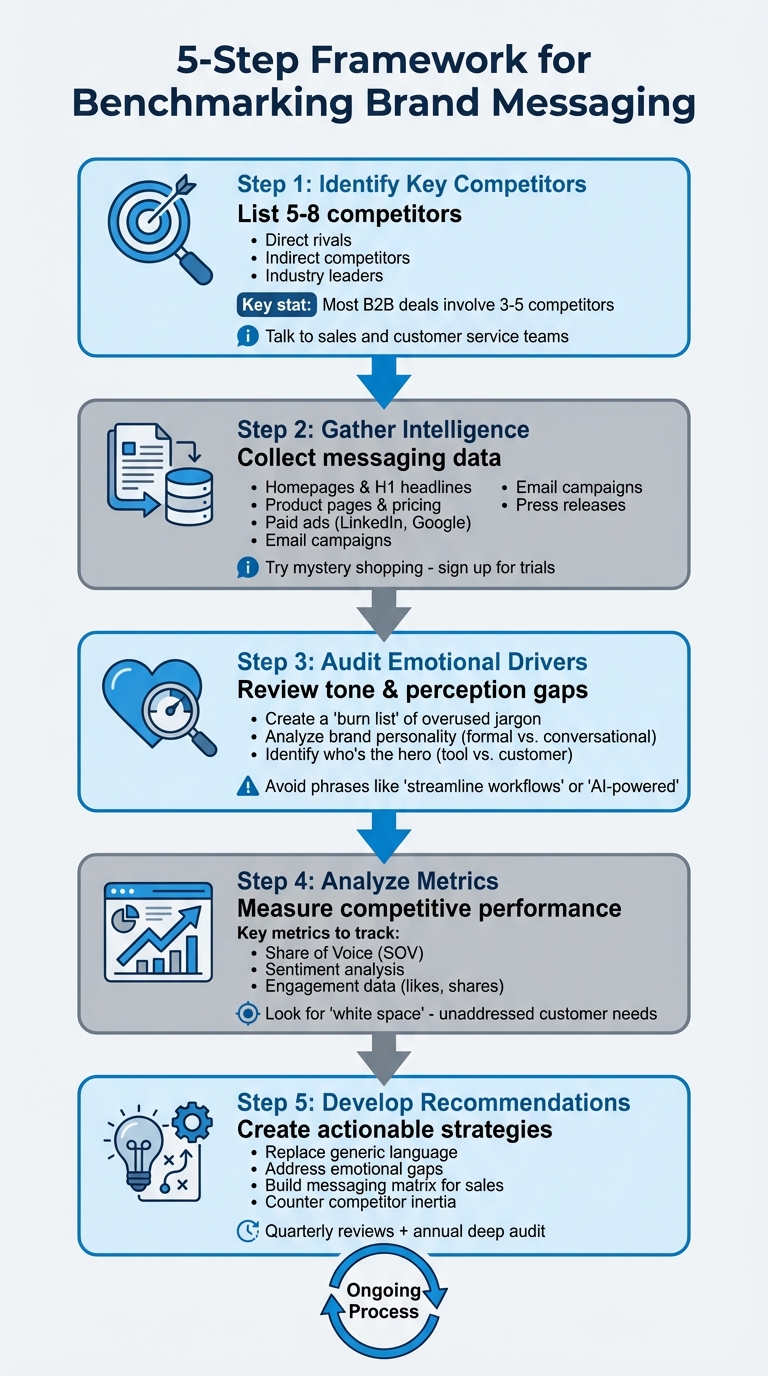
5-Step Competitive Benchmarking Framework for Brand Messaging
Step 1: Identify Key Competitors
Start by listing 5–8 competitors, including direct rivals, indirect competitors, and leaders in your industry. This is especially important since most B2B deals involve between 3 and 5 competitors.
Jennifer Hall, Associate Director of Agency Marketing at Vision Media, suggests:
"To determine your competitors, start by talking with your internal teams to learn who they consider competitors."
Your sales and customer service teams are great resources for this. They can share insights about brands prospects mention during discovery calls and which companies win deals you lose. Don’t overlook unconventional competitors like manual processes or spreadsheets. You can also search for your core business keywords to find "content competitors" - those ranking high on search engines, even if they don’t sell competing products. Customer interviews and win/loss analyses can help you uncover hidden competition.
Once you’ve built this list, the next step involves gathering detailed data about their messaging.
Step 2: Gather Intelligence on Competitor Messaging
Collect messaging data from various channels, including homepages (pay attention to H1 headlines), product pages, pricing sections, and press release boilerplates. Dive deeper by reviewing sales demo decks, outbound email campaigns, paid ads on platforms like LinkedIn and Google, and even metadata like title tags. You can also try mystery shopping - sign up for free trials or newsletters using a personal email to experience their sales process firsthand.
Natalia Slota from Apricot B2B raises a compelling point:
"If you removed your logo from your homepage right now, would buyers know they were looking at your company? Or would they assume they'd landed on a competitor's site?"
Use a five-tier framework to identify where competitor messaging is generic and where it highlights strengths. Pay attention to emotional tone and language nuances, as these can reveal perception gaps and opportunities for differentiation.
Step 3: Audit Emotional Drivers and Perception Gaps
Review competitor messaging for tired industry jargon like "streamline workflows" or "AI-powered", and create a "burn list" to avoid these overused phrases. Natalia Slota explains:
"When your messaging sounds identical to [competitors], buyers default to price or brand recognition instead of understanding your actual value."
Look closely at the tone and personality of your competitors’ brands. For example, if the industry leans toward a formal and technical tone, adopting a more conversational or relatable style could set you apart. Also, examine who is portrayed as the primary actor in their messaging - does it focus on the tool or the customer? This can reveal whether they emphasize automation or customer empowerment. Social listening tools can provide additional insights by comparing how customers talk about brands versus how brands describe themselves. These insights can help you identify emotional gaps and turn them into opportunities for differentiation.
Step 4: Analyze Metrics and Insights
Use metrics like Share of Voice to measure how often competitors are mentioned, sentiment analysis to understand brand perception, and engagement data (likes, shares, etc.) to see what resonates with audiences. Share of Voice and sentiment metrics can help pinpoint where competitors excel and where they fail to meet customer needs. Conor Bond from Crayon highlights the importance of this step:
"The positioning statement and brand promise are, unequivocally, the two most important stages to consider when analyzing your competitors' messaging."
Look for "white space" - areas where competitors fail to address critical customer needs. Reviewing boilerplate content in press releases can also reveal competitors’ core positioning, while recurring proof points can show what metrics or industries they prioritize. These insights will guide the final step: creating actionable recommendations.
Step 5: Develop Recommendations
Turn your findings into strategies that set your brand apart. Replace generic, overused language with messaging that’s specific and outcome-focused. Address emotional drivers and perception gaps competitors have overlooked, and craft a messaging matrix for your sales team that highlights your unique strengths. If a competitor’s inactivity is contributing to buyer hesitation, adjust your messaging to counter this inertia. Finally, make it a habit to revisit your messaging with quarterly reviews and an annual in-depth audit to keep it sharp and relevant.
Tools and Techniques for Benchmarking
To effectively apply a benchmarking framework, it's crucial to choose the right mix of qualitative and quantitative tools.
Qualitative Tools: Brand Audits and Customer Feedback
Qualitative tools help uncover why certain messaging strategies succeed or fall short. Start with digital touchpoint audits, where you manually review competitor homepages, product pages, and press release boilerplates. Pay close attention to boilerplates - small changes here often hint at major strategic shifts.
Another valuable approach is analyzing sales collateral. If you can access competitor demo decks or sales presentations, these often reveal storytelling techniques and customer pain points that aren't visible on public-facing platforms. Organize your findings within a messaging hierarchy to better understand their strategy.
AI-driven content intelligence tools are also gaining traction. These tools can evaluate tone alignment and the consistency of calls-to-action across competitor websites and social media posts. Additionally, tracking competitor emails over time can help you spot shifts in their messaging strategy.
Pair these qualitative insights with hard data to get a fuller picture of messaging effectiveness.
Quantitative Tools: SEO and Social Listening Platforms
While qualitative tools explain the "why", quantitative tools provide the numbers to measure messaging impact. For example, SEO platforms like Semrush (starting at $139.95/month) and Ahrefs (starting at $129/month) help identify keyword gaps - topics your competitors rank for but you don't. Lauren Schwartz, Digital Strategy Manager at Maid2Match, highlights the importance of Ahrefs:
"Ahrefs fills in the gaps to round out data gathered from Google Search Console, helping you make more informed SEO decisions".
Interestingly, over 90% of web content fails to attract Google traffic, often because it doesn't target keywords people actually search for.
Social listening platforms like Brandwatch and Sprout Social (starting at $199/month) track Share of Voice and sentiment across various channels. These tools analyze massive amounts of digital signals to measure how well messages resonate. Platforms like BuzzSumo (starting at $159/month) can pinpoint which messaging themes generate the most likes, shares, and comments. Tools such as Similarweb (starting at $199/month) reveal where competitor traffic originates, providing insights into which channels amplify their messages most effectively.
AI-powered tools like Meltwater's Mira AI combine qualitative and quantitative data. Mira AI scans thousands of posts and delivers plain-language summaries that explain spikes in sentiment or mentions, linking them to specific messaging triggers. You can even set up alerts to notify you when competitor engagement suddenly increases, giving you the chance to analyze and react swiftly.
Comparison Table: Tools for Benchmarking
| Tool | Category | Primary Application | Starting Price |
|---|---|---|---|
| Crayon | Market Intelligence | Tracking homepage, product page, and sales deck changes | Custom |
| Semrush | SEO/Market Audit | Keyword gap analysis and traffic source identification | $139.95/month |
| Ahrefs | SEO/Backlinks | Content gap discovery and domain authority measurement | $129/month |
| Brandwatch | Social Listening | Share of Voice and sentiment analysis across channels | Custom |
| Sprout Social | Social Listening | Real-time sentiment tracking and engagement metrics | $199/month |
| BuzzSumo | Content Trends | High-performing topics and engagement-driving formats | $159/month |
| Similarweb | Traffic Analytics | Mapping traffic origins and regional dominance | $199/month |
| Brandlight.ai | Content Intelligence | AI-generated heat maps and tone coverage analysis | Custom |
| Mailcharts | Email Marketing | Email frequency and promotional messaging benchmarks | Custom |
Research Insights: Refining Brand Messaging Strategies
Once you've gathered your data, the next step is turning those insights into messaging that truly resonates. This process helps you carve out a distinct position in the market.
Differentiation Through Messaging
One common pitfall is using competitor benchmarking as a blueprint to imitate rather than as a tool to stand out. Instead of mimicking what others are doing, focus on the gaps they leave behind. For instance, if competitors avoid discussing pricing transparency or fail to highlight specific client outcomes, those areas could be your opportunity to establish a unique voice in the market. A helpful tool here is a positioning map. By plotting two axes - like premium vs. budget or specialist vs. generalist - you can identify crowded areas and uncover untapped spaces.
Another key strategy is avoiding overused phrases. In crowded industries, terms like "compassionate care" in healthcare or "results-oriented" in legal services lose their impact quickly. Benchmarking can help you spot these clichés and steer clear of them. James Webb, Founder of Firebrand Agency, explains:
"The opportunity to stand out with genuine, specific, human messaging is wide open in almost every market - because the bar for specificity has been set remarkably low by everyone currently occupying it."
Improving Communication Effectiveness
Good messaging solves problems - it doesn’t just list product features. Barry Vasudevan from Forrester highlights this shift in focus:
"Buyers are trying to solve a business problem and are thinking about questions they need to ask in the buying process. We need to make sure that our messaging answers those questions."
Benchmarking can help you move from technical jargon to addressing the real challenges your audience faces. Tools like Share of Voice metrics can show how often your brand is mentioned compared to competitors, while sentiment analysis ensures that those mentions are positive. Interestingly, only 25% of marketers truly understand their audience. To close this gap, validate your messaging with your sales team - because if your sellers don’t believe in the differentiators, they won’t use them effectively in conversations.
Working with Consulting Firms
If your internal team lacks the time or expertise to fully leverage insights, consulting firms can step in to help. Competitive research is resource-intensive, and many internal teams skip critical steps due to limited bandwidth. Specialized consultants bring an outsider’s perspective, helping to uncover the disconnect between how you think your brand is perceived and how it actually resonates with your audience.
The Top Consulting Firms Directory is a great resource for finding experts in branding, strategy, and digital marketing. These firms go beyond surface-level exercises, like comparing logos, to conduct in-depth market analyses that highlight defensible competitive advantages. They also use advanced frameworks and AI tools to refine and validate personalized narratives. As Webb puts it:
"The businesses that end up with brands that genuinely perform... are the ones that insisted on the thinking before the designing."
Conclusion: Using Competitive Benchmarking for Brand Success
Competitive benchmarking isn’t just a one-time exercise - it’s a consistent effort that keeps thriving brands ahead of the curve. The numbers speak for themselves: 74% of marketers rely on benchmarking to track growth, and 54.3% of organizations compare themselves to 4–5 competitors to maintain a balanced yet effective perspective. This method uncovers gaps in the market - areas your competitors are neglecting - helping you sidestep the "affordable generalist" pitfall, where standing out becomes nearly impossible.
The real power of benchmarking lies in turning insights into action. Start by identifying what your competitors are not addressing - whether it’s pricing transparency, specific outcomes, or customer success stories. These gaps often represent your best opportunities. To structure this process, create a messaging matrix for 3–5 key competitors. This tool helps you pinpoint where your brand excels and where caution is needed. Additionally, performing an "outside-in" brand audit can reveal how external audiences perceive your brand compared to internal assumptions, exposing areas where your messaging might be falling short.
For businesses with limited resources, consulting firms can provide an objective and strategic edge. These experts go beyond surface-level comparisons, offering tools and insights to transform raw data into actionable competitive advantages. The Top Consulting Firms Directory is a great starting point to connect with specialists in branding, strategy, and digital marketing. As James Webb from Firebrand Agency puts it:
"The businesses that end up with brands that genuinely perform are those that insisted on strategy before design."
FAQs
Which competitors should I benchmark?
Take a close look at how your direct competitors handle their brand messaging and communication strategies. Focus on those actively engaging with their audience through various channels. By analyzing their performance - whether it’s the tone they use, the platforms they prioritize, or how they respond to customer feedback - you can uncover useful insights.
This type of benchmarking can help you refine your own messaging. It’s not about copying what others do but understanding what works well in your industry and adapting those elements to fit your brand’s voice and goals.
How do I find messaging “white space”?
To discover messaging “white space,” start by analyzing your competitors. This means looking for unmet needs, underserved audiences, or opportunities they’ve overlooked. Pay close attention to areas where competitors either aren’t present or are falling short. Instead of simply copying what they’re doing, ask yourself, “What aren’t they addressing?” This mindset allows you to identify strategic gaps where your brand can shine and set itself apart.
What’s the difference between SOV, ESOV, and SoA?
SOV (Share of Voice) reflects how visible your brand is within a specific category, giving insight into your market presence. ESOV (Excess Share of Voice) goes a step further by comparing your SOV to your market share, helping you determine whether your investment levels match your market position. SoA (Share of Audience) focuses on how well your target audience engages with your brand compared to your competitors. These metrics work together to evaluate visibility, investment effectiveness, and audience engagement, offering valuable insights to fine-tune your brand messaging and communication strategies.