Business Process Reengineering (BPR) is reshaping how educational institutions handle administrative processes, making them efficient and effective. This article highlights three key success stories where BPR transformed operations, improved outcomes, and reduced costs:
- Ithaca College: Transitioned 3,500 courses to a new LMS in eight months, saving resources and enhancing user experience. Their HR overhaul introduced tools like an HR Help Desk, cutting hiring times and improving processes.
- Telkom University: Digitized travel management systems, reducing reimbursement delays from 21 days to real-time tracking, while decentralizing approvals for faster operations.
- Colorado Community College System (CCCS): Unified 13 colleges under one ERP system, processing 1.5 million monthly transactions and managing $422 million in financial aid more efficiently.
Key Takeaways:
- Early stakeholder involvement ensures smoother transitions.
- Standardized processes reduce inefficiencies and errors.
- Technology integration with reimagined workflows drives measurable improvements.
These examples demonstrate how rethinking processes helps institutions focus on teaching and student success while addressing operational challenges.
1. Ithaca College: Campus-Wide Process Transformation
Scope of Processes Redesigned
Ithaca College undertook a major overhaul of its academic and administrative systems to streamline operations and enhance user experience. One of the key changes was the migration of its Learning Management System (LMS) from Sakai to Canvas, involving the transition of 3,500 courses for 5,000 students. The college also launched a three-year initiative called HR Service 2026 to modernize its human resources processes. As part of this effort, Ithaca integrated IC HR Cloud to handle payroll, benefits, recruitment, and performance management. Additionally, the HR department was restructured, introducing an HR Help Desk and an "HR Imagination Incubator" to foster ongoing improvements.
Measurable Outcomes Achieved
The LMS migration was completed in just eight months, from September 2020 to August 2021, ensuring that all 3,500 courses were ready for the Fall 2021 semester. This ambitious project was led by Jenna Linskens, Director of Learning and Innovative Technologies, and Jeff Trondsen, LMS & eLearning Applications Administrator. By collaborating with K16 Solutions, the college used a 90-day automated migration process, which eliminated the need to run two systems simultaneously - saving time, money, and reducing confusion for users.
"We decided to take decisive action... It also meant Ithaca didn't need to run two systems concurrently, something that would have been costly, confusing to the user community, and draining on the team's resources." - Jenna Linskens, Director of Learning and Innovative Technologies, Ithaca College
This efficient execution showcases how rethinking processes can lead to major institutional improvements.
Key Lessons Learned
One of the biggest takeaways from Ithaca’s transformation was the importance of gaining early buy-in from stakeholders. By involving students, faculty, and staff in the Request for Proposal (RFP) process, the college created advocates who helped ensure a smoother transition. Partnering with specialized vendors also proved invaluable. Reflecting on the process, Jeff Trondsen noted, "When we saw the K16 Solutions SystemMigration process and the results from it, it really was a night and day difference."
Another lesson was the strategic decision to shift faculty training from focusing solely on technical skills to emphasizing instructional design. By breaking the migration into semester-sized batches, the college minimized disruption and turned the change into an opportunity to enhance teaching practices.
"This digital transformation changed the way the faculty was using LMS platforms." - Jenna Linskens, Director of Learning and Innovative Technologies, Ithaca College
These insights highlight how thoughtful planning and collaboration can make large-scale changes more effective and less disruptive.
sbb-itb-97f6a47
2. Telkom University: Digital Official Travel Management
Scope of Processes Redesigned
Telkom University tackled a long-standing issue with its Official Trip Orders (SPPD). The process was bogged down by inefficiencies, relying heavily on manual methods. To solve this, the university completely revamped its travel management system, introducing a fully digital platform. This upgrade brought together Finance, HR, and IT teams to ensure the new system addressed the needs of all departments effectively.
Another major shift was decentralizing decision-making. By moving approval authority from a central office to individual units, the university sped up trip approvals and introduced real-time reimbursement tracking. This digital transformation streamlined the entire workflow, leading to noticeable improvements in efficiency.
Measurable Outcomes Achieved
Previously, employees had to cover travel expenses upfront and often waited up to 21 days for reimbursement, which discouraged participation in official travel. The new system eliminated these delays, reduced waste by going paperless, and made travel assignments more efficient. Rina Djunita Pasaribu highlighted the impact:
"The BPR process has resulted in radical changes to the official trip system at the university, namely from a mixed system of manual/offline & online to completely online, from a very centralized to decentralized decision process, and the availability of a transparent monitoring system."
Key Lessons Learned
Telkom University's journey shows that simply automating an inefficient process isn't enough to solve problems. Their success came from following a structured four-phase approach: Initiation, Analysis, Re-engineering, and Implementation/Evaluation. This method allowed them to rethink their workflows from the ground up.
A key takeaway was the importance of focusing on employees - prioritizing their involvement and reducing personal financial burdens. This experience underscores that successful Business Process Reengineering (BPR) in education requires more than just technology; it demands empowering stakeholders and addressing their needs. For other institutions, the lesson is clear: decentralize decision-making, engage stakeholders early, and design systems that simplify, rather than complicate, administrative tasks.
3. Multi-Institution System Implementation
Scope of Processes Redesigned
The Colorado Community College System (CCCS) tackled one of higher education's toughest challenges: combining 13 independent colleges into a single shared ERP system. This initiative replaced 13 separate Ellucian Banner platforms with a unified system, standardizing core processes like grading and tuition collection across institutions that had previously operated autonomously.
Similarly, the Southern University and A&M College System launched the "BannerSUnited" initiative, consolidating Banner ERP systems across five campuses. This effort created a shared course catalog and simplified student transfers between campuses. In another example, Roosevelt University and Robert Morris University merged their operations, technology, and data into a single Banner system within just four months in 2020, showcasing how quickly integration can be achieved.
These large-scale projects laid the groundwork for measurable operational and financial improvements.
Measurable Outcomes Achieved
CCCS’s consolidation resulted in significant operational gains. The unified system now processes 1.5 million student transactions per month during peak registration periods and handles $422 million in annual financial aid. The $26 million system proved far more cost-effective than upgrading individual platforms. Mark Superka, CCCS’s Vice President of Finance and Administration, highlighted the benefits:
"[The MEP model] gives us visibility across all the institutions and consistency of data. We can monitor spending and revenues and see trends in enrollment and funding, and better plan for them".
Individual campuses also reported notable efficiency improvements. For instance, Western University’s Engineering department automated its approval-to-hire process, cutting timelines from 3–4 weeks to just one hour. By May 2024, this solution scaled to 100 forms and processed 85,000 documents. At SIUE, digitizing graduate assistant contracts reduced processing time by over 50% and eliminated 22,500 paper documents annually.
These advancements allowed institutions to reallocate resources to critical areas like student services and faculty support, directly enhancing their academic missions.
Key Lessons Learned
Institutions discovered that building consensus across multiple campuses requires time and thoughtful planning. Andrew R. Dorsey, President of Front Range Community College, emphasized:
"The process of getting everyone to agree is critical. You have to think through the business processes every time, and then match the software application to the business process".
CCCS’s experience underscored the importance of budgeting at least two years for aligning business processes, as their initial 18-month timeline proved too short to achieve broad consensus among diverse institutions.
Projects that succeeded avoided imposing changes from the top down. Instead, they engaged faculty and staff as active collaborators. Early wins, like improving high-visibility services such as hiring or procurement within the first six months, helped build momentum. Institutions also found that focusing on enhancing service levels to support their academic missions - rather than just cutting costs - was key to securing stakeholder buy-in.
BPR Case Studies (HD)
Comparison Table
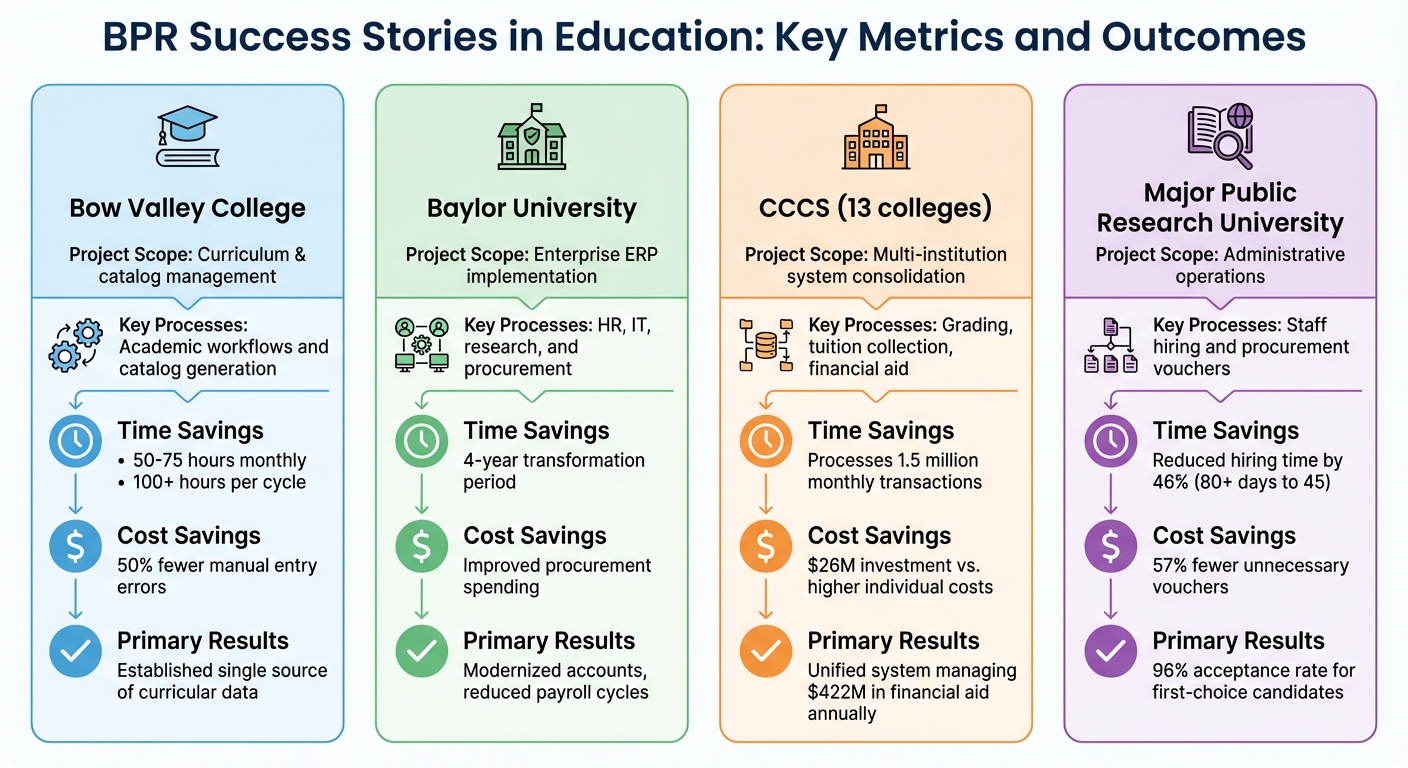
BPR Success Stories in Education: Key Metrics and Outcomes Comparison
Here’s a breakdown of key Business Process Reengineering (BPR) projects in education, highlighting their scope, redesigned processes, time and cost savings, and primary outcomes. These examples showcase how institutions tackled challenges like academic workflows and system consolidations, achieving measurable improvements.
| Institution | Project Scope | Key Processes Redesigned | Time Savings | Cost Savings | Primary Results |
|---|---|---|---|---|---|
| Bow Valley College | Curriculum & catalog management | Academic workflows and catalog generation | 50–75 hours monthly; 100+ hours per cycle | 50% fewer manual entry errors | Established a single source of curricular data |
| Baylor University | Enterprise ERP implementation | HR, IT, research, and procurement | 4-year transformation period | Improved procurement spending | Modernized accounts, reduced payroll cycles |
| CCCS (13 colleges) | Multi-institution system consolidation | Grading, tuition collection, financial aid | Processes 1.5 million monthly transactions | $26M investment vs. higher individual costs | Unified system managing $422M in financial aid annually |
| Major Public Research University | Administrative operations | Staff hiring and procurement vouchers | Reduced hiring time by 46% (80+ days to 45) | 57% fewer unnecessary vouchers | 96% acceptance rate for first-choice candidates |
This table highlights the variety of approaches and outcomes achieved through BPR in education. Institutions saw time savings ranging from hours to months, while cost reductions came from streamlining processes and automating repetitive tasks.
Conclusion
Stories from Bow Valley College, UCLan, and Olympia School District highlight three major takeaways for educational business process reengineering (BPR) efforts.
First, stakeholder involvement is crucial for successful transformation. UCLan’s strategy of actively engaging with stakeholders ensured staff felt valued and understood, which in turn encouraged them to embrace change. As Dr. Emily Bell of Fulton County Schools aptly said:
"If anyone in the standup has a problem, then we all have a problem".
This collaborative mindset turns resistance into teamwork.
Next, process standardization addresses inefficiencies that often hold institutions back. Relying on inconsistent, department-specific systems leads to errors and duplication. Bow Valley College showed how standardizing processes not only reduced errors but also significantly sped up operations. The lesson here? Focus on adopting proven best practices instead of customizing tools to fit outdated workflows.
Finally, integrating technology drives transformation when paired with reimagined processes. For example, a global education organization working with EY cut manual effort by 80% by introducing cloud-enabled systems and centralized call centers. This shift allowed IT issues to be resolved in hours rather than days. The result? Technology redefined how work gets done.
Educational institutions grappling with administrative challenges, budget pressures, or outdated systems should aim for transformational change, not just small improvements. Quick wins - projects that can be completed in six months or less - are a great way to build momentum and win over skeptics. Whether it’s reducing hiring times or boosting graduation rates, BPR provides a clear roadmap for meaningful progress.
For schools seeking expert guidance, the Top Consulting Firms Directory (https://allconsultingfirms.com) connects institutions with firms specializing in BPR, strategic management, and technology implementation. This resource can help identify the right partners to lead transformative projects.
FAQs
Why is early stakeholder involvement crucial for successful BPR in education?
Getting stakeholders involved early in Business Process Reengineering (BPR) within education is a game-changer. It promotes collaboration, minimizes pushback, and ensures the redesigned processes meet the needs of those most affected. When stakeholders have a seat at the table from the start, their feedback and concerns can guide the creation of a process that works better and lasts longer.
Early involvement also helps uncover potential hurdles and areas of resistance before they become major issues. By addressing these challenges upfront, trust is built, and stakeholders feel a sense of ownership over the changes. This not only makes implementation smoother but also leads to greater efficiency and stronger outcomes for schools and other educational organizations.
What are the main advantages of streamlining processes in educational institutions?
Streamlining processes in schools and universities brings a host of benefits. For starters, it boosts clarity and makes it simpler to monitor and manage daily operations. Cutting down on mistakes and inefficiencies not only saves time but also conserves resources - freeing up staff to concentrate on providing top-notch education.
On top of that, having standardized procedures leads to smoother workflows, making things run more efficiently for students, teachers, and administrators. These enhancements also make it easier for institutions to adjust to new challenges and set the stage for steady growth over time.
How does integrating technology enhance Business Process Reengineering (BPR) in education?
Integrating technology has transformed how Business Process Reengineering (BPR) is applied in education, making processes more efficient and encouraging fresh ideas. Tools like automation, data analytics, and digital platforms help educational institutions cut down on manual work, remove repetitive tasks, and make quicker, informed decisions.
Take administrative processes, for example - technology can streamline these tasks, improve how resources are allocated, and even boost student engagement. It also allows for real-time tracking and ongoing improvements, fostering a more adaptable and forward-thinking environment. By weaving technology into their operations, institutions not only improve efficiency but also set the stage for better learning outcomes and sustainable growth.