Most agile transformations fail because communication breaks at the top, not because teams run bad stand-ups.
I’d sum it up like this: if leaders send mixed messages, decision ownership is unclear, and feedback never turns into action, agile stalls. That matches the numbers in the article - 47% to 70% of agile transformations miss expected results, 41% fail when leadership is not involved, and 38% fail when management backing is weak.
If I were scanning this piece for the answer, here it is:
- Leaders must say the same thing about goals, trade-offs, and success measures
- Teams need clear decision rights so work does not stall in approval chains
- Feedback must close the loop so input changes backlog, roadmaps, or funding
- Do not scale agile yet if those three parts are still broken
The article’s main point is simple: agile does not fix weak company communication. It exposes it. And when senior leaders line up their message, success rates improve - one cited finding says transformations are 6.3x more likely to work when leaders share aligned messages.
So before you roll agile out any further, I’d check for three basics: one leadership story, written decision ownership, and at least two quarters of feedback that led to visible change.
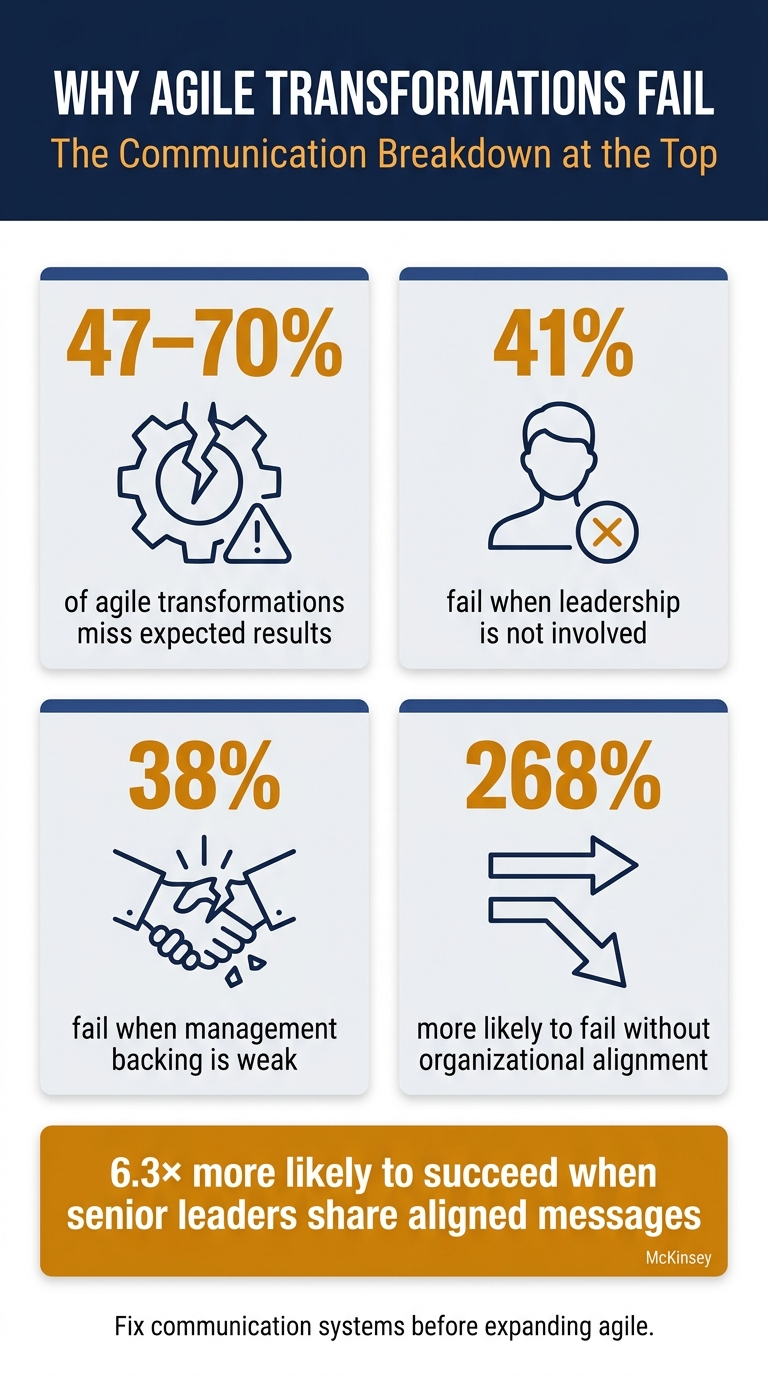
Why Agile Transformations Fail: Key Communication Statistics
Why Agile Transformations Fail (And How Yours Won’t)
Problem 1: Mixed Leadership Signals Undercut Agile Teams
Leaders often announce agile but keep the old control system running. That puts teams in a bind. They end up working under two models at the same time.
Fixed annual project scopes, stage-gate approvals, long upfront requirements documents, and committee sign-off for backlog changes and scope shifts do not vanish because the company starts using agile terms. Teams try to satisfy both systems and usually fall short on both. You can see that tension in day-to-day work.
The problem is big: projects using agile practices can be 268% more likely to fail when leadership and the broader organization are not aligned with agile principles.
How Conflicting Messages Show Up in Daily Work
The first pattern is false empowerment. Leaders talk about self-organizing teams, but key calls - scope changes, release timing, vendor choices - still have to move up two or three layers for sign-off. Teams get the message fast: empowerment is what gets said, but top-down control is what runs the show.
The second pattern is a metrics mismatch. A team may be told to test ideas every week based on customer feedback, but its scorecard still centers on on-time delivery against fixed scope. If the system punishes movement away from preset milestones, teams stop testing and start protecting the deadline. That's theater, not agile.
The warning signs are easy to spot:
- Rising decision time
- Late scope changes
- Repeated confusion about priorities
Solution: Set a Clear Leadership Communication Cadence
The fix is a single communication rhythm that keeps priorities, decisions, and metrics pointed in the same direction.
- Quarterly strategy reviews where executives state a small set of goals, spell out trade-offs, and update those goals as market conditions shift
- Monthly portfolio syncs that turn strategy into team-level priorities, sort out cross-team dependencies, and catch conflicting directives before they hit delivery teams
- One-page decision briefs with context, options, and trade-offs, so product owners and scrum masters get the same logic
- Visible dashboards that track customer outcomes, flow, and value delivered - not just whether the schedule was met
When this rhythm stays in place across several quarters, teams report fewer mixed messages and a clearer view of what success means.
Hands-Off vs. Engaged Leadership Communication
The gap between stalled change and steady progress shows up in how leaders communicate.
| Dimension | Hands-Off Leadership | Engaged Leadership |
|---|---|---|
| Team autonomy | High in theory; low in practice because boundaries are unclear | Genuine autonomy within defined outcome goals and decision rights |
| Impediment removal | Slow; systemic blockers persist for months | Executives actively clear cross-team and governance blockers |
| Trust | Low; teams see a gap between stated values and actual behavior | Higher; leaders consistently explain trade-offs and respond to feedback |
| Likely transformation outcome | Fragmented adoption, agile islands, eventual regression | Steady progress, improved delivery flow, higher engagement |
Engaged communication does not mean executives join daily standups. It means they show up in portfolio reviews, give context and constraints, explain why priorities changed, and line up funding and metrics with the agile behaviors they expect.
Even with a clear cadence, agile still breaks down when teams do not know who owns decisions and communication.
Problem 2: Unclear Roles Create Delays and Conflicting Priorities
A clear message from leadership helps. But agile work still bogs down when people don't know who owns decisions, updates, or escalations. When decision authority and information ownership are fuzzy, teams pause, wait, and second-guess. That's when work slows.
Where Role Confusion Hits Hardest
This problem gets expensive fast when the same leaders are trying to run day-to-day operations and lead the change at the same time. Without a clean split of responsibilities, teams are left guessing. Who makes the call? Who needs to be informed? What happens when two priorities collide?
Solution: Define Decision Rights and Communication Ownership
Set this up early. Write down decision rights, ownership, and communication paths at the start. Be specific about deliverables, escalation rules, and meeting protocols. People should know how information moves, where decisions get made, and who is expected to act.
Agile Roles, Communication Duties, and Failure Modes
| Role | Communication Duties | Primary Audience | Failure Mode if Unclear |
|---|---|---|---|
| Sponsor | Strategic vision, funding, and strategic approval | Change Leadership Team, Executives | Delegates without real support, leaving teams without authorized direction |
| Change Process Leader | Governance protocols, the change process, and integration | Initiative Leads, Project Teams | Inconsistent execution due to confusion about the change process and governance |
| Initiative Leads | Progress updates, resource needs, and escalations | Sponsor, Change Leadership Team | Duplicated direction and conflicting priorities between workstreams |
| Project Teams | Tactical status, impediment identification, and deliverables | Initiative Leads, Stakeholders | Delays and rework due to lack of authorized direction |
| Change Consultants | Best practices, coaching feedback, and methodology guidance | Leadership Roles | Workforce skepticism when leaders fail to match behavior to stated roles |
Once ownership is clear, the next problem tends to show up in feedback loops. The input comes in too late, and by then, the decision has already hardened.
sbb-itb-97f6a47
Problem 3: Weak Feedback Loops Turn Agile Communication Into Noise
Once roles are clear, the next test is simple: does feedback reach the right owner, and does anything change?
Agile runs on fast, closed-loop feedback. Input comes in, gets routed to the right owner, turns into a decision, and the result gets shared back out. When that loop breaks, teams keep moving on old assumptions while the actual problems stack up.
Why Retrospectives and Customer Input Often Fail to Change Decisions
The most common failure isn't that teams ignore feedback. It's that feedback gets spread across too many places.
It shows up in tickets, meetings, and chat. Then it gets split across teams. Nothing ties together, so product, customer success, and leadership end up reacting to different parts of the same issue. Leadership might be reviewing a quarterly NPS report that doesn't match what frontline teams hear every day.
Retrospectives break down in much the same way. They get skipped when delivery pressure goes up. And when they do happen, they often turn into venting sessions - no owner, no due date, no backlog follow-through. After a while, teams stop thinking retrospectives will lead to change, so they bring up fewer of the hard issues. The problem isn't the retrospective itself. It's the lack of follow-through on decisions.
Solution: Build Structured, Visible Feedback Paths
Treat feedback like a system, not just a conversation.
Use one intake path for each feedback type. Apply the same tags every time, and keep status on a shared board people can actually see. Every retrospective action should become a tracked ticket with:
- an owner
- a due date
- an outcome metric
It also helps to track a few basic measures. Look at the time from feedback to decision. Look at how much incoming input turns into backlog work. If feedback keeps coming in but nothing enters the backlog, that's a clear warning sign.
Weak vs. Strong Agile Feedback Practices
The gap comes down to one thing: whether feedback stays scattered or moves through one accountable path.
| Practice Area | Weak Feedback | Strong Feedback |
|---|---|---|
| Feedback collection | Scattered across email, chat, tickets, and meetings | Centralized in one system with consistent tagging |
| Retrospectives | Ad hoc sessions with vague discussion and no follow-through | Action-oriented sessions with owned tickets, due dates, and success metrics |
| Cross-team escalation | Informal, relationship-dependent, and slow | Documented pathways with defined response windows |
| Backlog connection | Feedback heard but not acted on | Input linked directly to backlog updates and roadmap changes |
| Visibility | Learning stays in the meeting room | Progress tracked on shared boards and dashboards |
Conclusion: Fix Communication Systems Before Expanding Agile
Most agile transformations fail for a simple reason: the communication system under them is off. Leaders send mixed signals. Roles remain fuzzy. Feedback gets collected, then goes nowhere.
Put those issues together and the pattern is clear. Communication has to be built into the operating model from the start. These are leadership-owned system problems, not team-level mistakes. The fix is plain: align the leadership narrative, document decision rights and communication owners, and tie retrospective actions and customer input to roadmap and funding decisions.
That is why aligned leadership messages matter: McKinsey found that transformations are 6.3× more likely to succeed when senior leaders share aligned messages about the change effort. Communication at the top is not just a soft skill - it gives the business a structural edge.
Use a clear go/no-go standard before any further rollout. At a minimum, that means:
- Documented decision rights
- A working communication cadence
- At least two quarters of closed-loop feedback
For outside support, the Top Consulting Firms Directory lists firms in IT, growth, and management, including value-creation and operating-partner support.
Key Takeaways for Executives and Operating Partners
For executives and operating partners, the sequence is straightforward:
- Align the leadership narrative first. Agree on one shared story - why agile, and what business outcome it should deliver.
- Make decision ownership explicit. Document decision rights and communication owners so teams do not have to guess.
- Turn feedback into decisions, not noise. Link retrospective actions and customer input directly to backlog updates and funding decisions.
- Stabilize before you scale. Expanding agile on top of a broken communication system does not solve the problem. It spreads it.
FAQs
How can leaders tell if their agile message is mixed?
Leaders can spot mixed agile messages when teams show confusion, fear, or uncertainty about what leadership actually wants. Other common signs are leadership misalignment, unclear governance, and executives who don't model the behavior needed for change.
Surveys and engagement metrics can help show whether the vision is clear and landing with teams. If people are left out of decisions or get inconsistent guidance, the message likely isn't clear, transparent, or used the same way across the business.
What decision rights should agile teams own?
Agile teams should own the decisions tied to their outcomes and project goals instead of waiting on rigid, top-down approvals.
Tools like RACI charts help set clear lines around ownership and accountability. It also helps to document roles, define escalation paths for disputes, and use clear prioritization matrices so decisions line up with business impact and urgency.
How do you prove feedback loops are actually working?
Track outcomes you can measure to see whether feedback is turning into action.
Good signs include:
- Fewer repeat conflicts
- Shorter resolution times
- Higher team satisfaction
- Better sprint velocity
- Less task overlap
- Stronger adoption
You should also watch for changes that are harder to measure but still matter. Maybe more people speak up in retrospectives. Maybe teams flag more issues through anonymous feedback channels. That usually means people feel safer sharing what’s not working.
Surveys and engagement metrics can help confirm whether feedback is shaping project decisions and strategy shifts.